

Brazilian women are being killed at record rates
Brazilian Women are being killed at record rates. Now it is a key election issue.
October 02, 2026
As the country heads to the polls, candidates are looking to sway female voters with pledges to tackle femicide. For the mother who has spent 20 years recording the names of 30,000 victims, it couldn’t come soon enough.

Ever since her daughter, Priscila, was shot dead by her ex-partner as she left a nightclub in 2007, Regina Jardim has been on a mission to ensure no one forgets her, or any of the four women killed on average every day in Brazil.
For almost 20 years, Jardim has uploaded brief profiles to commemorate these women, and today her Instagram page, Quem ama liberta (“Those who love, set free”) may be the closest thing Brazil has to a database of the victims of femicide. The 66-year-old retired teacher says she has collected the details of more than 30,000 murdered women.
“I had no idea of the scale of the problem, I had to let others know,” says Jardim, who in the early days scoured local press reports for news about women’s deaths. Her job became easier in 2015, when a new femicide law made it compulsory for police and public authorities to investigate and register gender-based violence.
Despite the 2015 law and other landmark legislation to protect women, femicides in Brazil continue to climb at an alarming rate. Last year, men killed 1,571 women, according to the Brazilian Public Security Forum. It was the highest number since records began – and experts believe the crime is still underreported.
“It is not only that violence has intensified, but it has also become crueller,” says Samantha Carvalho, a lawyer and researcher with the Laboratory for the Study of Femicide, based at the University of Londrina in southern Brazil. In recent years, the organisation has found evidence of a disturbing new trend of “femicide by fire”, she added.
Public fury at the state’s failure to combat the rising violence has forced the issue into the national political debate as Brazil goes to the polls in presidential elections on 4 October. A July survey for the Ideia Institute found femicide was one of the three top concerns for voters.

Women make up nearly 53% of the Brazilian electorate and the majority of swing voters. With the election deadlocked in its final days, candidates of all stripes have stepped up their pitch to female voters.
“If you beat your wife, don’t vote for me,” President Lula Inácio da Silva said as he launched his campaign earlier this year. “God took six days to make the world and it’s unfinished… It will only be finished when we end violence against women in this country.”
Lula told another rally last month that 40,000 perpetrators of violence against women had been arrested in the previous three months under a new crackdown. Addressing the UN general assembly in New York last month, he pledged to build a “country free of femicide”.
Lula’s main rival, Flávio Bolsonaro, of the rightwing Liberal party, has taken a more aggressive approach, appearing on stage clutching a knife and vowing chemical castration for male perpetrators.
Bolsonaro must push past the record of his father, the jailed former president and Donald Trump ally, Jair Bolsonaro, whose premiership was marked by open contempt for women.
As president, the elder Bolsonaro said that women should “stop whining” about femicide and once told a fellow lawmaker, Maria do Rosário, that he would not rape her because she “was not worth it”. In 2018 and 2022 hundreds of thousands of women mobilised in the #EleNão (“not him”) movement against Jair Bolsonaro, and female voters were pivotal to Lula’s election victory four years ago.
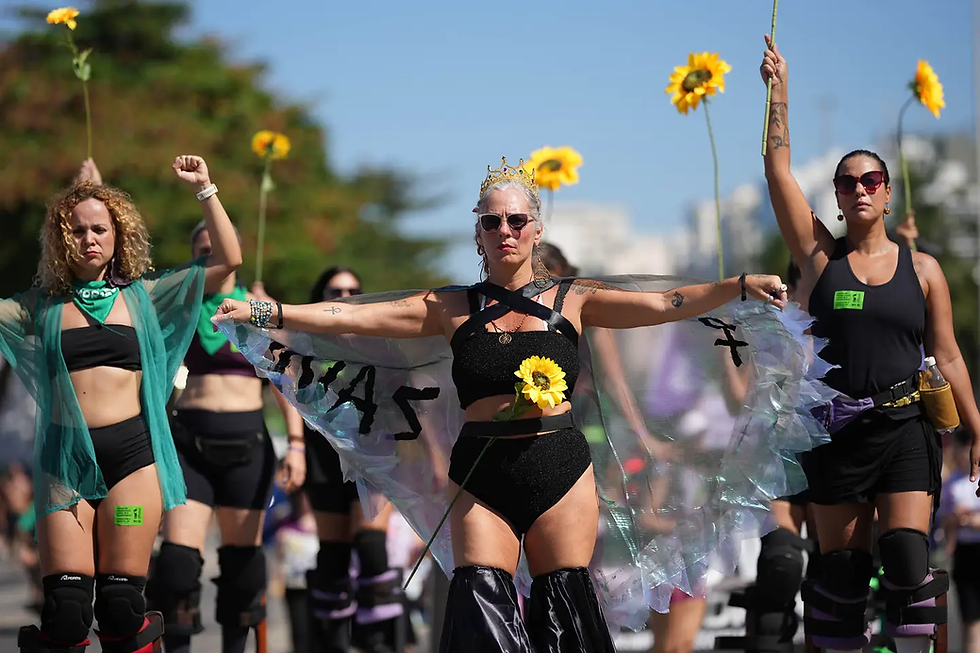
Flávio Bolsonaro’s tough-on-crime policies have closed the gap, with polls showing him locked in a dead heat with Lula. A public reconciliation with his stepmother, Michelle Bolsonaro, the most prominent woman on Brazil’s political right, has also boosted Flávio’s appeal to conservative and evangelical women.
Other candidates have made their own proposals to tackle femicide. Augusto Cury, a psychiatrist and bestselling author running as presidential candidate for the Avante party, has proposed sending out drones and using mobile apps to detect victims of gender violence. The suggestion has sparked widespread debate and much criticism.
“Evidence shows women are attacked in the home. What would drones do?” says Carvalho, who wants more resources allocated for better monitoring and training for police.
“We’re glad to hear all these beautiful speeches but we’re concerned that empty rhetoric is coming from politicians who have never shown concern for women’s rights and from some on the right who want to roll back laws protecting women,” she adds.
One challenge for whoever wins the election is tackling the “manosphere” or “machosfera”, the vast and thriving online network of forums and influencers promoting misogyny. Brazil is currently fast-tracking a law through the Chamber of Deputies that would equate online misogyny with racism and establish prison sentences of up to five years.
After almost two decades, Jardim says she doesn’t know how long she can keep up her memorial page, but welcomes the political spotlight being shone on the issue.
“We are at the beginning of a shift in awareness,” she says, “a process that must not be allowed to be broken or allowed to regress.”
Photographs by Cris Faga/NurPhoto via Getty Images, Quem ama liberta/Instagram, Silvia Izquierdo/AP
Copyright © 2026 Tortoise Media|


