Country Report: South Korea March 2026

By Juliana Girotto
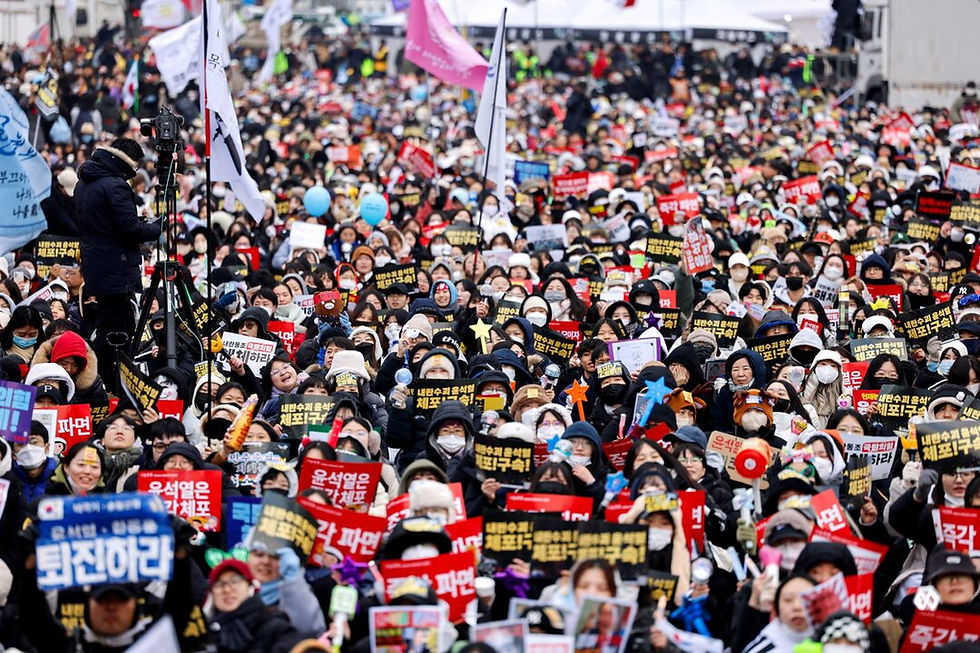
Despite its strong record on democratic governance and human rights, South Korea has faced persistent challenges in freedom of expression, labor rights, gender equality, and LGBTQ+ rights. Its growing relationship with the Democratic People’s Republic of Korea (DPRK, or North Korea) is also of concern, including the South Korean government's shift away from calling for accountability for North Korean human rights violations. The risks to South Korea's democracy must be addressed.
At the end of 2024, human rights advocates reported that former President Yoon's government limited scrutiny of its actions by expanding its use of the National Security Law (NSL). They also reported that it used criminal defamation lawsuits to retaliate against political critics at a markedly higher rate than did its predecessors. On December 3, 2024, Yoon ordered officials to arrest key political leaders and occupy journalists' offices, unjustly imposing marital law until he was quickly impeached.
Despite a subsequent change in power, suppression of freedom of speech continues. At the end of 2025, the government passed a revision of the Information and Communications Network Act, to take effect in July of 2026. This bill aims to eliminate fake news circulation through the media, punishing media companies or individual content creators if they distribute false or manipulated information online with the intention to cause harm or “seek undue profit.” However, what constitutes “false” information with the “intent of causing public harm” is not clearly defined, raising concern that government and corporate actors may be able to wield more complaints against the press, causing them to self-censor. UNESCO has warned that efforts to fight disinformation must not come at the cost of freedom or the risk of encouraging censorship. A coalition of five Korean media groups has demanded that punitive damages be limited and that the bill be reviewed and clarified.
Labor rights continue to be limited in South Korea, particularly for non-unionized employees and migrant workers. These workers face conditions such as extremely low wages, unsafe working conditions, lengthy hours, and lack of social benefits; these conditions have not been addressed, despite countless strikes and protests calling for such reforms. The South Korean government has also not ratified key conventions and protocols of the International Labor Organization which would provide more of these protections.
Regarding gender-based discrimination, South Korea ranked 101st out of 148 countries in the 2025 World Economic Forum’s Global Gender Gap Report. Among advanced economies, South Korea has one of the largest gender gaps in economic participation and opportunities. It has also seen a recent increase in “digital sex crimes” as a form of gender-based violence. These digital sex crimes include the use digital images that are captured non-consensually and sometimes shared, images that are captured with consent but shared non-consensually, or sometimes images that are deep-faked. The government has increased the penalties for these crimes, but its steps are not sufficient. Regarding the rights of LGBTQ+ people, the government has not yet enacted any comprehensive anti-discrimination legislation to protect this marginalized group.
One of the most concerning developments might be South Korea's relaxation of its criticism of the DPRK for its human rights violations. Although current President Lee has promised to pursue improvements on this front, critics have noted that the unification ministry’s restructuring has shifted focus from accountability to dialogue and engagement with Pyongyang. This restructuring includes the conversion of the “National Center for North Korean Human Rights” into the “Center for Peaceful Coexistence on the Korean Peninsula.” This action includes altering the center’s function in ways that will weaken its ability to record, investigate, and educate about North Korean human rights. This shift risks politicizing victims’ testimonies and removing them from international institutions, where they contribute to a global understanding of the current human rights situation in DPRK. If these changes outlast the current political administration, they could undermine international human rights norms in one of the regions where they are most needed.
Because of the limits on freedom of speech and the significant socioeconomic inequality for certain groups, Genocide Watch considers South Korea to be at Stage 3: Discrimination.
Genocide Watch recommends that the South Korean government:
Reform its new laws restricting freedom of expression to prevent their use against journalists, critics, and civil society.
Strengthen labor protections, particularly for migrant and non-unionized workers, and ratify key conventions of the International Labor Organization.
Adopt comprehensive anti-discrimination legislation, including protections based on gender, sexual orientation, and gender identity, and expand efforts to combat gender-based violence.
Maintain accountability for human rights violations in DPRK, ensuring that diplomatic engagement does not replace documentation, advocacy, and support for victims.