

Deadly Ethnic Violence Spreads in India’s Manipur State
Deadly Ethnic Violence Spreads in India’s Manipur State
New York Times
May 26, 2026
By Hari Kumar
Three years after riots tore apart Manipur, the state remains in disarray. Barbed wire and armed checkpoints made it difficult for Times reporters to cross, even before the recent clashes.

Security personnel at a buffer-zone checkpoint between Imphal and Churachandpur in Manipur, India, in March. .Credit:..All Photographs by Atul Loke
A fresh outbreak of ethnic conflict is rocking India’s remote eastern state of Manipur. Deadly ambushes, abductions and protest marches are cropping up in a land where such violence had already become routine.
In the past few weeks, the fighting between the Meitei and Kuki peoples has spilled over to embroil a third ethnic group, the Nagas. Kukis have clashed with Nagas in the hills of Manipur, amid disputes over rights of residence and control of the territory. More than a dozen people have been killed, including three Kuki church leaders who were shot in an ambush on May 13. Dozens have been kidnapped.
It is the most violent eruption in the region since May 2023, when clashes between the Kukis and the Meiteis killed hundreds. India’s government sent in paramilitary troops to suppress the fighting, which they achieved by severing the state into jagged parts.

Displaced Meiteis at a refugee camp in Imphal, in Manipur state.

Inside a building at the camp. In the past few weeks, fighting between the Meitei and Kuki peoples has spilled over to embroil a third ethnic group, the Nagas.
The Meitei people, mostly inhabiting the state capital, Imphal, and the surrounding plains, remain at war with the Kuki people, who mostly live in the hills. Each group has established safe areas behind battle lines, and tens of thousands have been displaced. They frequently blame each other for outbreaks of violence.
India’s national leaders have yet to comment on the latest stage in Manipur’s conflict. Prime Minister Narendra Modi visited the state last September, stopping for a few hours. His government has emphasized that most of the killings took place in the initial weeks of rioting in 2023 — and that Manipur’s history was already littered with similar incidents.
We visited the state just before the Nagas were drawn into the violence.
In March, we headed to Manipur to meet a few thousand Manipuris who regard themselves as a Lost Tribe of Israel, the B’nei Menashe.

The B’nei Menashe believe they are the descendants of Manasseh, a tribal patriarch from thousands of years ago. Evidence is thin, but Israel is welcoming them “home.”
Up and down India’s National Highway 2 to Manipur, there are countless roadblocks with armed guards, broad no-go zones between barbed-wire fences, and the constant threat of attack.
Tens of thousands had settled into lives constricted by the Meitei-Kuki conflict, with the government handing out roughly a dollar a day to those registered as internally displaced. Their camps fill public buildings, subdivided by hanging bedsheets.
Even before we set out from Delhi, it was clear that the battle lines could not be sidestepped.

A market in Churachandpur.

A wall of remembrance for victims of ethnic violence in Churachandpur.
When we called to book a hotel in Churachandpur, Manipur’s second-largest city, the manager told us that we might not be able to get there from the airport in Imphal. A Meitei driver cannot come to Churachandpur and a Kuki driver cannot go to Imphal without the risk of being killed, he told us.
We found a Nepali, ethnically an outsider to the region. On March 18 he drove us south from Imphal through Meitei-majority Bishnupur, where we saw uniformed security forces and passed through a few checkpoints, but were not stopped.
Just past Bishnupur, we hit the main buffer zone that divides Meiteis to the north and Kukis to the south. The barrier, unmarked on maps, is nearly two miles across. A heavily patrolled strip of land is subdivided by at least eight official checkpoints managed by heavily armed forces answering to the government, including the army, paramilitaries and state police. Entry required proof of identity and a convincing reason. Kukis and Meiteis were not allowed to cross.
Though all of this is India, the buffer zone functions like an international border between hostile countries. We saw hardly any people crossing. Similar but less militarized zones separate Manipur’s central flatlands.

Graves of some of the Kuki victims who died in 2023 in clashes with the Meiteis, at a cemetery in Churachandpur.

Hundreds died in the clashes three years ago.
Across the state, we met Kukis and Meiteis who felt their lives had been ruined by brutal and unrelenting division. In all, about 60,000 Manipuris are unable to return to their homes, according to public records, and 10,000 houses were destroyed or damaged in the upheaval.
Marauding Meiteis at the time ransacked a gynecology clinic in Imphal, run by Dr. Neiting Chagsam, a Kuki.
“We suffered so much then, I can’t bear to talk about it,” she said from her spartan new home in Churachandpur, where she has started a rudimentary clinic. “I am adjusting to my new life. I don’t speak to people in Imphal now. My staff and even my Meitei patients want me to come back, but there is no way of returning.”
She said she thought that only “1 to 2 percent of them suffer from hatred.” But that is enough, she said, to ruin it for the rest, and “even in our community, it is the same.”

Dr. Neiting Chagsam at her new clinic in Churachandpiur.
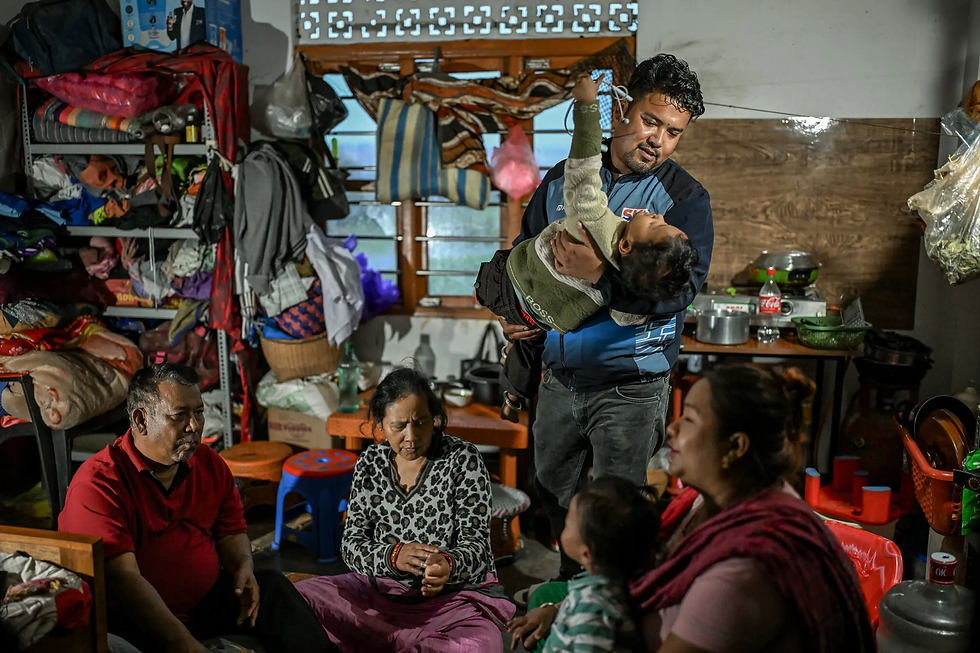
Lairenlakpam Singh, standing, a Meitei journalist, with his family at a relief camp in Imphal.
“Earlier, violence would happen for shorter periods, like two or three days, and then it would be normal again,” said Lairenlakpam Singh, a Meitei journalist who was driven from his home in Moreh on the Myanmar border in May 2023 and ended up in a relief camp in Imphal.
Mr. Singh, like most Manipuris we met, was perplexed by the ongoing violence, but still expected peace to return. “One day we will go back to our native place,” he said.
Hari Kumar and Atul Loke traveled between Imphal, Churachandpur and Kangpokpi, all in the state of Manipur.
Alex Travelli contributed reporting.
Hari Kumar covers India, based out of New Delhi. He has been a journalist for more than two decades.
A version of this article appears in print on May 28, 2026, Section A, Page 4 of the New York edition with the headline: A New Wave of Violence in India’s Forgotten War Zone.
Copyright 2026 The New York Times Company


