EU Funds Building Roma Ghettos in Italy

By Bernard Rorke
October 13, 2026
An Italian housing rights collective and the ERRC have called on the European Commission to suspend payments to Calabria Region and urgently investigate the chronic mismanagement and alleged misuse of EU funds to reproduce housing segregation, following the scandalous enactment of a “non-existent State of Emergency” that undermines Roma residents’ right to housing.
A new report strongly suggests that despite previous commitments to the EU, the Calabria Region is using EU funds to segregate and discriminate against Roma. The report published by the Stop Ghettos Committee, exposes the mismanagement of the EU-funded project to rehouse 400 Roma from the Scordovillo camp, and condemned the regional authorities for invoking “a non-existent State of Emergency" in order to repeal the fundamental right to housing.
The Committee warned if this is “not corrected by returning to respect for existing regional law, it will not only fail to guarantee the right to housing for these families and further fuel social conflict, but will seriously endanger the democratic stability of our territory.”
In October 2024, the ERRC, Italian rights organisations, and Members of the European Parliament called on the European Commission to investigate alleged misuse of EU funds by the regional government of Calabria, whose intent was to demolish and evict hundreds of Roma from an existing segregated camp and rehouse them in newly constructed dwelling units in the exact same segregated location. This was widely denounced for its explicit intent to create a new ghetto with European funds.
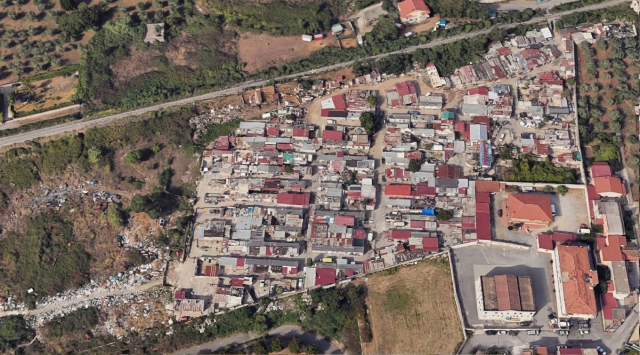
The Scordovillo camp, located in the city of Lamezia Terme in the province of Catanzaro in the southern region of Calabria, has existed for about 40 years. Accommodating around 440 Italian Roma, including more than 280 minors, the camp is adjacent to a large illegal landfill, and sanitary conditions in this site of environmental degradation are described by local activists as appalling.
In March 2024, the Calabria Region, drawing on €36 million of EU funds, adopted a resolution to tackle the housing conditions and related privations suffered by the residents “through an integrated and innovative approach that combines environmental and housing infrastructure interventions, as well as measures to promote education and social inclusion.” From this total amount, it became clear that the Calabria Region intended to use €28 million to build 120 new housing units on the site of the old camp where the Roma families will be transferred, effectively creating a new ghetto in Scordovillo.
The civil organizations presented the Commission with compelling evidence that the Calabria Region’s plans for a new improved ghetto ran contrary to the EU Roma strategic framework, Council conclusions and European Parliament resolutions calling for the eradication of housing segregation, and investment in integrated social housing. In December 2024, in response to the Commission's request for explanations, the Region assured the Commission that the project had been modified, with the ‘ghetto plan’ replaced in January 2025 by a program of ‘dispersed housing’ based on recovering existing public housing and purchasing units on the private market.
State of exception: the big fail and deliberate derail of the ‘dispersed housing’ program
The lack of meaningful progress and worrying regress on this project since its 2025 modification is exposed in detail by the Stop Ghettos Committee. The verdict is clear: “Implementation has largely failed.” By 23 July 2026, only 13 units had been positively assessed for purchase. The weaknesses identified by the Committee at the outset soon materialised:
“The selection criteria favoured isolated units in ways that risk resegregating the families, properties were sought partly outside the Municipality of Lamezia Terme, uprooting the families, and real estate agencies were excluded from the process. In practice, the Region is now housing few families in existing public housing estates in Lamezia Terme that are themselves degraded. One of them, Ciampa di Cavallo, is an established ghetto district that already concentrates Roma families.”
Faced with failure to secure enough housing and the prospect of losing EU funds, the Region declared a completely unwarranted ‘State of Exception’ on 7 July 2026. The existing housing allocation law was suspended, allowing for an accelerated, unregulated process whereby the Calabria Region could assign housing with complete disregard for normal legal protections. The Stop Ghettos Committee report spelled out the consequences:
“This move eliminated key rights for Roma families, such as security of tenure, proportional housing size, choice of location, and social rent rates, creating a legal vacuum and risking arbitrary evictions. The decision sparked social conflict: non-Roma families on ordinary housing lists feared losing out, and some municipalities opposed the project.”
The suspension of ‘normal’ process eliminated the right to allocation of housing in one's own municipality of residence allowed the municipality to begin assigning units available in its own stock in Lamezia. This disrupted the existing balance between emergency and ordinary allocations and generated social conflicts. According to the report, these districts were described as all being in a state of degradation, with one district “in all respects a ghetto, since it has long concentrated a large number of low-income Roma families with a history of social exclusion.”
The glaring illegality of invoking a non-existent ‘State of Emergency’ to revoke the fundamental rights of a vulnerable and discriminated group, not only imperils their safety, well-being and right to a home, but undermines democratic first principles and runs completely counter to ‘European values’.
The Stop Ghettos Committee has called on the European Commission to reopen a dedicated examination of the Scordovillo project to examine whether the funding is being used in an economically efficient and transparent manner; and to determine whether the ‘dispersed housing programme’ is “delivering genuine social mixing or, contrary to its stated purpose and to the assurances given to the Commission, reproducing segregation.”
The Committee’s report findings strongly suggest the Calabria Region has breached the anti-segregation requirements attached to EU cohesion funding, and the Stop Ghettos Committee has called on the Commission to suspend further payments pending an urgent assessment of the current situation, and until full compliance with human rights obligations can be assured.
Copyright © 2026 ERRC