

Nigerian Christian Freed After Ten Years in Prison
Nigerian Christian Pardoned After Ten Years in Prison
Condemned to Death for Self Defense Against Fulani Terrorist
Truth Nigeria
December 24, 2025
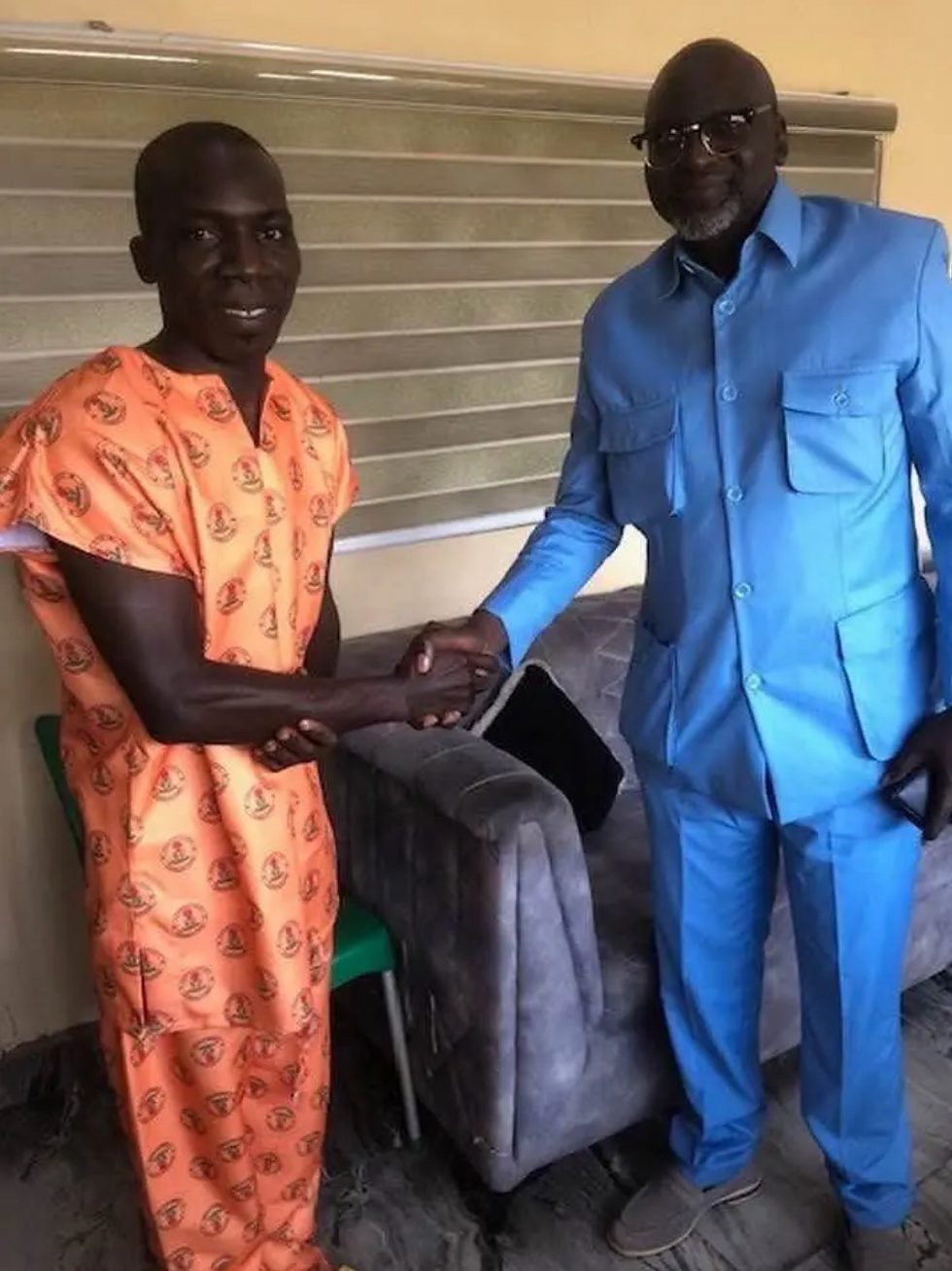
Pardoned inmate Sunday Jackson with International human rights attorney Emmanuel Ogebe| Photo Credit: Emmanuel Ogebe.
Christian farmer’s release sparks relief, anger, and questions about justice that arrives only under foreign pressure
By M. Kiara
(Lagos) – When Adamawa State Governor Ahmadu Fintiri signed the papers freeing Sunday Jackson, Nigerians exhaled.
Then many asked an uncomfortable question: Why now?
Jackson, a Christian farmer from northeastern Nigeria, spent nearly ten years in custody; four of them on death row for killing a Fulani terrorist who stabbed him during a confrontation on his farm. Nigerian courts rejected his claim of self-defense, sentencing him to death by hanging in 2021. His final appeal failed in March 2025.
This week, Jackson walked free under a Christmas clemency order.
Across Nigeria, reactions have been swift, emotional and sharply divided. Celebrations are mixed with suspicion that justice arrived only when international pressure made continued silence costly.
The President of the Middle Belt Forum (MBF), Dr. Bitrus Pogu, warmly welcomed the pardon granted to Sunday Jackson by Governor Ahmadu Fintiri of Adamawa state.
Speaking exclusively to TruthNigeria from Abuja, Pogu said, “I am delighted by this development. The young man suffered greatly for an action for which he should rightly have been celebrated as a hero.”
“All people of the Middle Belt of honour, dignity, and a fair sense of justice join Jackson and his loved ones in celebrating his hard-won freedom today together,” Pogu said, President of the Middle Belt Forum. “I salute the courage of Gov. Fintiri for this bold and just decision.”
Others praised the decision but criticized the system.
“Common sense has at last prevailed in the protracted case of Sunday Jackson v. the State, in which the appellant confronted his aggressor and defended himself. The case went all the way to the Supreme Court,” said Kola Alapinni, General Counsel and Director of Advocacy for the Foundation for Religious Freedom. “Mr Jackson ought never to have been compelled to fight for his exoneration, yet the system entirely subverted common sense.”
Relief Followed by Rage
On social media, joy came first.
The hashtag #FreeSundayJackson, long used by activists and Christian leaders, resurfaced within hours. Posts praised God, thanked international advocates, and welcomed Jackson back to life.
Then the tone changed.
“American effect,” Celine AJ posted. “If not for the U.S., this man would be dead.”
Lagos-based commentator Wunmi Adegoke wrote, “If this was truly justice, why did it take foreign pressure to make it happen. Why now, after many years of silence?”
“It’s not a pardon,” Toju Oluwatosin posted. “He was not supposed to be arrested in the first place.”
That question; why justice waited, now dominates public discourse.
A Case Nigeria Could No Longer Contain
For years, Jackson’s case remained largely confined to Christian circles and human rights lawyers. That changed as international scrutiny intensified.
In March, Nigeria’s Supreme Court upheld Jackson’s death sentence. Months later, the United States re-designated Nigeria as a country of particular concern (CPC) for severe religious freedom violations, a move that reopened long simmering tensions between Washington and Abuja.
U.S. lawmakers escalated the pressure. Rep. Riley Moore called Jackson’s imprisonment incompatible with any serious security partnership, saying one of Nigeria’s “first steps” must be his release.
Shortly afterward, Washington announced new visa restrictions targeting individuals linked to religious freedom abuses.
Only after that sequence did Jackson receive clemency.
“This pardon didn’t happen in isolation,” Nigerian journalist Anuhe Aba told TruthNigeria. “It happened when the international consequences of inaction became real.”
Media Tone Shifts Inside Nigeria
Equally striking has been how Nigerian media responded.
For years, major outlets avoided religious framing, describing terrorist attacks as farmer-herder clashes or “communal clashes” and “criminal disputes.” Following Jackson’s case, that language has shifted.
National broadcasters have openly debated whether self-defense laws are applied unevenly in northern Nigeria. Commentators openly questioned whether Jackson’s Christianity shaped his prosecution.
“What used to be whispered is now said on air,” Aba noted. “That alone tells you something has changed.”
Mercy Or Damage Control?
The Adamawa State government framed the pardon as routine, part of a seasonal exercise of mercy, citing Jackson’s conduct and constitutional authority. He was released alongside some other inmates.
But critics say that explanation avoids the core issue: Why a man sentenced to death for defending his life remained condemned for years despite clear legal irregularities, until foreign pressure mounted.
International human rights lawyer Emmanuel Ogebe, who helped lead Jackson’s advocacy abroad, has long pointed to violations in the case, including constitutionally excessive delays in judgment.
“A country that failed to stop mass murder nearly executed a man who survived one,” Ogebe said after Jackson’s release. He called for judicial review of the ruling, legislative clarification on self-defense, and compensation for Jackson’s lost years.
A Victory That Condemns the System
Among supporters, relief is undeniable. Jackson entered prison in his twenties. He leaves in his thirties, alive.
But his pardon has become something more than personal vindication.
“It proves the system works, but only when outsiders are watching,” said Pastor Tajudeen Matanmi, speaking to TruthNigeria. “How many others are still inside because no foreign government noticed them?”
That question is now being asked well beyond church pulpits by lawyers, journalists, and ordinary Nigerians who see Jackson’s freedom as both a victory and an indictment.
What the Pardon Really Signals
Sunday Jackson’s release closes a case. It does not close the problem it exposed.
For many Nigerians reacting to the pardon, the lesson is sobering: justice arrived but only after the world intervened.
Jackson is free.
The system that nearly executed him remains intact.
And for those still unseen, still unheard, the question lingers, who will speak for them?
M.Kiara is a news analyst for TruthNigeria.
Copyright 2025 TruthNigeria


