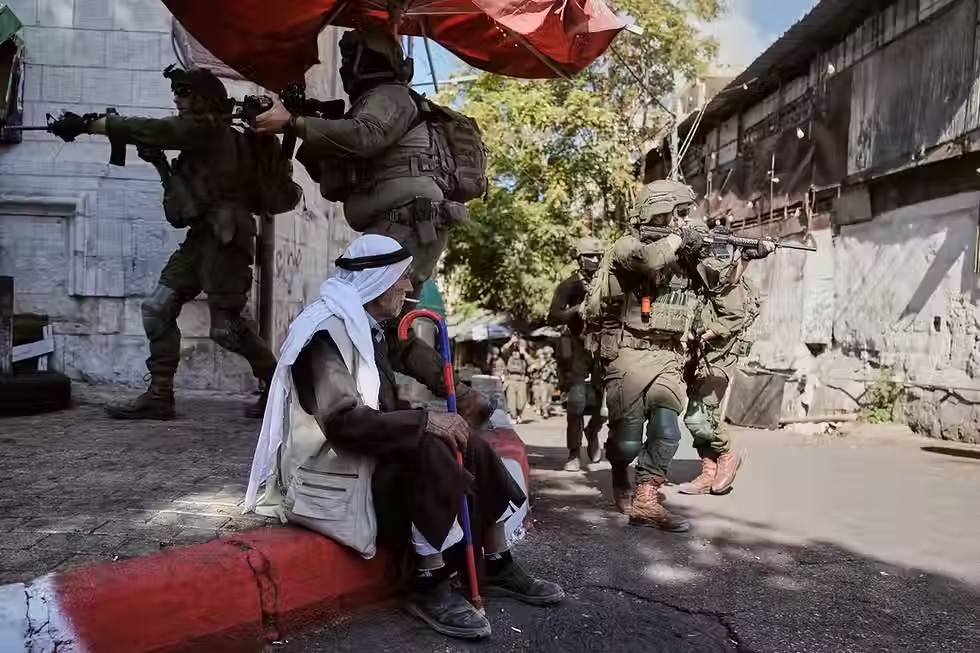
Ceasefire violations in Gaza

Updated: May 8
Special Report: Ceasefire Violations in Gaza
April 2026
By Aiden Carlton, Leonardo Monopoli and Karolina Bonde

In October 2025, Israel and Hamas signed a ceasefire agreement brokered by the United States, Egypt, and Qatar, in a renewed attempt to end nearly two years of the war in Gaza. The "Comprehensive End of Gaza War" built on a collapsed January 2025 ceasefire and set out binding obligations for both sides. The conditions included an end to hostilities, the immediate resumption of humanitarian aid, the release of all remaining hostages held in Gaza, and the freeing of around 2,000 Palestinian prisoners from Israeli jails. Yet, within days of its entry into force, both parties were trading accusations of non-compliance, with new violations reported daily. The signing of the 20 Point Peace Plan strengthened the ceasefire deal and can be seen as an extension of the deal reached on October 9, 2025.
Context
A ceasefire is a formal agreement between warring parties to stop fighting, either temporarily or permanently. A ceasefire is not the same as an armistice, which is a formal agreement to permanently end all military operations in a conflict. A ceasefire is instead intended to create conditions for humanitarian relief, negotiations, and the protection of civilians. On the other hand, a peace plan function as a comprehensive guide that outlines steps for ending hostilities allowing for the transition to a stable society.
The conflict that made the October 2025 agreement necessary has deep historical roots. The Israeli-Palestinian conflict stretches back nearly a century, to Britain's World War I pledge to establish a national home for the Jewish people in Palestine and the subsequent displacement of an estimated 750,000 Palestinians from their homes, known locally as the Nakba. This formed the basis for decades of settler colonial rule and the formation of an apartheid state.
The current phase of the conflict began on October 7, 2023, when Hamas launched an attack on Israel in which 1,139 people were killed and around 250 were taken captive. As Genocide Watch has stated, this attack enacted long-established genocidal intent by Hamas against the people of Israel. We note Israel’s asymmetrical warfare in Gaza. Israel has committed multiple war crimes, crimes against humanity, andgenocide, with databases documenting expressions of genocidal intent against the people of Palestine.
Genocide Watch first identified a Genocide Emergency Alert in October 2023, continuing to monitor escalating atrocities with further reports. Following the Independent International Commission of Inquiry’s report on the Occupied Palestinian Territories, Genocide Watch recognizes the situation in Gaza to amount to genocide under the under the United Nations (U.N.) Convention on the Prevention and Punishment of the Crime of Genocide.
The attack by Hamas triggered a devastating Israeli offensive on Gaza that has killed at least 75,200 Palestinians, the majority of whom are innocent civilians, including women and children. According to new data, the human cost of the conflict may be even higher. Throughout the conflict, Israel faced widespread accusations of using siege and starvation tactics alongside heavy bombardment, with rights groups andU.N. legal bodies accusing them of committing genocide. Israel has also routinely flouted international humanitarian law, especially regarding the core doctrines of distinction and proportionality.
A first short ceasefire in November 2023 quickly collapsed. A more substantial deal was reached on Jan. 15, 2025, after fifteen months of war, providing for a phased hostage and prisoner exchange. Despite some success, Israel was consistently accused of violating it by killing Palestinians on a near-daily basis. Israel accused Hamas of violating the deal by delaying providing the names of hostages. In March 2025, theceasefire finally broke down when Israel resumed military operations.
The October 2025 "Comprehensive End of Gaza War" agreement was thus the third major attempt to halt the fighting and the most detailed in its humanitarian obligations and enforcement mechanisms. A barebones agreement, it was augmented by the signing of the 20 Point Peace Plan which laid out in detail the end to the war in Gaza. However, their success seems to be limited, as both parties, particularlyIsrael, fail to adhere to the provisions of the ceasefire and peace deal. The ceasefire has, however, led to diminished international attention on Gaza.
This report will seek to evaluate violations of the ceasefire and peace agreement. It will do so through a thematic analysis of the use of force, occupation and humanitarian violations, rearmament, and key obstacles to peace.
The Use of Force
The clearest violations of the ceasefire can be seen with the use of deadly force and violence. Under Art. 3 of the Peace Plan, both Hamas and Israel were required to respect the immediate cessation "of all military operations, including aerial and artillery bombardment." This has not happened, as Israeli airstrikes, shelling, and gunfire have continued unabated. Instead, Hamas has sought to reassert control of Gazaby eliminating rival armed clans and families, such as the Dugmush Clan, and occasionally clashing with the Israeli Defense Forces (IDF).
Both parties routinely accuse each other of violating the ceasefire and appear to be biased in their reporting. However, authoritative figures from the U.N. state that IDF operations since the October 2025 ceasefire have left 765 Palestinians dead and 2,140 injured. These figures have been confirmed by reputable human rights organizations such as Save the Children and Danish Refugee Council, which added that at least 180 children have died in this “ceasefire period.” In this period, four IDF soldiers have also been killed.
Crucially, the Israeli military body, Coordinator of Government Activities in the Territories (COGAT), has routinely accused Palestinians of violently engaging IDF soldiers, and the IDF has frequently failed todistinguish civilians from combatants in its attacks. In December 2025, Fadi and Juma Abu Assi, 8 and 10 years old, were killed in an Israeli drone strike acknowledged by the IDF. COGAT described the boys asconducting "suspicious activities" and posing an "immediate threat" to Israeli soldiers. Similarly, in January 2026, two cousins, Mohammad and Suleiman Al Zawaraa, were killed by an explosive device planted to eliminate “terrorists’” who were approaching troops. Such claims have allowed Israel to continue violating the ceasefire with impunity, using alleged Hamas’ violations as justifications for its own actions. This trend constitutes a violation of the international humanitarian legal principles of distinction and precaution, as civilians are not properly separated from combatants, and the IDF failed to take steps to separate civilians from combatants and minimize harm to civilians.
Additionally, the IDF has regularly violated the principle of proportionality, carrying out military actions which lead to damage and civilian impact that would far outweigh the military advantage gained. For example, on Oct. 19, 2025, following an alleged Hamas violation of the ceasefire and the death of two IDF soldiers in Rafah, the IDF retaliated by killing 45 Palestinians. Similarly, on Oct. 29, 2025, following a supposed exchange of gunfire that killed one Israeli soldier, the IDF killed 104 Palestinians, including 46 children, in a bombing attack. Hamas denied any role in killing of the soldier, and Israel subsequently named 24 militant targets, ignoring the 80 other fatalities that were caused by the bombing.
Hamas has also failed to respect the ceasefire by engaging in summary executions and clashes with rival factions. Since the ceasefire, the Office of the High Commissioner of Human Rights has recorded 80 reported killings of Palestinians by Hamas, undermining Art. 1 of the Peace Plan that declares Gaza a "de-radicalised terror-free zone." According to internal sources in the Palestinian Authority (PA), Hamas continues its effort to retain control of Gaza through guns and violence.
Israel has also targeted journalists and human rights defenders in Gaza, demonstrating a concerted attempt to silence human rights reporting. On Jan. 21, 2026, Israeli forces killed three journalists on their way to film the newly formed displaced camp in Netzarim. On March 9, 2026, Amal Shamali was found dead after an air strike on the Nuseirat refugee camp. Since the start of the war, the IDF has killed more than 270 journalists and media workers.
Occupation Violations
In 2024, an International Court of Justice (ICJ) Advisory Opinion stated the illegality of Israel’s continued presence in the Occupied Palestinian Territories (OPT). Nevertheless, Israel has proceeded to enforce an open-ended occupation, leaving many residents homeless, unemployed, and unable to travel, with no change evident since the ceasefire. The ceasefire deal stated that Israel was to withdraw to a “yellow line”that gives it control of half of Gaza. Additionally, it is stated in Art. 16 of the Peace Plan that Israel must not occupy or annex Gaza and in Art. 12 that Gazans were free to stay, leave, or return. Despite Israeli withdrawal claims, the level of territorial, maritime, and administrative control exercised by Israel indicates that Gaza remains occupied under international law.
According to a BBC Verify analysis, in October 2025, Israel placed its markers of the “yellow line” a few hundred meters ahead of the recognized line. Pushing westwards, Israel controls 54% of Gaza, signifying a violation of the agreed-upon line. In January 2026, Israel moved the yellow line deeper into Gaza, according to satellite images.
Additionally, Israel has implemented a no-go or “buffer” zone behind the yellow line, killing civilians that cross it (even unknowingly) while looking for food, shelter, firewood or their belongings. Operating as a buffer zone, this gives the IDF considerable space to manoeuvre and create a "kill zone". This is a stark violation of Art. 3 of the Peace Plan. The Abu Assi brothers were killed by the IDF after crossing the line in the town of Bani Suheila, and the Al Zawaraa cousins were killed near the yellow line in Northern Gaza. Israel has also failed to clearly mark all the “yellow line,” resulting in further civilian killings. This is a crucial violation of the ceasefire and international law, as civilians fall under the category of protected persons in armed conflict.
All military operations must remain "frozen" as well, according to Art. 3 of the Peace Plan. Instead, since the ceasefire, Israel has engaged in the widespread demolition of essential infrastructure and residential buildings. A U.N. report found that Gaza is the recipient of acts amounting to "domicide," which has relentlessly continued since the ceasefire began. At the start of the ceasefire in October 2025, 92% of Gaza’s housing units were fully destroyed or damaged. In November 2025, a BBC Verify analysis concluded that Israel has demolished at least 1,500 buildings in Gaza since the ceasefire. Oxfam estimates that 2,500 residential buildings were destroyed by January 2026. As of April 2026, 1.7 million people are currently sheltering in some 1,600 displacement sites in Gaza. Therefore, Israeli occupation of Gaza has caused significant harm to civilian infrastructure, violating Art. 3 of the Peace Plan. Rutgers University Professor of Law Adil Haque has also stated that the "destruction of civilian property by an occupying power" amounts to a violation of international humanitarian law. Furthermore, it continues to have detrimental effects on the livelihood of Palestinians. The lack of shelter has killed 39 Palestinians from early December to late January.
Additionally, Art. 7 of the Peace Plan stated that water, electricity, sewage, and medical infrastructure were to be rehabilitated. With 90% of Gaza’s water, sanitation, and hygiene (WASH) infrastructure damaged, the human rights of Gazans, including their right to safe drinking water and sanitation, continue to be compromised, with no significant Israeli action taken to rectify this situation. In fact, Israel has intentionally prevented the entry of necessary repair materials such as pipes and generators, as well as that of life-saving equipment such as reverse osmosis machines. As a result, Gaza continues to be "deliberately deprived of water."
Israel continues to prevent heavy machinery from entering Gaza to remove rubble and clear roads to allow humanitarian aid to reach civilians. This represents a clear violation of Art. 7, as only six machines have been allowed to enter Gaza, while experts estimate that 500 are needed.
Israel’s indefinite occupation maintained by the use of force may amount to de facto annexation and thus constitutes an act of aggression, unlawful under international law and therefore in breach of Art. 16 of the Peace Plan.
Humanitarian Violations
The October 2025 ceasefire agreement, like the January agreement, stated that there should be humanitarian aid and relief should immediately be allowed into Gaza. However, the evidence suggests this obligation was breached almost immediately. From Oct. 11, 2025 to April 1, 2026, an average of 100 trucks per day has entered Gaza. This is a fundamental violation of the 20 Point Peace Plan’s call for “full” aidto enter Gaza, in accordance with the January 2025 agreement’s call for 600 trucks a day
In November 2025, U.N. Office of the High Commissioner for Human Rights (OHCHR) reported that humanitarian access remains critically restricted, with only two of six crossings reopened. They also noted that major hospitals are only partially functional and require restoration, equipment, and supplies to reach full operational capacity. Experts were quoted as saying that “Continuing failure to ensure that the U.N., through OCHA and the U.N. Relief and Works Agency for Palestine Refugees in the Near East (UNRWA), directly manages aid delivery and distribution in Gaza, as mandated by international law, is unacceptable and cannot be justified.”
The same month, relief agencies reported that Israel was blocking entry of shipments of bottles for baby formula and over a million syringes needed to vaccinate Gazan children. Israel claims that the items are “dual-use,” meaning they could be used for both civilian and military purposes. This designation has significantly disrupted the delivery of many humanitarian supplies amidst an urgent crisis.
In a more recent report, Gaza's Government Media Office recorded a significant shortfall in aid delivery between October 2025 and February 2026, with only 43% of the allocated number of aid trucks entering Gaza. Aid drivers attributed part of the delay to prolonged Israeli inspection procedures at crossings. Additionally, requests for aid have dramatically decreased following the stringent NGO registration regulations Israel approved in 2025, alongside an increased rate of rejection. The restrictions extended beyond quantity: Israel blocked nutritious food items, including meat, dairy and vegetables, while allowing through items of little nutritional value, such as snacks, chocolate, and soft drinks. Commercial shipments cannot replace humanitarian aid, as they are of “high monetary value but low nutritional value”.
Medical evacuations represent a further area of non-compliance. The October 2025 agreement stipulated that humanitarian conditions must be consistent at minimum with the January 2025 agreement, which had explicitly committed Israel to allowing wounded Palestinians to leave Gaza for treatment and to opening the Rafah crossing within seven days of the first phase's implementation. According to UNRWA, medical evacuations remain on hold; since the ceasefire, only 700 patients have been evacuated from Gaza. Gaza's Health Ministry reports that more than 20,000 patients and wounded people are waiting to travel abroad for treatment, among them approximately 4,000 cancer patients requiring specialized care, around 4,500 children, 440 life-saving cases requiring urgent intervention, and nearly 6,000 wounded people in need of continued hospital care outside Gaza.
Additionally, half of all medical facilities in Gaza are not operational to date, with severe medical shortages arising from the restrictions imposed by Israel on the border crossings. Alongside the continued destruction of WASH facilities, these closures are contributing to a wider public health crisis, attested to by UNICEF, including widespread respiratory diseases, parasitic infections and outbreaks of hepatitis, diarrhea and gonorrhea.
Rearmament
Historically, Hamas and other militant Palestinian organizations in Gaza have sought to import weapons through Gaza’s border with the Sinai Peninsula in Egypt. In 2005, as part of the Roadmap for Peace process, the PA and Israel formed the Agreement for Movement and Access. They opened the Rafah Border Crossing under the PA, and it was supervised by the European Union’s European Union Border Assistance Mission (EUBAM) for the Rafah Crossing Point. In 2007, Hamas managed to take control of Gaza, and it took over the border crossing, removed foreign oversight, and massively expanded a network of tunnels beneath the border to smuggle in weapons, ammunition, and other supplies. Although initially closed, the border crossing finally reopened in 2008, remaining under Hamas’ control. Following Hamas’ invasion of Israel on Oct. 7, 2023, the IDF managed to capture the border, including the Rafah Border Crossing, in 2024, shutting it down until American pressure for a ceasefire led to its reopening in 2025.Therefore, the crucial border crossing has been unavailable to civilians, and its closure blocked the flow of humanitarian aid into Gaza.
Alongside this, Hamas has refused to completely disarm. It has not yet made plans to do so, claiming that there was no such provision under the ceasefire agreement, despite conflicting claims from U.S. officials. Instead, it has sought to gradually repair and rearm its armed faction, steadily attempting to reassert control over Gaza. Hamas’ armed wing has been devastated, its access to the border crossing severed, and its access to its network of underground tunnels inhibited by Israeli operations to dismantle the tunnels. To compensate, Hamas has sought new avenues for procuring arms, such as sending drift containers to Gazafrom the Sinai by water and likely using funds and materials for humanitarian aid and commerce to refill its stockpiles and repair its infrastructure. However, the extent of Hamas’ exploitation of humanitarian aid isdisputed.
Israel has also played a part in moving weapons into Gaza by helping to arm anti-Hamas factions such as the Popular Forces, thus introducing proxies into the conflict in an effort to undermine Hamas’ hold on the enclave. This constitutes another violation of the ceasefire and peace deal.
Blocks to Progress in the Peace Process
The 20-point plan issued by the Trump Administration outlined two main phases to end the war in Gaza. There have been serious concerns about the shortcomings of the first phase. For instance, although diminished, violence is still prevalent between the IDF and Hamas, with hundreds of Palestinians killed since the ceasefire was supposed to take effect. Additionally, the IDF has only partially withdrawn to its designated buffer zone in Gaza, retaining a presence in several major population centers. Requirements for humanitarian aid have also yet to be fulfilled, with much of Gaza undergoing shortages of essentials like food and medical services. The famine in Gaza was declared officially over in December of 2025, but this does not mean that Palestinians in Gaza broadly live without hunger. Additionally, Israel’s recent re-closure of the Rafah Border Crossing in the face of conflict with Iran is likely to have a detrimental impact on access to food.
Nevertheless, on Jan. 14, 2026, the U.S. announced that the process was moving into phase two, However, the second phase of the peace plan has seen very sparse progress. One of the key components of this plan is the introduction of an administration of Palestinian technocrats, the National Committee for the Administration of Gaza, under the auspices of the Board of Peace. However, Israel has not allowed the individuals named for the committee to enter Gaza, stating that as long as Hamas' ceasefire violations continue, they will not do so. Additionally, it is unclear if the Board of Peace will manage to procure a sufficient number of peacekeepers for its proposed International Security Force (ISF). The intention was to create a force of 20,000 troops, and, so far, five countries have volunteered to contribute unspecified numbers of troops: Kazakhstan, Albania, Kosovo, Morocco, and Indonesia. Indonesia briefly promised to contribute 20,000, but soon after scaled down its promise to 5,000-8,000. Reports indicate that the US will try to bring up the number of committed forces to 10,000 by the end of 2026, after seeking commitments from approximately 70 countries. There is no significant movement towards agreement for the implementation of a ceasefire, and peace is increasingly out of reach due to the U.S. and Israeli strikes against Iran, the renewed Israeli incursion in Lebanon against Hezbollah, and Iranian sponsorship of regional proxies.
The genocide against the civilians of Gaza has continued despite the advent of a ceasefire, mutating into a more discrete, yet still-deadly form. Due to the near-total destruction of the Gaza Strip, the indiscriminate bombings and widespread atrocities committed against Palestinian civilians, and documented statements indicating genocidal intent, Genocide Watch recognizes that the crisis amounts to Stage 8: Persecution and Stage 9: Extermination. Elements of Stage 4: Dehumanization and Stage 1: Classification are highlighted in the lack of humanity through which the IDF continues to operate, in failing to differentiate between civilians and militants, blocking humanitarian aid delivery, and impeding the entrance of crucial machinery to clear rubble and construct temporary shelter highlights. Since the start of the war, Israel has vehemently denied perpetrating a genocide, leading Genocide Watch to recognize Stage 10: Denial.
Recommendations
Genocide Watch recommends prioritizing the following:
A suspension of all offensive military operations in Gaza by both Israel and Hamas, in order to respect the ceasefire agreement signed on Oct. 10, 2025 and international law.
The efficient and unimpeded distribution of humanitarian and developmental aid in Gaza.
The gradual and full withdrawal of the IDF from Gaza.
The dismantling of Hamas' armed faction, as well as the disarmament of other Palestinian militias in Gaza
A viable, long-term solution for Palestinian administration and rule of law in Gaza.
Self-determination granted to the Palestinian people in its full form.