Water as a Weapon in Gaza


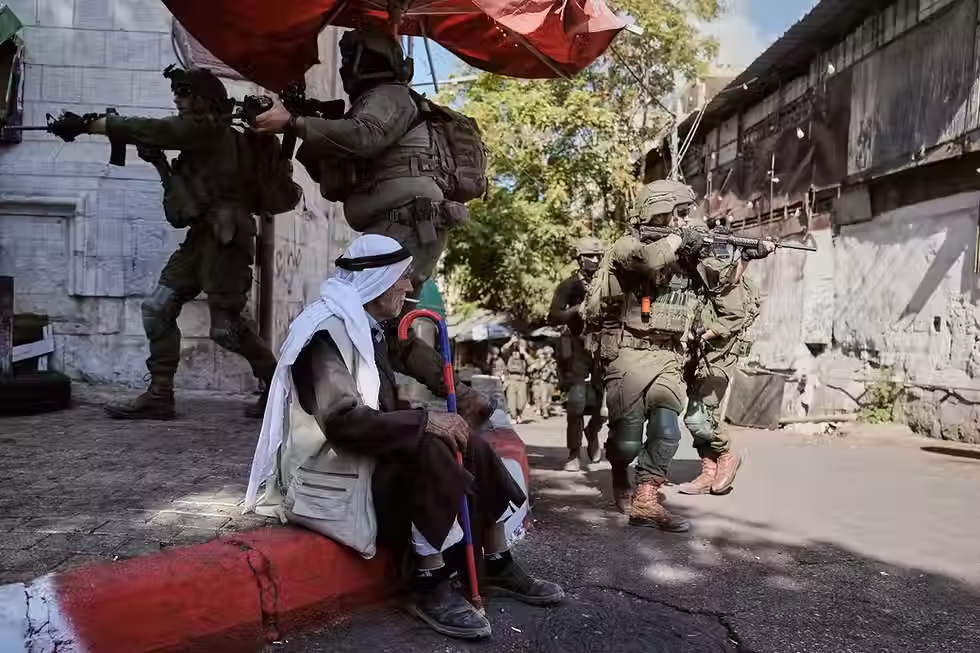
Photo by Abid Katib/Getty Images
by Karolina Bonde
May 2026
Historically civilians’ restricted access to water during warfare has been a form of collateral damage when infrastructure is damaged and water supply chains are disrupted. Recently, restricting water usage has been used as a key method of warfare. By damaging water infrastructure, military combatants gain cumulative tactical leverage while avoiding actual combat. However, international actors have not been able to protect civilians’ access to water during war by applying the relevant and established laws. Thus, the tactic spreads with impunity.
Humanitarian groups have extensively documented this pattern in Gaza, especially since the October 7 attacks committed by Hamas and Israel's ensuing military onslaught. Humanitarian groups have documented this pattern extensively in Gaza during the Gaza War. Several other prominent cases show that combatants are ignoring the established laws that protect civilians’ access to water during war. In Gaza, observers have documented clear deprivation of water as a tool against civilians. The violations of law have not been addressedmand this lack of accountability may encourage this violation in future warfare. Already, United States (US) President Donald Trump has threatened to target Iran’s power plants and desalination infrastructure, despite longstanding protections afforded to civilian infrastructure that is necessary for survival. Indeed, strikes on desalination plants in Iran, Bahrain, and Kuwait have already been reported in March and again in July.
This report examines the systematic restriction of water in Gaza through the findings of Doctors Without Borders (DWB), presented in its April 2026 report. It also considers how such acts have spread with impunity in warfare elsewhere.
Water Deprivation in Gaza
For years, DWB has warned about the collapse of water and sanitation conditions in Gaza. Operating directly on the ground, DWB has repeatedly documented how restrictions on infrastructure, fuel, and humanitarian aid have affected the civilian population’s ability to access necessities essential for survival. In April 2026, DWB stated, “Israeli authorities have used access to water as a weapon against Palestinians, systematically depriving people in Gaza, Palestine, of water in a campaign of collective punishment.” Since the start of the war, DWB reports that Israel has destroyed or damaged nearly 90% of Gaza’s water and sanitation infrastructure, including desalinationplants, boreholes, pipelines, and sewage systems.
Israel’s use of water deprivation was signaled openly in the immediate aftermath of the October 7, 2023 attacks by Hamas on Israeli citizens. Genocide Watch has previously stated that those attacks were acts of genocide, as is the Israeli response. On October 9, 2023, the then-Israeli Defense Minister Yoav Gallant announced a "complete siege” of the Gaza Strip and that there would “be no electricity, no food, no water, no fuel, everything is closed.”Similar rhetoric followed from Major General Ghassan Alian, head of the Israeli Coordination of Government Activities in the Territories (COGAT), who stated: “There will be no electricity and no water [in Gaza], there will only be destruction. You wanted hell, you will get hell.”
The destruction of water and sanitation systems in Gaza has penetrated every aspect of civilian life, including hygiene, disease prevention, childbirth, food preparation, and psychological survival itself. Families dig makeshift toilets into the sand inside overcrowded tent encampments, often meters away from the boreholes used to access drinking water. During winter flooding, sewage spreads directly into living spaces. Access to soap, detergent, and basic hygiene products has repeatedly been cut off. Mothers have reportedly torn pieces of clothing into improvised diapers for infants. Women and girls struggle for access to menstrual hygiene products, increasing their risk of infection and illness. Some women have resorted to bathing in the sea, despite reports that Israeli forces fire towards civilians who approach the shoreline.
Untreated solid and medical waste compounds this collapse. As early as March 2024, the United Nations Development Programme (UNDP) warned that if the issue of solid waste, including medical waste, was not adequately addressed, it would exacerbate the suffering of Palestinians in the Gaza Strip, severely affecting public health given limited access to healthcare, and contaminating agricultural land and the aquifer as pollutants seep into the soil.
Children’s daily existence is shaped by the crisis. Many wake each morning not knowing whether water trucks will arrive.
DWB's mental health professionals have documented suicidal ideation linked directly to the collapse of water and sanitation conditions. Therefore, deprivation of water to Gazans is not only a humanitarian issue. Restricting access to water and sanitation is one form of systematic destruction of the conditions necessary for their life, health, and human dignity.
The Mechanisms of Deprivation of Water
In the Gaza War, Israeli authorities have used three interrelated systems to deprive Gazan civilians of access to water:
Direct destruction: The Israeli authorities have destroyed or damaged 89% of water and sanitation infrastructure in Gaza. The northern desalination plant has been demolished entirely. Damaged infrastructure includes over 60% of its 196 publicly- and NGO-run desalination plants. This has stripped Gaza of the physical capacity to produce clean water at scale.
Access denial: On July 30, 2025, 87% of Gaza's territory was under Israeli evacuation order or military control, cutting residents off from wells, water points, and repair sites within these zones. As of March 2026, 58% of Gaza remains inaccessible, leaving much of the population unable to reach functioning water infrastructure even where it exists. This control extends to humanitarian delivery: in September 2025, during Israeli forces' incursion into Gaza City, Israeli authorities denied 100% of DWB's 27 requests for water trucking movements, blocking emergency water supply to areas cut off by military control.
Supply blockage: Since January 1, 2026, every single DWB request to bring supplies through the Israeli-controlled approval system has been denied. Israel classifies water desalination pumps, water testing kits, RO membranes, chlorine tablets and even latrine units as requiring complex military approval; in any other context, those items would be considered basic humanitarian supplies. In November 2025, six large reverse osmosis units, each capable of producing 10,000 liters of drinking water per hour, were turned away at the Kerem Shalom crossing. Initially approved, then rejected in November, they were rejected again in December following US military intervention. As of March 2026, they have still not entered Gaza. Meanwhile, 2,150 latrine units have been sitting in a warehouse in Jordan since April 2025.
In addition to targeting equipment and supplies, Israeli military attacks have targeted the people who try to provide or access them. In July 2025, seven children were killed in central Gaza while waiting for water at a distribution point. More recently, UNICEF announced its outrage after Israeli forces killed two drivers it had contracted to deliver clean water to families in northern Gaza. The same attack wounded two others and occurred during routine water trucking at the Mansoura filling point. UNICEF suspended operations at the site.
Thus, water infrastructure is not simply caught in the crossfire of war, subject to collateral damage. Rather, water is being denied at every link in the chain, from demolished plants to blocked supplies and fatal attacks on the people physically carrying water.
Independent experts appointed by the United Nations Office for the Coordination of Humanitarian Affairs (OCHA), have expressed despair for the situation, stating, “Israel is using thirst as a weapon to kill Palestinians. Cutting off water and food is a silent but lethal bomb that kills mostly children and babies. The sight of infants dying in their mothers’ arms is unbearable. How can world leaders sleep while this suffering continues?”
The Legal Framework: Clear Prohibitions, Limited Enforcement
For decades, international humanitarian law has addressed the weaponization of water. The International Committee of the Red Cross (ICRC) identifies four core prohibitions directly applicable to water in armed conflict:
the ban on poisoning or rendering water unfit for use
the ban on destroying objects indispensable to civilian survival
the ban on attacking works containing dangerous forces such as dams, and
the ban on destroying enemy property.
Drinking water installations and supplies are explicitly named within these protections, and starvation as a method of warfare is prohibited, regardless of the nature of the conflict. Even if a water installation is targeted because it is used solely by armed forces for military action, adversaries must refrain from any action that would deprive civilians of essential water.
In the current war, Israel has breached each of these four prohibitions through direct attack and blocking humanitarian aid, supplies, and equipment.
As occupying power, Israel's obligations go further. The Berlin Rules on Water Resources, grounded in the Fourth Geneva Convention Article 55, state that the obligation to protect water installations and ensure adequate supply to an occupied population is absolute. Israel is not merely prohibited from destroying Gaza's water infrastructure: it is legally required to maintain it. Also, under the Rome Statute, intentionally using starvation as a method of warfare, including by depriving civilians of water, is a war crime and may constitute the crime against humanity of extermination or an act of genocide. In November, 2024, the International Criminal Court (ICC) issuedarrest warrants for Israeli Prime Minister Benjamin Netanyahu and then-Minister Gallant on precisely this charge.
In the Geneva Conventions, the underlying prohibition on starvation as a method of warfare is established in Additional Protocol I. Israel is not a party to Additional Protocol I, so it disputes that the prohibition is legally bindingon it. This argument does not hold, as the prohibition on starvation is also part of customary international law, which binds all states, regardless of which treaties they have ratified.
The International Court of Justice (ICJ) was equally unambiguous. In its January 2024 order, the court found a "real and imminent risk of irreparable harm arising from the deprivation of potable water" in Gaza and issued binding measures requiring Israel to restore humanitarian access. Israel has not complied with that order, nor with the three that followed. Israel's position implicitly echoes the argument of legal scholar Yoram Dinstein, who has called the prohibition "unjustifiable and utopian" on the grounds that siege warfare has historically been lawful. But even a siege has legal limits. According to the ICRC, a siege aimed at starving civilians is prohibited, and any starvation effects directed at enemy forces must be exclusively confined to them. A party cannot use military purposes as cover for depriving civilians of what they need to survive. Israel’s deprivation of access to water and sanitation that the DWB report documents in the Gaza War goes far beyond those limits.
Impunity, Resistance, and Failure of Enforcement
Regarding Israel’s deprivation of water to civilians in Gaza, the law has spoken repeatedly, through ICC arrest warrants, ICJ provisional measures, and extensive documentation by humanitarian and human rights organizations.
The response, however, has increasingly been to undermine and dismantle the institutions doing the speaking. Following President Trump's return to office as the US President in January 2025, the US sanctioned the ICC prosecutor, deputies who lead the Office of the Prosecutor, and four judges including two on the pre-trial chamber that issued the warrants regarding Prime Minister Netanyahu and then-Minister Gallant. The ICJ orders have been ignored in their entirety.
The October 2025 ceasefire agreement between Israel and Hamas explicitly promised "full aid" and "rehabilitation of infrastructure including water, electricity and sewage, without interference from the two parties." However, since that agreement took effect, 13 types of water, sanitation and hygiene items submitted by DWB have been rejected for importation to Gaza. These items include chlorine tablets, antiscalant essential for running desalination systems, and water pipes for a hospital. Acts like these underscore the urgency of addressing the prevailing impunity.
A Pattern of Water Deprivation in the West Bank and Gaza
The events unfolding in Gaza reflect a longer history of Israeli control over Palestinian water resources. In November 1967, Military Order 158 was issued after Israel's occupation of the West Bank and Gaza. It stated that Palestinians could not construct any new water installation without first obtaining a permit from the Israeli army. However, those permits proved almost impossible to obtain.
What followed was a structural and sustained disparity in access to water. Israelis, including settlers in the West Bank, use an average of 247 liters of water per day per person, or three times the 82 liters available to Palestinians in the West Bank. In Palestinian communities not connected to the water grid, daily consumption is only 26 liters per person, a level comparable to disaster zones.
The Israeli human rights organization B'Tselem concludes that the crisis of water access facing Palestinians is the direct result of a deliberate Israeli policy that treats water as a tool of control over the Palestinian population. It explains that Israel justifies this policy by citing the arrangements laid out in the Interim Agreement it signed with the PLO in 1995. But that agreement was only ever intended to hold for five years, and the West Bank today looks nothing like it did when it was signed. Since then, the Palestinian population has nearly doubled, yet Israel has never adjusted the ceiling on how much water Palestinians are allowed to draw. The gap forces the Palestinian Authority to buy water back from Israel's state-owned supplier, Mekorot, at a steep premium over its actual cost.
Gaza has long struggled with contaminated water. Even before October 2023, 90-95% of its water supply was contaminated and unfit for human consumption. Gaza's only freshwater source, the Coastal Aquifer, had been progressively depleted and contaminated by sewage and seawater infiltration. Israel restricted the entry into Gaza of materials and equipment necessary for the development and repair of infrastructure, contributing further to a marked deterioration in the water and sanitation situation. In addition, Israel did not allow water transfers from the West Bank to Gaza.
Israel damaged and destroyed water infrastructure in Gaza during its multiple military operations there. Amnesty International documented such damage done between 2002 and 2009. In just eight months ending in March 2003, the Israeli army destroyed 102 wells in Gaza, forcing residents to use unsafe water sources such as agricultural wells. In a single invasion in Rafah in early 2003, Israeli forces demolished two public wells providing drinking water to half of the town's 120,000 residents. In a subsequent May 2004 raid in Rafah, UN aid agencies reported that damage to water and sewage networks caused an immediate public health collapse in which over 1,300 children were brought to a single clinic in ten days, suffering from diarrhea and skin diseases. In the winter of 2008-09, Israel’s Operation Cast Lead caused approximately $6 million worth of damage to water infrastructure, including the damage or destruction of four reservoirs, eleven wells, and 20,000 meters of water mains.
Taken together, these incidents illustrate Israel’s systemic pattern of attacking water infrastructure as a means of warfare in Gaza.
Beyond Gaza
In Gaza, the world is witnessing the systematic deprivation of a resource indispensable to civilian survival, carried out as a method of warfare, documented exhaustively, and met with impunity, despite clear legal prohibitions. But Israel’s deprivation of water in Gaza is not an isolated case, but the most extensively-documented instance of this tactic. This crisis in Gaza thus represents a test of whether the protections underpinning civilian survival in armed conflict retain any practical meaning.
For example, in Ukraine in 2023, the dam at the Kakhovska Hydroelectric Power Plant was destroyed by Russian forces with catastrophic consequences, including the disruption of drinking water and sanitation services for one million people. In Yemen in 2023, both Houthi forces and Saudi-backed government forces have weaponized water infrastructure in Taizz: Houthis have shut off supply valves and blocked water trucks, while government forces have diverted water resources to fund military operations. In Sudan in 2025, the deliberate seizure of water resources has worsened famine and triggered mass displacement, creating one of the world's largest humanitarian crises for 30 million people.
The logic in each case is the same. Attacks on water infrastructure offer military, political, and psychological leverage without requiring direct combat. The tactic is deniable, cumulative, and effective.
In April 2026, that logic was stated openly at the highest level. US President Trump threatened "complete demolition" of Iran's power plants, including water desalination plants, unless Iran reopened the Strait of Hormuz. Amnesty International's Secretary General responded that intentionally attacking civilian infrastructure constitutes war crimes under international law. Tehran responded that it would "irreversibly destroy" essential infrastructure across the Middle East, including vital water systems, if the US followed through. In regions such as the Gulf, where desalination plants supply the vast majority of drinking water, such an exchange would be immediately catastrophic. In July 2026, the US and Iran each struck desalination plants, disrupting water supply for thousands of civilians; such strikes were also reported in March.
The Ten Stages of Genocide
As identified in prior analysis, Genocide Watch recognizes Palestine as experiencing all Ten Stages of Genocide. In addition, the engineering of water scarcity through infrastructure destruction, supply blockades, and displacement orders reflects the preparatory logic of Stage 7: Preparation, in which conditions are deliberately constructed to make survival impossible for the targeted group before extermination accelerates. These acts also amount to Stage 8: Persecution, as the group is deliberately deprived of a resource essential to life in order to slowly destroy it, and to Stage 9: Extermination, as the resulting deprivation directly drives mass death within the population.
Genocide Watch recommends that:
Israel must immediately allow unimpeded entry of all water and sanitation supplies and equipment.
Israel must restore humanitarian access across the full Gaza Strip and end displacement orders that cut people off from water sources.
Israel must comply fully with all four ICJ provisional measures of orders.
All states must apply the same legal standards to attacks on civilian water infrastructure, regardless of which party commits them.