Search Results
Search this site
6525 results found with an empty search
- US & EU Appeasement of Serbia Risks Balkan Security
Analysis by Christian Edwards Aleksandar Vucic, Serbia's president, is seen in his office in Belgrade, Serbia, January 17, 2023. Oliver Bunic/Bloomberg/Getty Images. (CNN) — When Russia invaded Ukraine, the United States and European Union accelerated their pivot towards Serbia. Rather than juggling the contradictory demands of pluralistic and fractious Balkan states, Western capitals focused the bulk of their efforts on a singular target. Their policies had two aims. First, to bring Serbia into the Western fold, away from Russia. Second, to allow their respective administrations to focus more fully on supporting Ukraine. Traditionally one of Moscow’s closest allies in Europe, Belgrade has long tried to tread the line between its historical ties to Russia and a potential future of closer European integration. Western diplomats have sought to pull Serbian President Aleksandar Vucic from the orbit of his Russian counterpart, President Vladimir Putin, by pledging a swifter path to EU membership while simultaneously warning of isolation if they break rank. But, 18 months on, some observers say the current approach has been all carrot and no stick, and as a result is failing to achieve both of its aims. Serbia has refused to participate in all rounds of EU sanctions against Putin. And Serbia has continued to pursue its own interests in the region with diminishing accountability, stirring conflicts abroad to distract from discontent at home, safe in the knowledge they will not be rebuked in the West. The effects of this have been felt most keenly in Kosovo, which achieved independence from Serbia in 2008, after the bloody Balkan wars of the 1990s. But Belgrade – and many ethnic Serbs in Kosovo’s north – still refuse to recognize its sovereignty, straining relations between the neighbors. CNN spoke with several experts, as well as locals in Serbia and the north of Kosovo, who are rankled by US and EU attempts to court Serbia into the Euro-Atlantic community, and contend that their continued pursuit of the policy risks alienating democratic allies and increasing security concerns in the region. A Kosovar local waves a US flag as thousands celebrated the announcement of the independence of Kosovo, in February 2008. Daniel Mihalescu/AFP/Getty Images/File ‘A Russian Trojan horse’ Western governments have long treated Serbia as the indispensable Balkan voice, sometimes at the expense of more peripheral players, some observers say. “Their belief is that Serbia is the Balkan state, as they see it. Serbia is the one that, if you can bring them on side – whatever that might mean – everything will be easier,” Jasmin Mujanovic, a political scientist specializing in the Western Balkans, told CNN. While consecutive US administrations have tried to bring Vucic and his Serbian Progressive Party (SNS) “in from the cold,” these efforts “have become especially brazen” since the war began in Ukraine, Mujanovic said, and have not achieved the US’ objectives. “They seem to believe that they are bringing Serbia closer towards the EU and towards NATO and towards Western thinking and away from Russia… But that isn’t something I would say is being reflected on the ground,” Alicia Kearns, a British lawmaker and chair of the parliamentary Foreign Affairs Select Committee, told CNN. Vucic has long maintained a cozy relationship with his Russian counterpart, Putin. Speaking after a National Security Council meeting in February, Vucic justified his decision not to sanction Russia because it was “the only country not to have imposed sanctions against us in the 1990s.” “They supported our territorial integrity in the United Nations,” he added, referring to Russia’s refusal to recognize Kosovo’s independence. Serbia lost control of Kosovo after a NATO bombing campaign in 1999, which ended the massacre of ethnic Albanians – who make up more than 90% of Kosovo’s population – by Serb forces. Serbia's Aleksandar Vucic, left, and Kosovo's Prime Minister Albin Kurti, right, at an EU-facilitated meeting in Brussels, Belgium, on May 2, 2023. EU Council/Anadolu Agency/Getty Images Despite EU-supported efforts toward energy transition, Serbia remains heavily dependent on Russia, having sold a majority stake of its oil company to Russia state-owned giant Gazprom. The result is that, despite Serbia’s professed hopes to join the EU, Vucic has continued to walk a tightrope between Moscow and Western powers. Though he has joined UN resolutions condemning Russia’s invasion of Ukraine, Serbia’s leader has shown little willingness to join western sanctions. In April, the Serbian government denied reports that it sold weapons and ammunition to Ukraine, after a leaked Pentagon document emerged claiming otherwise. Serbia said at the time that it maintained its policy of neutrality, though some Western officials took the reports as proof that their policy was working. Several analysts told CNN that Serbia has had to do very little to win praise from American and European officials, and that in reality Vucic has left a trail of broken promises. “When we had his [Vucic’s 2020] re-election, we were all told, just wait until after the election, you’ll suddenly see that he becomes very Western- and European- oriented,” said Kearns. “It didn’t happen.” “We were told he would join sanctions and show that he is genuinely on our side. It didn’t happen. We were told he wouldn’t get closer to Russia. He signed a security agreement with Putin in September. Time after time, he laughs in the face of the West. And when I ask Western officials, ‘why are you so determined to let Vucic play you?’ they say he is the best option,” said Kearns. Kearns has been one of the few Western figures to criticize Serbia publicly. But it has come at a cost. After she spoke to CNN, Vucic issued an apparent threat to her during an address on state television, claiming that “if the government of Great Britain is not willing to react” to her criticisms of Serbia, “We will be forced to react.” Given such behavior, some question whether the whole project of Serbian integration is viable, under its current government. “Assuming we somehow miraculously bring Serbia into the EU, with this sort of regime, you are practically bringing another Russian Trojan horse into the EU, like you have in the shape of [Hungarian Prime Minister Viktor] Orban,” Majda Ruge, a Balkan expert at the European Council on Foreign Relations, told CNN. “Yes, you may affect enlargement, but you’re certainly not going to neutralize Russian influence in the region – you’re just going to import it into the EU.” In a statement to CNN, Serbia’s ambassador to the United States denied that Western support for Belgrade was fueling tensions in the Balkans. “In truth, U.S. and European support for Serbia is based on the fact that these diplomats recognize that Serbia today is playing an important role in promoting Balkan stability,” said Marko Duric. “Serbia is deeply committed to becoming a member of the European Union, and has voted for the United Nations resolution condemning Russian actions in Ukraine and has upheld it’s territorial integrity and sovereignty, and repeatedly sent various types of aid.” Kosovo and the rule of law The effects of the West’s forgiving approach to Belgrade are felt most keenly in Kosovo, which has depended on Western support since declaring independence. While more than 100 countries recognize its sovereignty, Serbia does not, viewing it instead as a breakaway state. Attempts to normalize relations between the two countries – overseen by the US and EU – have been fraught and occasionally violent. The fiercest flashpoint came after mayoral elections Kosovo’s four northern municipalities in May. These elections often pass without fanfare: Around 90% of the population in this region are ethnic Serbs, and so, under ordinary circumstances, they elect ethnic Serbs as their mayors. But these were not ordinary circumstances. In November, mayors from the Belgrade-backed Serb List party, which dominates the four municipalities, simultaneously resigned. They were followed by ethnic Serb police officers, administrative staff and judges in the region. Their resignations triggered new elections, due to be held in December. Serb List said it would not participate in the elections, after Serbs in the region boycotted them, with Vucic’s full support. But, given the tensions, Kosovo agreed to postpone the elections until April – a decision that was praised by the Quint, an informal group comprising the US, UK, France, Germany and Italy. With Kosovo Serbs not participating, ethnic Albanian candidates ran unchallenged. Election officials said only around 1,500 people voted across the four municipalities – a turnout of just 3.5%. Some mayors were elected with scarcely more than 100 votes. But while the elections were by no means representative, for Kosovo’s Prime Minister Albin Kurti, the issue had come to represent nothing less than the rule of law itself. “We have four mayors whose legitimacy is low. But, nonetheless, there is no one who is more legitimate than them. We have to have the rule of law. We are a democratic republic,” Kurti told CNN in May. However, the prime minister’s stance has been criticized as hardline and uncompromising. His allies accused him of forcing entry to the mayor’s offices on May 26, when many were surrounded by protesters, against explicit instructions. “The US did tell Kurti – and this is where he’s at fault – they told him not to install them in the municipal buildings. And this is where Kurti ignored the specific direction,” said Edward Joseph, a foreign policy lecturer at Johns Hopkins University who served for a dozen years in the Balkans, including with NATO. A Pristina government official told CNN that they did not want to “surrender” official government buildings to protesters. “The mayors entered their offices… Serbia had urged Serbs to boycott the elections. Now they wanted no one to enter those buildings. But then, the question is: If the mayors should not enter the building, who should?” But while Kurti may have taken an uncoordinated action, the response to this was not inevitable. The worst of the violence came not on the day the mayors entered their offices, but three days later, in the town of Zvecan – when the mayor was not even in the building. The violence was extreme. Dozens of NATO peacekeepers were injured after they were attacked by ethnic Serbs. Some injuries were severe: Three Hungarian soldiers were shot; one had his leg amputated. Kurti told CNN these were not “peaceful protesters,” but a “fascist militia” known to operate in Kosovo’s north, “who are being paid and ordered by Belgrade.” NATO peacekeepers clash with local Kosovo Serb protesters in Zvecan, May 29, 2023. Laura Hasani/Reuters Others agree with Kurti. Kearns told CNN that British troops stationed in Kosovo had found “weapons caches hidden in churches and ambulances by Serb militia in the north of Kosovo. We heard about grenades outside people’s doorsteps if they refuse to support Serb militia.” Despite this, much of the diplomatic response has focused on Kurti’s actions, for which Kosovo has paid a heavy price. Since the fallout from the elections, Kosovo has been disinvited from joint military exercises with the US, excluded from European infrastructure projects and slapped with sanctions that the Kosovar Business Alliance says could cost its economy €500 million ($550 million) by the end of this year. Kearns criticized the “unbalanced” response from the West, saying it ignored the true cause of the troubles. “The start of the crisis was the Serbian government committing foreign interference in domestic Kosovar affairs, where they told Kosovar Serbs not to vote in the local elections. That is foreign interference,” she said. Kurti has tried to proclaim Kosovo’s sovereignty against the twin forces of foreign interference and organized violence, to which, according to Mujanovic, the US and EU have responded: “No. That is not appropriate in these circumstances.” ‘The Zelensky of the Balkans’ Given Kosovo’s reliance on Western backing, some fear Kurti’s intransigence is frustrating his allies and weakening his country. Some are calling for a complete change of tack. “He’s trying to be the Zelensky of the Balkans,” Shqiprim Arifi, mayor of the southern Serbian region of Presevo, told CNN. “He is using rhetorically, and in a populist way, the argumentation of the rule of law. He wants to be the Zelensky of the Albanians.” Serbia’s Presevo Valley represents the flipside of the north of Kosovo. Whereas Kosovo’s north is populated mostly by ethnic Serbs in an Albanian-majority country, the Presevo Valley is populated mostly by ethnic Albanians in a Serb-majority country. The best way to improve the situation, Arifi said, is for Kurti to do as Western allies demand: Work to create as “Association of Serb Municipalities” (ASM) in the north of Kosovo. Kosovo Prime Minister Albin Kurti during an interview at his office in Pristina, August 24, 2022. Ben Kilb/Bloomberg/Getty Images/File Kurti has been accused of preventing the implementation of self-governing municipalities for Serbs, as outlined in the 2013 Brussels Agreement aimed at normalizing relations between the Balkan neighbors. Under the agreement, Serbia could create the ASM in northern Kosovo, which would operate under Kosovo’s legal system, with Kosovar police remaining the only law enforcement authority. A decade on, these municipalities have not been created, leaving disputes to fester over the degree of autonomy for Kosovo Serbs. But there are doubts as to whether this solution – now being forcefully pushed by the US and EU – will ease tensions. “Trust me, it won’t be the best solution,” Dusan, a Serb living in Leposavic municipality, told CNN. “Maybe, in the first couple of months, it will be a relief. Maybe, ‘Oh look, we finally got something.” But it would be a false dawn. “From an economic aspect, our lives will not be improved, but it will be worse,” he said, since residents would have to start paying for services and taxes currently covered by Kosovo’s government. CNN is withholding Dusan’s real name, since he feared that his comments could affect his livelihood. There are also concerns that the ASM could beckon more geopolitical tensions. “We don’t know what these municipalities will be,” said Kearns. “Will it just be that the local municipalities are responsible for their own water and electricity and taxes? Or is it that it is going to be a new Republika Srpska? The reality is, I don’t think anyone wants another Republika Srpska.” Republika Srpska, one of the two entities comprising Bosnia and Herzegovina, proclaimed independence in 1992 and was formally recognized under the Dayton Agreement of 1995. In recent months, its pro-Russian President Milorad Dodik has tried to pave the way for its secession from Bosnia. Republika Srpska President Milorad Dodik at his office in Banja Luka, Bosnia and Herzegovina, January 19, 2022. Oliver Bunic/Bloomberg/Getty Images In June, Republika Srpska lawmakers voted to suspend rulings by Bosnia’s constitutional court, in a move described by experts as “legal secession” and a grave contravention of the Dayton Agreement. The US condemned the move, saying it threatened Bosnia’s sovereignty. “The folks in Pristina and Kurti have made it very, very clear that they see in the autonomous municipalities a new Republika Srpska. And they don’t see in that model a solution for Kosovo. They see a new version, a new generation of crisis for Kosovo, and ultimately the region as a whole,” said Mujanovic. Serbia’s envoy to Washington, Duric, insisted in his statement to CNN that Belgrade was committed to a peaceful relationship with Kosovo. “Serbia is also actively working to de-escalate tensions with Kosovo often in cooperation with US and the EU and is committed to ensuring that Southeastern Europe remains peaceful,” he said. The wrong horse? Throughout the recent months of tensions, the US and EU have continually reiterated their commitment to the cause of bringing Vucic on side. But Serbia has acted with increasing abandon, representing what Kearns called “a failure of deterrence diplomacy.” One damaging episode came in Ohrid, North Macedonia, in March when, after months of negotiations brokered by the US and EU, Serbia and Kosovo finally accepted a bilateral agreement aimed at normalizing relations between the two countries. But, while this was heralded as a breakthrough, Vucic left the negotiations without having signed the document, claiming in a TV address that he was unable to do so: “I have excruciating pain in my right hand… that pain is expected to continue for four years.” Vucic speaking at Ohrid, North Macedonia, March 18, 2023. Boris Grdanoski/AP Another came when Serbian authorities detained three Kosovo police officers, which it claimed were “deep inside the territory of central Serbia” and preparing to commit “an act of terrorism.” But Kosovo insisted that the officers had been “kidnapped” within Kosovo’s borders and that Serbia had committed and “act of aggression.” The US and EU were slow to respond to this incident. KFOR, NATO’s Kosovo Force, issued a statement 48 hours after the officers were reported missing. The US issued a statement three days later, claiming that the arrests were made on “spurious charges.” Joseph told CNN that the Serbian account of events was hard to believe – and that the wording of the US statement suggested their officials likely weren’t buying it, either.“If the US were genuinely unsure about whether the Kosovo police were in Serbia, then why use such a categorical term [as “spurious”], which pre-empts the purview and judgement of the Serbian court?” And yet Serbia was not punished for the detentions. The officers’ release was secured two weeks later – not by Western allies, but by Viktor Oban. After such episodes, Joseph told CNN that the “see no evil” approach to Vucic’s regime may be starting to crack. “The question here is: Who in the Biden administration still believes that Vucic is this partner?” he said, pointing to the recent sanctioning of Aleksandar Vulin, director of Serbia’s intelligence service, as evidence that the Biden administration “is no longer captive to fear and illusion about Vucic.” But whether this translates into a change of policy is unclear. Red Star fans display a tifo with the Serbian flag, a tank T-84 and an inflammatory message, July 26, 2023. BETAPHOTO/SIPA/Shutterstock In the meantime, Vucic has raised the stakes. In response to the sanctioning of Vulin, Vucic banned arms exports from Serbia for 30 days, claiming “everything must be prepared in case of aggression against the Republic of Serbia.” “He’s basically saying ‘we’re going to go into conflict, we have to stop all of the weapon exports right now, because we need it for our national security.’ He’s literally threatening war. I’ve never seen him so explicit before,” said Ruge of the ECFR. And the president’s message has been taken up by some Serbian citizens. At Red Star Belgrade soccer match last month, nationalist Serb fans held up a banner reading “When the army returns to Kosovo.” Vucic attended the match, according to local media. “The situation is clear who the bully of the Balkans still is,” Meliza Haradinaj, Kosovo’s former foreign minister, told CNN. “Time will prove that this ‘investment’ of appeasing Serbia will go in vain.” © 2023 Cable News Network. A Warner Bros. Discovery Company. All Rights Reserved.
- World’s Eyes on Kosovo Amid Push to Halt War Crimes Court
By Barbara Surk Efforts by Kosovo to suspend a war crimes courtset up to prosecute atrocities committed by ethnic Albanians during their independence struggle are threatening relations with Western allies who backed Kosovo’s split from Serbia, European and American officials have warned. The court, based in the Netherlands, was created in 2015 by Kosovo’s Parliament at the urging of the country’s Western allies. With a team of international judges and prosecutors and operating under Kosovo’s jurisdiction, it is expected to hear war crime cases against former members of the Kosovo Liberation Army, the guerrillas who fought in the 1998-99 war to break away from Serbia. Former members of K.L.A. have taken up positions of power in Kosovo, a predominantly ethnic Albanian country of 1.8 million people, and now largely make up its economic and political elite, including the current president and prime minister. In December, a group of lawmakers, mostly K.L.A. veterans, tried to rush through a vote in Parliament that would suspend Kosovo’s law that regulates the court. The vote never took place, but its sponsors claimed to have the support of President Hashim Thaci, who was previously accused of leading an organized crime network. Local news media have reported that indictments are imminent and that some leading political figures could face arrest. When lawmakers return on Monday after a winter recess and Parliament reconvenes, the United States, the European Union and other Western allies will be watching. The court is viewed by world powers as a vital prerequisite for regional reconciliation in the aftermath of the bloody Balkan wars of the 1990s. But the moves to halt the court before it has even begun hearings have infuriated Kosovo’s Western backers. They warned the country’s leaders against sabotaging the rule of law, and the harshest criticism has come from the country’s allies, which nearly 19 years ago led a NATO bombing campaign to wrest Kosovo from the violent oppression championed by Slobodan Milosevic, Serbia’s former strongman. The United States said in a Jan. 4 statement signed by Germany, Britain, Italy and France that any move to stop the court’s work risked “all that Kosovo has achieved.” “We condemn such a move, and anyone who supports it will be rejecting Kosovo’s partnership with our countries,” the statement added, warning of “severe negative consequences” — including Kosovo’s integration into the European Union and NATO. The European Union gave the court funds for five years when it was created. Recently, the bloc’s special representative to Kosovo, Nataliya Apostolova, declared on Twitter that any abrogation of the law establishing the court would be “a dangerous move undermining the rule of law and credibility of Kosovo as E.U. partner.” “It’s the most serious and dramatic clash between the highest state institutions of Kosovo and the West,” said Agron Bajrami, editor of Koha Ditore, one of Kosovo’s largest daily newspapers. The persistent attempts against the court is a signal of “panic within the ranks of Kosovo leadership,” he said. And Kosovo leaders’ unusual defiance of the United States — the “defenders and guardians of our independence,” Mr. Bajrami said — is perhaps an indication that “some of them expect to be indicted.” Some former K.L.A. commanders, including Mr. Thaci, Prime Minister Ramush Haradinaj and the Parliament speaker, Kadri Veseli, are said to be spearheading the efforts to repeal the law regulating the court, known officially as the Kosovo Specialist Chambers and Specialist Prosecutor’s Office. Some citizens in Kosovo have expressed concerns that their leaders are working for personal gains rather than the national interests. Many say that former guerrillas who have dominated the government since last year’s election have failed at leading the country, which has a significant Serbian minority. They complain bitterly about the lack of legal protections and civil rights, along with endemic and institutional corruption. But even among the most vocal critics in the ethnic Albanian majority, it is hard to find anyone who would dispute the former guerrilla fighters’ role in liberating the country from oppression. Putting them on trial, many say, would be like trying to revoke Kosovo’s independence. “We totally reject trying K.L.A. members for crimes on an ethnic basis,” said Albin Kurti, a lawmaker and former leader of the largest opposition movement, Vetevendosje. “It’s harmful for our state internally and for our nation externally.” “We opposed that court then, and we will oppose it now,” Mr. Kurti said. But he added that his movement, which has 32 seats in Parliament, would not cease its efforts to bring the country’s current leaders to justice for what he said were “crimes committed in peacetime.” The court is supposed to conduct trials stemming from a three-year criminal investigation by a European Union task force set up in 2011 and led by an American diplomat, Clint Williamson. The inquiry followed up on accusations — documented in a 2010 report by the Council of Europe, an independent body dealing with human rights abuses — that the K.L.A., now disbanded, had violated international law. In July 2014, Mr. Williamson presented findings that said senior K.L.A. members had persecuted ethnic Serbs and ethnic Albanian political opponents after the 1998-99 Kosovo war, and that they had singled out minority populations with acts that included “unlawful killings, abductions, enforced disappearances, illegal detentions in camps in Kosovo and Albania.” The task force accused Mr. Thaci of having led a crime network, the Drenica Group, that flourished in Kosovo and Albania and smuggled human organs, weapons and heroin during and after the war. Mr. Thaci has denied the accusations. Three years ago, after becoming president, he was instrumental in supporting the law creating the war crimes court. Now, he is supporting efforts to stop the court, partly to protect himself, experts say, and partly to preserve the longstanding narrative that the ethnic Albanians of Kosovo were victims, not perpetrators of wartime atrocities. Separately, in December he pardoned three former K.L.A. membersconvicted of killing an entire Albanian family in 2001 because the father was suspected of working for the Serbian police. It is not clear whether Kosovo’s 120-seat Parliament will vote on repealing the law on the court. Two-thirds of lawmakers will have to support the repeal for it to pass, because it would require amending the Constitution. Western powers have always been adamant that Kosovo, like other countries in the region, has to come to terms with the Balkan wars. France and Germany sent envoys to Kosovo’s capital, Pristina, in what appeared to have been an effort to step up pressure on leaders to refrain from attempts to amend the Constitution. “Anyone suspected of committing war crimes was to be tried, regardless of ethnicity or nationality,” said James Ker-Lindsay, a professor of politics and an experts on the Balkans at St. Mary’s University in London. “Nobody,” he added, “got a blank check on war crimes.” But Mr. Thaci told the Voice of America’s Albanian Service on Wednesday that he would be bound by the Constitution to sign any legislation to abolish the court if Parliament passed the measure. Asked whether he was concerned that he might be charged with war crimes, the president said he was “not afraid of justice.” https://www.nytimes.com/2018/01/13/world/europe/kosovo-war-crimes-court.html (c) 2018 The New York Times
- Cameroon's Anglophone crisis: No end in sight
After four years of civil war in Anglophone Cameroon, state and rebel forces have refused to engage in serious dialogue while citizens and children suffer in crossfire. DW's Adrian Kriesch reports from western Cameroon. By Adrian Kriesch "Drive on!" a soldier shouts at us in the middle of Bamenda, the economic capital of northwestern Cameroon. We have stopped because a large pool of blood, next to a pair of plastic sandals, blocks our way. "Maybe it's just animal blood. We're still investigating," says the soldier dismissively. Meanwhile, around us, soldiers go house-to-house. A street further on, they load young men onto a lorry because they cannot show proof of identification. "We're scared of the army. They make us very angry," a young motorcycle taxi driver tells us. Violence has escalated in Cameroon since 2016. Lawyers in the city of Bamenda had taken to the streets, protesting the neglect of the English-speaking minority in the western regions of Cameroon. Soon, other branches of civil society joined. Cameroon became an independent country in the 1960s by merging a former French-speaking mandated territory and an English-speaking one. To this day, formally there are two official languages (English and French), two education systems, and two legal systems. But, in reality, the English-speaking minority in western Cameroon has felt disadvantaged, neglected and oppressed by the central government in the capital Yaounde. The state reacted to the peaceful protests in 2016 with force. At least six people were killed, and soon afterward, armed resistance groups formed. The security situation remains out of control. The absent father figure Bamenda's mayor Paul Achobang is a member of President Paul Biya's party. Biya has been in power in Cameroon for almost 40 years. But since the beginning of the crisis, the 87-year-old strongman has failed to visited the region once. Instead, he is said to spend weeks Swiss luxury hotels, booking entire floors. Still, Biya — whose portrait hangs in the mayor's office — is seen by some, including Achobang, as a father figure. According to the mayor, Biya wants the best for everyone, has offered amnesty to all, and, if the region is neglected, it is down to lazy parliamentarians, or there are not enough resources to go around. The government would like to repair the disastrous roads, but no company has tendered for the contract, because it is too dangerous. "Is Paul Biya at fault?" asks Achobang before answering himself: "No, it's the people of Bamenda." Besides, he claims, Bamenda has improved dramatically due to "Operation Clean Bamenda," a military maneuver that has the army greatly increase its presence in the city. "Sooner or later we won't hear any shots being fired here," declares Achobang. But just a few hours later, shots ring out across Bamenda, and an explosion is heard. Two days later, 8-year-old Nsoh Macpeace is buried. Separatists and soldiers battled in front of his home, and when the child left the house, a grenade exploded. "The boy is so experienced with this conflict over four years. He knew where to hide when people were shooting," says his aunt Gladys Kum, as she struggles to hold back tears. On this day, he hid with his grandmother. "This explosion with the grenade — they were lying there, waiting for the child to come out, it happened," Kum says. "I don't know why God allowed this to happen How long will this go on?!" Aunt Gladys Kum breaks down. City of fear Bamenda is filled with fear of attacks by soldiers and separatists. Everyone knows someone kidnapped for ransom. Schoolchildren only wear uniforms during classes because they fear being kidnapped by separatists if they wear their school uniforms in the town. In the countryside, most schools have been closed for the past four years. Separatists target schools to pressure the government. In October, a shocking attack killed seven children in the town of Kumba. Drunk soldiers, armed separatists We travel to Numba. The road is a procession of checkpoints, where security forces openly drink liquor and demand bribes. Further along, a gang of separatists armed with hunting rifles and machetes holds us up. Their leader, Kevin, says he was a former student at the University of Bamenda, while another member of the gang counts money collected from passing cars. Kevin claims the locals willingly give money to the fighters. The soldiers are the evil ones, he says: "They rape, burn houses. They commit so many crimes. They rape young women." In Numba, Pastor Roland Arrey says he is tired of hearing the same thing. "Everyone wants to tell their story and show they are winning," he says, "but nobody wants to engage in dialogue. They are playing peoples' lives." Both the military and the separatists are accused of profiting financially from the conflict. Any peacemaking dialogue seems a long shot: The government has incarcerated an important separatist leader. Meanwhile, separatist groups do not speak with one unified voice. Many used to sympathize with the separatists, but now that has changed. Pastor Arrey looks downcast as he walks through the remains of the village school. Torn schoolbooks litter the floor, broken desks stand aside. Schools should have reopened in September, but separatists threatened the teachers. "The school symbolizes a lot for every community that aspires for development and growth. How does a community like this build a future with children that have never gone to school?" he asks in a hollow voice. Dialogue? The German government said in 2020 that gross human rights abuses and atrocities have been committed by both actors in the conflict. Only dialogue, Berlin said, would solve the crisis — and Germany welcomed new laws to decentralize Cameroon's government as "an important signal in their readiness to compromise and engage in dialogue." In the town on Numba, Pastor Arrey has provided a ray of hope by building a youth learning center. Young people can train to become tailors or barbers. An alternative school program is available to children three times a week. Youngsters sit in an overcrowded classroom. Two volunteers from the village take the classes: in one corner, a woman teaches the older children to write. In another corner, younger children listen as they are taught to read. This kind of center is a blessing, says a smiling Pastor Arrey. For him, life is worthless without hope. This article was adapted from German by Cai Nebe. © DW News 2021
- Violence May Delay U.S. Troop Withdrawal From Afghanistan
The Biden administration is reviewing a deal between its predecessor and the Taliban for a May 1 deadline to pull all American troops out of the country. By Adam Nossiter and Thomas Gibbons-Neff KABUL, Afghanistan — Both the Afghan government and its Taliban foes appear to be gearing up for a violent spring amid uncertainty over whether the Biden administration will meet a May 1 deadline for the withdrawal of all American troops from Afghanistan. On Thursday, the Pentagon raised questions about whether the pullout — agreed to in a February 2020 U.S.-Taliban peace deal — would go ahead on schedule as the Biden administration reviews the agreement made by its predecessor. That statement followed bellicose remarks by Taliban and Afghan government officials, amplified by waves of violence across the country. “Without them meeting their commitments to renounce terrorism and to stop the violent attacks against the Afghan National Security Forces, it’s very hard to see a specific way forward for the negotiated settlement,” John F. Kirby, the Pentagon spokesman, said at a news briefing. “But we’re still committed to that.” Zabihullah Mujahid, a Taliban spokesman, said Friday on social media that Mr. Kirby’s assertions were “unfounded.” The agreement between the Taliban and the U.S. government started the withdrawal of U.S. and NATO forces from Afghanistan in exchange for counterterrorism pledges from the Taliban and a promise to push the Afghan government to release 5,000 prisoners. The move amounted to the strongest attempt yet by the United States to extricate itself from its longest war, potentially paving the way for the Taliban’s future inclusion in the Afghan government. But the talks excluded the Afghan government and left it feeling sidelined and unheard, according to Afghan officials. Under former President Donald J. Trump, they said U.S. diplomats frequently ignored concerns from Kabul in an attempt to expedite the negotiations. There are currently 2,500 U.S. troops in Afghanistan, down from 12,000 this time last year. And while the Afghan government favors the withdrawal of Western forces, it wants a slower timetable than the one agreed to with the Taliban. Now, it faces the prospect that the uncertainty around meeting the troop withdrawal deadline could fuel even more violence. With the peace talks between the Afghan government and the Taliban in Doha, Qatar, at a standstill, Washington’s review will examine the Taliban’s commitments to severing ties with terrorist groups and reducing violence as agreed. U.S. officials have long insisted that the agreement was “conditions based,” and that if the Taliban does not meet those terms it would extend the presence of U.S. forces in the country. The Taliban, gearing up for the spring fighting season, is already well positioned around several Afghan cities after making steady gains across the country in recent years. But recent overtures from the Biden White House have sent a more reassuring message to President Ashraf Ghani of Afghanistan and other government officials, raising their hopes that they will no longer be sidelined and that the Americans will not leave any time soon. Hamdullah Mohib, Afghanistan’s national security adviser, unleashed a harsh diatribe against the Taliban last week while speaking to a group of Afghan commandos at an air base outside Kabul, the capital. “They have proved that they don’t have any desire for peace and that they are a terrorist group,” said Mr. Mohib, who has a long history of spouting such sharp rhetoric. His latest remarks came on the heels of a phone call with his new U.S. counterpart, Jake Sullivan. Afghan officials have said privately that Mr. Sullivan’s hourlong call restored a certain level of trust between the Ghani administration and the White House and made them confident that their voices will be heard as the peace talks in Doha continue. On Thursday, the new secretary of state, Antony J. Blinken, talked with Mr. Ghani and expressed “the U.S. desire for all Afghan leaders to support this historic opportunity for peace while preserving the progress made over the last 20 years.” Assurances from the White House that the Ghani administration will have ample lines of communication to Mr. Biden’s cabinet seem to have also assuaged the Afghan government’s concerns over the U.S. decision to retain Zalmay Khalilzad, the diplomat who spearheaded the U.S.-Taliban negotiations that excluded the Afghan government. Mr. Khalilzad will be reporting to a “very organized” decision-making process, Mr. Ghani said during a virtual appearance at the Aspen Security Forum, adding that he expects a “predictable relationship” with the Biden administration. Some Afghan officials distrust Mr. Khalilzad and were hostile to his dialogue with the Taliban under the Trump administration, particularly his pressure on them to release the roughly 5,000 Taliban prisoners with hopes that a reduction in violence would follow. It didn’t. But it did open the way for talks between the Afghan government and the Taliban that began in Doha in September. Asfandyar Mir, a postdoctoral fellow at Stanford University, said that an additional complication for the Biden administration is that the Afghan government is a “house divided” with rivalries throughout. Many Afghan officials say they believe that the Taliban have only a single interest: to seize power by force. And all sides in the conflict agree that missing the May troop withdrawal deadline would quickly change whatever equilibrium has been established on the country’s battlefields and could risk setting off a concerted Taliban effort to enter cities. In the meantime, regional powers, especially Iran and Pakistan, are biding their time and waiting to see what comes next under Mr. Biden. Iran, for instance, hosted Mullah Abdul Ghani Baradar, the Taliban’s deputy leader, in Tehran on Wednesday, which could be perceived as demonstrating the country’s willingness to play a more active role in the talks. Iran’s involvement in the Afghan war has shifted since 2001, underscoring the changing geopolitical currents over the war’s duration. On one hand, Tehran’s official line has denounced the return of the Taliban as a direct threat to Iran. But on the other, Iranian operatives have made quiet overtures to the insurgent group, offering weapons and other equipment, in Afghanistan’s southwest, Afghan officials say. The Taliban does not “trust the United States and we will fight any group that is a mercenary for the United States,” Mr. Baradar was quoted as saying in the Iranian news media in an apparent reference to the Afghan government. But just a month earlier, Iran’s foreign minister, Mohammad Javad Zarif, all but offered up an Iran-trained Afghan Shiite militia to serve the Kabul government in “the fight against terrorism.” He was speaking in an interview with an Afghan news outlet. Officials here took that as a clear signal from its powerful neighbor that it intends to get further involved in the Afghan conflict. Earlier this week, a Taliban delegation met with officials in Moscow, and on Friday, Abbas Stanekzai, a Taliban negotiator, told reporters that the Ghani’s administration is not “honest about peace.” Abdullah Abdullah, the chairman of the Afghan government council leading the peace negotiations, sounded a pessimistic note in an interview with The New York Times on Thursday. “The Taliban have taken a sort of maximalist position,” Mr. Abdullah said. “Before the negotiations, we were led to believe there would be a significant reduction in violence,” he added. “The recent attitude of the Taliban has not been encouraging,” Mr. Abdullah said, noting that the group had yet to make a promised break with Al Qaeda, the terror group responsible for the Sept. 11 attacks and the main reason U.S. forces invaded the country in 2001. A report from the U.S. Treasury Department earlier this month indicated that Al Qaeda had only gained strength in Afghanistan and continued its ties with the Taliban throughout 2020. Despite waves of targeted killings across the country — striking fear in some of Afghanistan’s most populated cities, including Kabul — the Afghan Independent Human Rights commission found that the number of civilian deaths had decreased by more than 20 percent compared with 2019. The report also found that 8,500 civilians had been killed and wounded in Afghanistan in 2020. Najim Rahim and Fahim Abed contributed reporting. © The New York Times 2021
- Yazidi Genocide: Ten Years On
Yazidi Genocide: 10 Years On, The Suffering Of The Community Continues Forbes Aug 3, 2024 Dr. Ewelina U. Ochab Dr Ewelina U Ochab is a Forbes contributor, lawyer, and author. [August 9, 2014] Thousands of Yezidis were trapped in the Sinjar mountains as they tried to escape credit: 2014 Anadolu Agency On August 3, 2014, Daesh (also known as ISIS, ISIL, or IS) launched a devastating attack on Sinjar , inflicting widespread atrocities on the Yazidi community. The terror group killed thousands, predominantly targeting men and elderly women, while abducting boys to forcibly conscript them as child soldiers. Thousands of women and girls were kidnapped and subjected to sexual slavery and violence. To this day, over 2,600 Yazidi women and children remain unaccounted for. Daesh’s crimes included murder, enslavement, deportation, and forced displacement. The group systematically imprisoned, tortured, abducted, exploited, abused, raped, and coerced women into marriages across the region. In the days following the Sinjar assault, Daesh expanded its campaign of terror to other communities in the Nineveh Plains, causing 120,000 people to flee in the dead of night in a desperate bid to save their lives. The atrocities perpetrated by Daesh against the Yazidis, Christians, and other religious and ethnic minority communities have been recognized as meeting the legal definition of genocide by the United Nations and several countries (both governments and parliaments). However, the determination was not followed by any comprehensive responses ignoring the very duties the U.N. Convention on the Prevention and Punishment of the Crime of Genocide (Genocide Convention) bestowed upon States - the duty to prevent and the duty to punish genocide. Ten years after the attack on Sinjar, these duties still apply. Why? Because this genocide is ongoing . Over 2,600 Yazidi women and children are still missing and there has been no international effort to get them back. Because the discriminatory narratives that enabled the genocide are still present. Among others, in 2023, reports suggested an increase in hate speech and rhetoric against the Yazidi community in Iraq. Because the United Nations Investigative Team to Promote Accountability for Crimes Committed by Daesh/ISIL (UNITAD) , the U.N. Security Council-established mechanism to collect and preserve evidence of the genocide is closing in September 2024 and there is no plan to continue this work to ensure justice and accountability, empower victims/survivors to testify and be assisted throughout the process, and help them to move on with their lives (including by exhuming mass graves and establish what happened to their loved ones). Because Yazidi internally displaced persons (IDP) camps are being closed and Yazidis are being pressured to return to Sinjar - without any adequate assistance, without infrastructure in the region and no security assurances, with Turkey bombing the region with impunity. The list goes on. In October 2023, the Joint Committee on Human Rights (JCHR) of the U.K. Parliament launched an inquiry into the U.K.'s responses to Daesh. The JCHR confirmed that the evidence they have received shows that there have been no prosecutions in England and Wales of returned Daesh fighters for international crimes, such as genocide and crimes against humanity. Among others, concerns have been raised regarding the lack of coordination between relevant departments and issues with evidence sharing. Significant concerns were also expressed about the repatriation of Britons in Syria and Iraq and the use of deprivation of citizenship orders. The JCHR has never published a report from the Inquiry, as its work concluded due to the general elections and the dissolution of Parliament. The important work of the JCHR must continue. Furthermore, other countries should examine their responses to Daesh, identify shortfalls and introduce changes that would enable better responses in the future. The suffering of the Yazidi community will continue and the community will not be able to move on with their lives until the truth about the atrocities is established and the perpetrators are brought to justice for the true nature and scale of the atrocities that targeted the annihilation of the community in the region. And as long as there is no justice for the community, their future is not secure as impunity always begets further crime. States and the international community as a whole must end the impunity and send a strong message - that one cannot get away with genocide. This is a message that continues to be relevant 10 years after the horrific atrocities against the Yazidis. Follow me on Twitter or LinkedIn . Check out my website or some of my other work here . Dr Ewelina U Ochab is a Forbes contributor, lawyer, and author. Dr Ochab is a senior programme lawyer with the IBA's Human Rights Institute. Copyright 2024 Forbes
- Europe’s Anti-Semitism Comes Out of the Shadows
By Jim Yardle SARCELLES, France — From the immigrant enclaves of the Parisian suburbs to the drizzly bureaucratic city of Brussels to the industrial heartland of Germany, Europe’s old demon returned this summer. “Death to the Jews!” shouted protesters at pro-Palestinian rallies in Belgium and France. “Gas the Jews!” yelled marchers at a similar protest in Germany. The ugly threats were surpassed by uglier violence. Four people were fatally shot in May at the Jewish Museum in Brussels. A Jewish-owned pharmacy in this Paris suburb was destroyed in July by youths protesting Israel’s military campaign in Gaza. A synagogue in Wuppertal, Germany, was attacked with firebombs. A Swedish Jew was beaten with iron pipes. The list goes on. The scattered attacks have raised alarm about how Europe is changing and whether it remains a safe place for Jews. An increasing number of Jews, if still relatively modest in total, are now migrating to Israel. Others describe “no go” zones in Muslim districts of many European cities where Jews dare not travel. But there is also concern about what some see as an insidious “softer” anti-Jewish bias, which they fear is creeping into the European mainstream and undermining the postwar consensus to root out anti-Semitism. Now the question is whether a subtle societal shift is occurring that has made anti-Jewish remarks or behavior more acceptable. “The fear is that now things are blatantly being said openly, and no one is batting an eyelid,” said Jessica Frommer, 36, a secular Jew who works for a nonprofit organization in Brussels. “Modern Europe is based on stopping what happened in the Second World War. And now 70 years later, people standing near the European Parliament are shouting, ‘Death to Jews!’ ” This is not the Europe of 1938. French leaders have strongly condemned the violence. Chancellor Angela Merkel of Germany this month led a rally against anti-Semitism in Berlin at which she told Germans, “It is our national and civic duty to fight anti-Semitism.” Europe has seen protests and outbursts of anti-Semitism whenever the Israeli-Palestinian conflict has erupted, and some analysts say this summer’s anger is a cyclical episode that like others will fade away. Some note that the number of reported anti-Semitic incidents this year in France, for instance, is well below some years in the 2000s. Yet as European support for the Palestinian cause and criticism of Israel have hardened, many Jews describe a blurring of distinctions between being anti-Israel and being anti-Jew. With Europe still shaking from a populist backlash against fiscal austerity, some Jews speak of feeling politically isolated, without an ideological home. Many left-wing political parties are anti-Israel. Many right-wing parties, some with anti-Semitic origins, are extremist and virulently anti-immigrant. And many Jews who have voted with the Socialist Party in France and Belgium worry that those parties are weak and becoming more dependent on fast-growing Muslim voting blocs. Even among those inclined to condemn racism in any form, fighting anti-Semitism is no longer seen as a priority, with Jews often perceived as privileged compared with Muslims and other minorities confronted with discrimination. Many younger Muslims often seem alienated in Europe. Struggling to find work and frustrated by their lack of acceptance, a small but vocal group of them has become inflamed by the politics of the Middle East, especially the Israeli-Palestinian conflict. European officials are deeply concerned that radical Islam, nurtured in the Middle East, could take root in Europe. Mehdi Nemmouche, a French Muslim arrested in connection with the killings at the Jewish Museum in Brussels, fought as a jihadist in Syria. A French journalist who was held captive in Syria until April said Mr. Nemmouche had been one of his torturers. “We are a microcosm of the Middle East,” said Philip Carmel, European policy director for the European Jewish Congress. “The Middle East is being imported into Europe.” Visits to some of the flash points of the summer violence revealed a picture of what Prime Minister Manuel Valls of France has called a “new anti-Semitism.” In Sarcelles, the Paris suburb where pro-Palestinian protests spiraled into riots, the alienation of France’s immigrants and minorities lies just below the surface. In Brussels, the headquarters of the European Union, some secular Jews described a changing atmosphere and questioned whether it was time to leave. And in Wuppertal, Germany, a city proud of its commitment to religious and ethnic diversity, the attempted firebombing of a synagogue exposed underlying tensions that became even clearer this month when, unexpectedly, a group of Muslim men patrolled a neighborhood wearing makeshift uniforms that said “Shariah Police.” The French Melting Pot On the afternoon of July 20, a siege mentality gripped Little Jerusalem, the Jewish commercial district in Sarcelles. A crowd of young Jewish men had gathered at the synagogue as a pro-Palestinian protest was held a few blocks away. France’s Interior Ministry had tried to ban the protest, which spun into a riot. Cars were burning. Young men were throwing rocks as the police fired tear gas. A Jewish-owned pharmacy was set on fire. “We were all concentrated here to defend the synagogue,” said Levi Cohen Solal, 21, who joined the human cordon outside the synagogue. “Everybody was scared.” Blocked by the police, the rioters never reached the synagogue, but Sarcelles became a televised symbol of France’s new anti-Semitism — a depiction many local residents did not recognize. A working-class suburb where generations of immigrants are packed into government housing, Sarcelles is a melting pot of religions and ethnicities, where many people speak of a largely peaceful coexistence. To many residents, the demonstration, which was organized by outsiders on social media, was an indictment not of Sarcelles, but of France. Youth unemployment is soaring, especially in immigrant havens like Sarcelles, and many French-born children and grandchildren of immigrants have become alienated from French society. “They have a real hatred against the state,” said Bassi Konaté, a city social worker, who added that many of the protesters came from poorer districts nearby. “A big proportion of these people feel neglected. A lot of these people don’t know anything about Gaza. But they want to confront the police.” An early sign that these broader resentments were morphing into more open expressions of anti-Semitism came with the emergence several years ago of Dieudonné M’bala M’bala, a French comedian who lashed out at Jews and played down the Holocaust. He has since allied himself with Jean-Marie Le Pen, the 86-year-old founder of the far-right National Front, who this summer used an apparently anti-Semitic pun, which alluded to Nazi crematories, as a riposte to a Jewish critic. Many of the comedian’s shows have since been banned in France, but his popularity has continued to rise, unnerving many Jews. “For the past four or five years, we have felt a growing insecurity,” said David Harroch, who runs a Jewish bookstore in Little Jerusalem. “My customers tell me how worried they are about the climate here, the situation. A lot of people have left.” Israeli officials predict that as many as 6,000 Jews will migrate from France this year, a stark reversal from the 1950s, when Sephardic Jews, Arabs and others began arriving in Sarcelles from North Africa. A booming economy made work plentiful. But during France’s recession in the late 1970s, the city’s ethnic groups became pitted against one another for limited public resources. Rahsaan Maxwell, a political scientist who has studied Sarcelles’s ethnic groups, said the Sephardic Jews had incurred resentment because they were better organized and able to mobilize politically to win certain perks from the elected local council: a special Jewish section in the local cemetery, widening of a road in front of the main synagogue, kosher offerings at an annual city dinner for the elderly, and segregated swimming hours for men and women at a city pool. In his 2012 book, “Ethnic Minority Migrants in Britain and France,” Mr. Maxwell wrote that Sephardic Jews became so influential that “when Israel was at war with Lebanon in the early 1980s, Sephardic Jewish activists in Sarcelles were aggressive about using it as a litmus test for local politicians to see whether they supported Israel and the Jewish people.” Yet many Jews and Muslims born in that era grew up together without rancor in government housing. Not far from one of the city’s storefront mosques is a small Superette grocery owned by a Muslim family. One of the owners, Abdel Badaz, recently stood behind the counter with a childhood friend, Mickaël Berdah, 36, a Jew whose family emigrated decades ago from Tunisia. They both criticized the riot as the work of young troublemakers. “When you’ve grown up in the neighborhood, and you know everybody, there isn’t that kind of hate,” Mr. Berdah said. “When there is that kind of hate, it is at the roots, something about the way parents have educated their children.” Later, near the grocery, a tall teenager pedaled his bicycle toward two journalists and shouted at them to leave, saying the media had lied about Sarcelles. The youth, Diakité Ismael, 19, the French-born son of Senegalese immigrants, soon calmed down and, like others, argued that there was no animosity in Sarcelles between local Muslims and Jews. “Look,” he said, as a bearded Jewish man in a dark suit and skullcap walked by, “there’s one.” But when asked about Gaza, Mr. Ismael became agitated, rambling and warning that the world was hurtling toward a catastrophe. He said he had seen video of an Israeli bomb hitting a funeral in Gaza. “Somehow, some Jews control politics, information, business and finance,” he said. “I’m not talking about the Jews here. I’m talking about Jews in general.” “Jews, in general,” he added, “only let you see what they want you to see.” In Brussels, Heightened Alert Music rose from the center of Brussels on Sunday, with joggers and bicyclists moving freely down city streets as the seat of the European Union held its annual no-car day. It had the giddy air of a street fair, if less so for the city’s Jewish organizations, which the police had placed under heightened security since two recent incidents. The first happened the previous Sunday, Sept. 14, which marked the European Day of Jewish Culture. As people gathered to dedicate a plaque at a Holocaust memorial, youths hurled stones and bottles until the police arrived. Three days later, a fire erupted on an upper floor of a synagogue in the city’s Anderlecht district; the authorities are investigating the incident as arson. It was the May shooting at the Jewish Museum in Brussels — and the subsequent arrest of Mr. Nemmouche — that attracted international attention, as four people were killed, including two Israelis. But there have been smaller incidents that received less notice: a Turkish shop owner in Liège who posted a sign saying he would serve dogs but not Jews, a voice on the intercom of a commuter train that announced a stop as “Auschwitz” and ordered all Jews to get off. “This summer, I started to see the world in a different way,” said Marco Mosseri, 31, a native Italian who works in the automotive industry in Brussels. “I was scared. I spent several nights without sleep. For the first time, I was thinking that maybe I could die from my religion.” With its chocolate shops, Trappist beers and gray gloom, Brussels is the center of Europe’s sprawling bureaucracy, a symbol of the loathed policies of austerity. But Brussels also embodies the demographics transforming much of urban Europe, with generations of Muslim immigrants and their descendants now representing roughly a quarter of the population. The Jewish community is small, about 20,000 people, most of them assimilated, secular Jews like Mr. Mosseri, who usually do not draw attention to their heritage. (A recent report issued jointly by two European Jewish organizations found that 40 percent of European Jews hide their Jewishness.) Now some secular Jews say they have stopped wearing a necklace with the Star of David, or allowing their children to wear T-shirts for a Jewish summer camp on public buses or trains. And since the start of the conflict in Gaza this summer, many describe social media, especially Facebook, as a swamp of hatred. “I have friends who are never political and they are posting things about Gaza every day,” said Ms. Frommer, the employee of the nonprofit organization. “It seems like an obsession. Is your obsession because you want to save children, or because you have a problem with Jews?” In a city so devoted to politics, the issue of Israel can seem unavoidable to some Jews, even those who strive to be apolitical or tend to be critical of Israeli policy. Ms. Frommer grew up in Brussels, but then left for college in Britain, followed by a long stint working in Cambodia. When she returned to Brussels four years ago, she was struck by how much more polarized life seemed. Her Jewish friends were sticking closer together as office chatter now sometimes bore a sharper edge. This summer, one of her Belgian colleagues repeatedly mentioned the Israeli-Palestinian conflict. “He would often try to bring up the subject when I tried not to,” she said. “Then the subject would shift from Israel to Jews. Then it was, ‘Were there really six million Jews killed in the Second World War?’ ” Nor was the comment isolated. There have been signs that anti-Jewish sentiment transcended the immediate backlash against the Gaza war. In Hungary, the rise of the far-right Jobbik party has brought concerns that anti-Semitic views are gaining mainstream traction. In Italy, extreme right-wing activists were blamed for a flurry of anti-Jewish graffiti, including Nazi swastikas, on buildings in various cities. In Rome, f liers calling for a boycott of at least 40 Jewish-owned stores appeared last month with the signature of the far-right group Vita Est Militia. Italian investigators were also looking into whether such far-right parties were building alliances with extremist left-wing groups. In Brussels, several pro-Palestinian marches were held this summer, most of which were peaceful, but a few bore an anti-Semitic edge, including shouts of “Death to Jews!” While Belgian politicians quickly condemned the shooting at the Jewish Museum, some Jews felt the response to the protests, including that of the center-left Socialists, was tepid at best. “The Socialist Party is afraid, because of the votes here in Belgium,” said Dr. Maurice Sosnowski, an anesthesiologist and prominent Jewish leader in Brussels. “In Belgium, they are not willing to speak loudly, because there are a lot of Muslims.” In the nonprofit world of Brussels, the politics of Israel, which some on the European left view as essentially the pursuit of racist objectives against Palestinians, have made it difficult to keep the fight against anti-Semitism high on the agenda. “Some see it in conflict with the anti-racism movement,” said Robin Sclafani, director of the Brussels-based group A Jewish Contribution to an Inclusive Europe. The organization, also known as CEJI, provides anti-discrimination training to teachers, social workers and others. Ms. Sclafani said she now receives numerous requests for training sessions to combat discrimination against Muslims, yet there is little interest in workshops on anti-Semitism. “Nobody comes,” she said, adding that she has started pairing the sessions together. Michaël Privot, director of the European Network Against Racism, said that blaming only the Islamic fringe for anti-Semitism discounted academic studies that show how deeply ingrained it remains among all Belgians — as well as other Europeans — and risked giving a free pass to right-wing extremist groups. “You have, basically, a golden opportunity for the right fringe to blame it on Muslims and claim innocence,” Mr. Privot said. On Sunday, as much of the city enjoyed the car-free streets of Brussels, a group of secular Jews gathered at the headquarters of CEJI with a visiting journalist to discuss ordinary life for them. Because of the heightened security alert, three plainclothes police officers were stationed in the lobby. Like others in the room, Ms. Frommer described a growing sense of isolation. As a teenager, she participated in left-wing Jewish youth groups, but she said some of her friends were now attracted to the extremist right-wing party Vlaams Belang. The party is led by Filip Dewinter, an outspoken critic of Muslim immigration who has been courting Jews, despite his party’s past links to anti-Semitism. “I would never be able to vote for someone like that,” Ms. Frommer said. “But some people are now. It is more and more legitimate to vote right wing.” She and others said that many friends were talking of moving to Canada or to the United States, if not Israel, even though they are uncertain whether their anxieties are fully justified. “These are people with good jobs,” she said. “And life is comfortable here. The big question is: Should we be paranoid or not?” Anxiety in Germany The news spread quickly in the early morning of July 29 among the Jews of Wuppertal, Germany. Someone had tried to firebomb the city’s synagogue. The devices had failed to ignite, leaving the building with little damage, unlike the collective psyche of its members. “For Jews in Germany, especially for us, this has very, very deep meaning,” said Artour Gourari, a local businessman and synagogue member. “Synagogues are burning again in Germany in the night.” Nowhere in Europe has the postwar imperative to fight anti-Semitism been more complete — and more intertwined with national redemption — than in Germany. In Wuppertal, a manufacturing center, the city’s synagogue was burned in 1938 during the two-day rampage known as Kristallnacht, when an anti-Jewish pogrom swept across Nazi Germany. After the war ended, Wuppertal’s Jewish community had no synagogue and, with only 60 members, seemed destined for extinction. But with the collapse of the Soviet Union in the 1990s, the German government opened the country to persecuted Soviet Jews, and soon refugees from Uzbekistan, Belarus, Ukraine and Russia had settled in Wuppertal. The local Jewish population reached 2,500. The presidents of Germany and Israel attended the 2002 inauguration of the new synagogue. Now a police van is stationed around the clock in a small park across from the synagogue. The police have arrested three suspects in the firebombing attack, all Palestinians, including one from Gaza, as well as a 17-year-old refugee. The refugee has lived in Wuppertal for two years, among the different Muslim communities of Turks, North Africans and asylum seekers from Egypt, Syria, Jordan and Lebanon. Until the synagogue attack, Wuppertal officials had taken pride in the peaceful coexistence of so many religions and ethnicities. Many of the older Muslims had arrived in the 1960s for work but assumed they would eventually return to their home countries. Now a third generation, born in Germany, is growing up with different expectations, as well as a sense of alienation. “They have to justify why they don’t fully belong to the society,” said Samir Bouaissa, a local Muslim leader. One of the local high schools is named after a famous Jewish poet, Else Lasker-Schüler, and is commonly called “The School Without Racism.” Yet two recent graduates described rising tensions in the multiethnic student body, including resentment by some Muslim students over a sister-school arrangement with a school in Israel. This summer, during the Gaza crisis, several Muslim adolescents began circulating anti-Israel posts on social media. This one “got shot yesterday,” said a Facebook post from Gaza shared by a student. It showed a photograph of a female Israeli soldier and added an obscenity. The student added his own postscript: “You get what you deserve.” Antonia Lammertz, 19, a recent graduate, said only a small minority of students were extreme but that a softer bias was common even among the mainstream. “In my school, to be called a Jew was to be cursed, or insulted,” she said, noting a problem that officials have tried to root out at many German schools. City religious leaders reacted quickly after the synagogue attack. Imams and Christian ministers rushed to the building to pledge support. More than 300 people came to a hurriedly organized peace meeting the next day. “People were shocked,” Mr. Bouaissa said. “A threat against one of our religious houses is a threat against all of us.” Earlier this month, the city’s religious leaders, including many Muslims, got another shock: a small group of men, one only 19, spent an evening walking through a Muslim neighborhood, lecturing young people about vices like gambling (while apparently not mentioning Jews). They were wearing orange jackets that read “Shariah Police.” The leader was a Salafist, Sven Lau, who called the event a one-time publicity move to stir more “Islamic discussion.” That, it did. Local prosecutors filed charges. German officials, including Ms. Merkel, reacted with a blend of shock, indignation and alarm, while mainstream Muslims also protested. And local neo-Nazis responded with their own patrol, dressing in red pullovers and pledging to protect the public from Islamists. For Leonid Goldberg, the community leader of the Wuppertal synagogue, the emergence of a radical Islamic fringe is less a surprise. Just four days before the synagogue attack, someone had spray-painted “Free Palestine” on the front wall of the building. In recent years, Mr. Goldberg has used a celebration of Rosh Hashana at the synagogue — an event attended by elected officials and religious leaders of the city, including Muslims — to warn about rising anti-Semitism among extremist Muslims in the city. “No one wanted to hear that,” he said. Copyright: The New York Times Company
- BBC Newsnight: "Fear and Freedom in Myanmar"
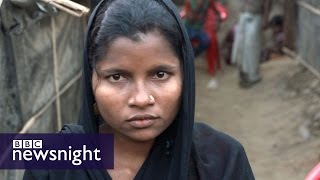
By Jonah Fisher Newsnight and BBC Our World's joint investigation reveals the extent of the appalling treatment of the minority Rohingya Muslim community. Jonah Fisher has this report - which contains some shocking images. ____________________________________________________________________________________________________________________________________________ (c) 2017 BBC Newsnight
- Myanmar Muslim minority subject to horrific torture, UN says
By Jonah Fisher The Rohingya are a Muslim minority group from Myanmar A top UN official says "crimes against humanity" are being committed by the military and police against Myanmar's Rohingya Muslim minority. The UN's special rapporteur for human rights in Myanmar, Yanghee Lee, was speaking as part of a joint BBC Newsnight-BBC Our World investigation. Aung San Suu Kyi, who has been in power almost a year, declined an interview. A spokesman for her party said the allegations were "exaggerated" and an "internal" not "international" issue. Ms Lee has not been given free access to the conflict area in Myanmar. But after speaking to refugees in Bangladesh she told the BBC that the situation was "far worse" than she expected. "I would say crimes against humanity. Definite crimes against humanity... by the Burmese, Myanmar military, the border guards or the police or security forces." She said the problem of abuse was "systemic" within the Burmese security forces, but said that Aung San Suu Kyi's elected government should bear some of the responsibility. "At the end of the day it is the government, the civilian government, that has to answer and respond to these massive cases of horrific torture and very inhumane crimes they have committed against their own people." Former democracy icon Aung San Suu Kyi led the National League for Democracy (NLD) to a majority win in Myanmar's first openly contested election in 25 years in November 2015. More than 70,000 Rohingya - a Muslim minority group from Myanmar - have fled to Bangladesh in the last few months, after a militant attack in October triggered a military crackdown In camps in Bangladesh, the BBC heard allegations from recently arrived Rohingya refugees that the Burmese security forces had shot civilians, and abducted and raped young girls. Many of the refugee accounts are supported by both satellite and video evidence. The BBC has repeatedly asked Ms Suu Kyi for an interview to discuss the Rohingya. Aung San Suu Kyi won elections in 2015 after 15 years of house arrest Although the Myanmar constitution forbids her from becoming president, she is widely seen as de facto leader. But since she won an election landslide 16 months ago, Ms Suu Kyi has not done any interviews with journalists based in Myanmar - international or foreign - or held a meaningful press conference. The spokesman for Ms Suu Kyi's political party, the National League of Democracy, Win Htein, told the BBC that under the current constitution, Ms Suu Kyi did not have the power to get the army to stop. Media captionVideo of the beatings first appeared on Burmese social media, as David Campanale reports Responding to Ms Lee's claims of "crimes against humanity" he said reports of hundreds of dead Rohingya were "exaggerations" and that "sometimes the United Nations is wrong". "As a new government we're just trying to achieve to a modern country. We have thousands of problems. "We don't believe it's crimes against humanity," he added. "It's an internal affair - it's not an international affair." Tens of thousands of Rohingya have fled to Bangladesh in the last few months The Burmese government has set up its own investigation into allegations of abuses. It is led by a former general and has been criticized by Ms Lee for being dominated by military men and for its methodology. On Monday Ms Lee will present her latest findings to the United Nations Human Rights Council in Geneva and will formally call for a Commission of Inquiry to be established, similar to the ones looking at abuses in places like North Korean and Syria. Contacted by the BBC, both the UK and the EU refused to say they would support the establishment of a commission of inquiry. A draft Human Rights Council resolution seen by the BBC proposes a watered down investigation. Many are wary of doing anything that might be seen as undermining Myanmar's elected leader. (C) 2017 BBC News
- Trump and the battle for eastern Syria
By Jonathan Marcus The battle for Mosul may be entering its final phase. The battle for Raqqa is under way. But the battle for the future of eastern Syria is just beginning. This is where the parallel struggles - on the one hand the US-led coalition against so-called Islamic State (IS), and on the other the Assad regime and Iran against a variety of US-backed Kurdish and rebel groups - meet head on. All of the bitterness and complexity of the Syrian conflict is here and with IS increasingly on the back foot - at least in terms of its organised hold on territory - this is where the strategic stakes are growing day by day. This is also where the US risks being drawn ever closer into the Syrian conflict - as the shooting-down of a Syrian warplane that was reportedly bombing US-backed forces near Tabqa, south-west of Raqqa, shows. This is the fourth incident in almost as many weeks where the US has taken military action against elements loyal to the Assad government. Previous incidents were far to the south, near al-Tanf, close to the Syrian border with Iraq, where Iranian-backed allies of President Bashar al-Assad approached a US-designated exclusion zone, within which US troops train and advise rebel forces. The US has presented these actions as being legitimate tactical responses to potential threats to its personnel, or in this latest case "in collective self-defense of coalition-partnered forces". But these "tactical" actions cumulatively risk a step-change in US involvement at a time when many critics of the Trump administration say that it is lacking any over-arching strategy in Syria. Indeed President Donald Trump's willingness to give the Pentagon more leeway in responding to such potential threats only serves to increase the likelihood that such encounters will happen more frequently. There are fears that what strategy the US has - and there are powerful voices in the White House urging further steps to counter Iranian influence in the region - could precipitate a range of unwanted consequences. This, after all, is one of the key factors in the Trump administration's backing of Saudi Arabia's efforts to ostracise Qatar, even though the US maintains its key air base and command centre in the region there. In eastern Syria - specifically in the area near the border with Iraq - US forces have struck Iranian-backed fighters, sending a wider signal that will clearly be heard in Tehran. The fault is by no means all Washington's. It may lack a strategy but it is responding to immediate tactical concerns. Iran is pushing at the envelope and its timing is no accident. Iranian advisers and Iranian-backed militia groups, not least Hezbollah, provide a crucial element of President Assad's fighting strength. With IS up against it, a race is on to see who will dominate the territory it vacates. Iran, already a major influence in Iraq, is eager to consolidate and extend its influence inside Syria. Some analysts have speculated that it would like to establish a "land bridge" between Damascus and Baghdad that would enable the movement of arms and materiel to its allies in Lebanon. But whatever the motivation, Iran clearly intends to capitalise on its support for the Assad regime to achieve lasting influence in Syria. This struggle is also increasing tensions between Washington and Moscow. The Russian ministry of defence's statement in the wake of the shooting down of the Syrian warplane contains much of the usual rhetoric - the charge that the US is violating Syrian sovereignty and breaking international law. But Moscow has also suspended the co-ordination channel set up to avoid clashes between US and Russian forces. The statement carried a threat too - namely that in areas where Russian aircraft are operating, coalition drones and aircraft west of the Euphrates river will be tracked and "treated as targets". It should be noted that the co-ordination mechanism has generally worked well and its operation is as much in Moscow's as Washington's interest. A previous "suspension" of the mechanism by Russia seems to have been by word only - behind the scenes contacts continued. But as the battle for eastern Syria steps up, Russia and its Syrian government ally seem intent on drawing a line in the sky, just as President Assad's ally Iran seeks to draw new lines on the ground ___________________________________________________________________________________________ (c) BBC News
- Japan Marks Hiroshima Anniversary, With North Korea on Its Mind
By Jonathan Soble Attendants observed a minute of silence during the 72nd anniversary memorial service for the atomic bomb victims at the Peace Memorial Park in Hiroshima, Japan, on Sunday.CreditAgence France-Presse — Getty Images Every year in early August, Japanese politicians and peace activists converge on Hiroshima to commemorate the day when the city was devastated by an American atomic bomb. In the famous peace park, the horrors of World War II are vividly recounted. Speakers of all political stripes repeat Japan’s postwar mantra: “Never again.” The familiar reaffirmations of peace were there this year, too, on the 72nd anniversary, with Prime Minister Shinzo Abe on Sunday declaring that Japan, “as the only country to be irradiated in war,” would “firmly advance the movement toward a world without nuclear weapons.” But there was no hiding the tensions straining Japan’s postwar pacifism, as fears over the fast-advancing nuclear program in neighboring North Korea— and political disagreements over how to respond — rose jarringly to the surface. The cenotaph for the victims of the Hiroshima bombing. The city’s appeal of “never again” has gained urgency as North Korea accelerates work on its nuclear weapons program.CreditKyodo/Reuters At a news conference after the official memorial ceremony, a forum normally dominated by reflections on the past and appeals for a peaceful future, a reporter prodded Mr. Abe about the alarmingly here-and-now problem of the nuclear ambitions of the North’s leader, Kim Jong-un. North Korea’s repeated defiance of a ban on testing missiles and nuclear bombs prompted the United Nations Security Council on Saturday to unanimously adopt a resolution imposing the most stringent sanctions yet against the country.At a news conference after the official memorial ceremony, a forum normally dominated by reflections on the past and appeals for a peaceful future, a reporter prodded Mr. Abe about the alarmingly here-and-now problem of the nuclear ambitions of the North’s leader, Kim Jong-un.North Korea’s repeated defiance of a ban on testing missiles and nuclear bombs prompted the United Nations Security Council on Saturday to unanimously adopt a resolution imposing the most stringent sanctions yet against the country. Prime Minister Shinzo Abe delivering a speech during the memorial service on Sunday.CreditAgence France-Presse — Getty Images The reporter asked, Should Japan, whose Constitution renounces war, acquire the means to strike North Korean missile sites if an attack on Japan appeared imminent? It is a topic that has occupied policy makers and defense experts in recent months as Pyongyang, the North’s capital, has stepped up the pace of its missile tests, with pieces of its increasingly sophisticated arsenal splashing down in waters off Japan. But it seemed a remarkable subject for the anniversary in Hiroshima. Mr. Abe’s answer was hardly a comfort to Japanese pacifists. Though he responded that his government was not planning to arm Japan to carry out any pre-emptive strikes, at least for now, he stopped well short of rejecting the idea outright. Thousands stood in the center road near the cenotaph to commemorate the victims on Sunday in Japan. CreditKimimasa Mayama/European Pressphoto Agency “At the present time, we are not planning any specific deliberations about possessing” weapons for a pre-emptive strike, Mr. Abe said. He added that Japan needed to strengthen its defenses generally, “given that the security situation surrounding Japan is becoming increasingly severe.” Although Japan has a military, the Self-Defense Forces, it has forgone certain offense-oriented weapon systems, like long-range missiles and bombers. Such weapons are seen as being incompatible with its Constitution, which was created by occupying American forces after World War II and has been interpreted as allowing Japan to fight only to fend off attacks. Burning incense at the Peace Memorial Park. The United States dropped the bomb on Aug. 6, 1945, in Hiroshima, where 140,000 died. CreditAgence France-Presse — Getty Images Several local news outlets noted the contrast between the occasion and Mr. Abe’s remarks, as did supporters of Japan’s increasingly beleaguered peace movement. “What a thoughtless thing to say in Hiroshima!” said one Twitter user, whose handle translated to “Peace is Number One.” Many experts have questioned whether pre-emptive strikes on North Korean installations would be effective, given that Pyongyang takes countermeasures like keeping its missiles mobile or hiding them deep underground. But that has not stopped some Japanese from arguing that their country should at least have the option to try. As a treaty ally of the United States, Japan relies for its defense on the deterrent power of the Americans’ vast arsenal, including the aircraft carriers, Tomahawk missiles and nuclear weapons that Japan does not possess. That ambivalent stance — rejecting such weapons for itself but approving their deployment by the United States — has also created political friction. “This hell is not a thing of the past,” Hiroshima’s mayor, Kazumi Matsui, said at Sunday’s ceremony. He has urged the prime minister to sign the Treaty on the Prohibition of Nuclear Weapons, which was negotiated at a United Nations conference last month. CreditKimimasa Mayama/European Pressphoto Agency On Sunday, the mayor of Hiroshima, Kazumi Matsui, and survivors groups urged Mr. Abe to sign the Treaty on the Prohibition of Nuclear Weapons, a first-of-its-kind agreement negotiated at a United Nations conference last month. Mr. Abe has declined to support the treaty, arguing that while eliminating nuclear weapons may be desirable, unilateral disarmament by Japanese allies would only aid North Korea and China. “We need a realistic, step-by-step approach,” Mr. Abe said Sunday, “in order to achieve a nuclear-free world.” _________________________________________________________________________________________________________________________________ (c) 2017 The New York Times
- Rohingya crisis: How much power does Aung San Suu Kyi really have?
By Jonathan Head The huge exodus of Rohingya from Myanmar's Rakhine State, and the brutal tactics of the security forces, have stirred up strong condemnations of the Nobel Laureate and de-facto leader, Aung San Suu Kyi, who has defended her government's actions as a legitimate response to terrorism. As it emerges Ms Suu Kyi will miss next week's UN General Assembly debate, how much power does she really have inside her country? Aung San Suu Kyi's formal title is "state counsellor". It is a position she created to get around a clause in the constitution - aimed specifically at her - that bars anyone with a foreign spouse or foreign children from the presidency. Ms Suu Kyi is by far the most popular political figure in Myanmar and she led her National League for Democracy (NLD) to a landslide victory in the 2015 election. She makes most of the important decisions in her party and cabinet. She also holds the position of foreign minister. In practice, the actual president, Htin Kyaw, answers to her. The constitution was drafted by the previous military government, which had been in power in one form or another since 1962. It was approved in a questionable referendum in 2008. At the time, it was not recognised by the NLD or Ms Suu Kyi. It was the key to the military's declared plan to ensure it still had a guiding role in what it called a "discipline-flourishing democracy". Under it, the armed forces are guaranteed one quarter of the seats in parliament. Image captionAlthough Htin Kyaw is Myanmar's president, in practice he answers to Aung San Suu Kyi The military retains control of three vital ministries - home affairs, defence and border affairs. That means it also controls the police. Six out of 11 seats on the powerful National Defence and Security Council, which has the power to suspend democratic government, are military appointees. Former military personnel occupy many top civil positions. The military also still has significant business interests. Defence spending is still 14% of the budget, more than health and education combined. For more than 20 years the military and Aung San Suu Kyi were bitterly opposed. She spent 15 of those years under house arrest. Image captionMs Suu Kyi addresses supporters after her temporary release from house arrest in 1995 After the election, they had to find ways to work together. She had the mandate. The generals had the real power. They still disagreed on important issues, like amending the constitution, which she wants, and the pace of peace talks with the various ethnic armies that have been fighting the government from Myanmar's borders for the past 70 years. But they agreed on the need to reform and improve the economy and the need for stability - "rule of law" is Ms Suu Kyi's favourite mantra - at a time when rapid change has been stirring up social tension. Increasing hostility But on the issue of the Rohingya, Ms Suu Kyi must tread carefully. There is little public sympathy for the Rohingya. Much of the Burmese population agrees with the official view that they are not citizens of Myanmar, but illegal immigrants from Bangladesh, even though many Rohingya families have been in the country for generations. That hostility has increased markedly after the attacks on police posts by militants from the Arakan Rohingya Salvation Army in October last year and this August. Myanmar: Who are the Arakan Rohingya Salvation Army? Inside Rakhine State, the local Buddhist population are even more hostile. Conflict between them and the Rohingya - who they refer to as Bengalis - goes back many decades. Many Rakhine Buddhists believe they will eventually become a minority, and fear that their identity will be destroyed. The Rakhine nationalist party, the ANP, dominates the local assembly, one of the few not controlled by Ms Suu Kyi's NLD. Image captionGen Mn Aung Hlaing has made it clear he has little sympathy for the Rohingyas There is strong sympathy for them among the police - almost half of whose officers are Rakhine Buddhist - and the military. The military is the real power in northern Rakhine State, along the border with Bangladesh, where access is tightly controlled. And the powerful armed forces commander, Gen Min Aung Hlaing, has made it clear he has little sympathy for the Rohingya. Independent media He has referred to the current "clearance" operations there as necessary to finish a problem that dates back to 1942, a period of shifting front lines between Japanese and British forces that saw bitter communal fighting between Rohingya and Rakhine Buddhists. The military sees itself now as fighting an externally funded terrorist movement, a view shared by much of the public. It seems to be applying its "four cuts" strategy, used in other conflict areas, in which soldiers destroy and terrorise communities thought to be giving support to insurgencies. The media is also a factor. One of the biggest changes in Myanmar over the past five years has been the proliferation of new, independent media outlets, and the dramatic growth of mobile phone and internet use, in a country that scarcely had landlines a decade ago. Moral authority? But very few media have shown what is happening inside Bangladesh, or the suffering of the Rohingya. Most have focused instead on displaced Buddhists and Hindus inside Rakhine, who are far fewer in number. The popularity of social media has allowed disinformation and hate speech to spread quickly. Myanmar conflict: Fake photos inflame tension So Aung San Suu Kyi has very little power over events in Rakhine State. And speaking out in support of the Rohingya would almost certainly prompt an angry reaction from Buddhist nationalists. Whether, with her immense moral authority, it might start to change public prejudice against the Rohingya, is an open question. She has calculated that it is a gamble not worth taking. She is known to be very stubborn once she has made up her mind. Image caption Ms Suu Kyi has been widely condemned internationally over the Rohingya crisis Is there a risk that the military might step in and replace her, should she challenge what they are doing in Rakhine? They have the power to do so. In the current climate, they might even have some public support. But it is worth remembering that the current power-sharing arrangements with the NLD are more or less what the military was aiming for when it announced its Seven Stage Roadmap to Democracy back in 2003. At the time this was dismissed as a sham. But it turns out Myanmar's political development over the next 14 years followed that roadmap closely. Even after its own political party was trounced in 2015's election, the military remains by far the most powerful institution in the country. Only this time, it has Aung San Suu Kyi as a shield, to be battered by the international outcry over its actions. _____________________________________________________________________________________________________________________________________________________________ (c) 2017 BBC News
- Southeast Asia summit draft statement skips over Rohingya crisis
A draft of the statement to be issued after a Southeast Asian summit makes no mention of the exodus of Rohingya Muslims from Myanmar’s Rakhine state following a military crackdown that has been described by the United Nations as ethnic cleansing. By John Chalmers Myanmar State Counselor Aung San Suu Kyi attends the opening session of the 31st ASEAN Summit in Manila, Philippines, November 13, 2017. REUTERS/Athit Perawongmetha One paragraph of the communique, seen by Reuters on Monday, mentions the importance of humanitarian relief provided for victims of natural disasters in Vietnam and a recent urban battle with Islamist militants in the Philippines, as well as “affected communities” in northern Rakhine state. The statement was drawn up by the Philippines, current chair of the 10-member Association of Southeast Asian Nations (ASEAN) - which includes Myanmar - whose leaders met for a plenary session in Manila on Monday. The draft did not give any details of the situation in northern Rakhine or use the term Rohingya for the persecuted Muslim minority, which Myanmar leader Aung San Suu Kyi has asked foreign leaders to avoid. The government in mostly-Buddhist Myanmar regards the Rohingya as illegal migrants from Bangladesh and does not recognize the term. Well over 600,000 Rohingya have fled to Bangladesh to find shelter in refugee camps after military clearance operations were launched in response to attacks by Rohingya militants on security posts on Aug. 25. The plight of the Rohingya has brought outrage from around the world and there have been calls for democracy champion Suu Kyi to be stripped of the Nobel peace prize she won in 1991 because she has not condemned the Myanmar military’s actions. From left, Malaysia Prime Minister Najib Razak, Myanmar State Counsellor Aung San Suu Kyi, Thailand Prime Minister Prayuth Chan-ocha, Vietnam Prime Minister Nguyen Xuan Phuc, Philippine President Rodrigo Duterte, Singapore Prime Minister Lee Hsien Loong, Brunei Sultan Hassanal Bolkiah, Cambodia Prime Minister Hun Sen, Indonesia President Joko Widodo and Laos Prime Minister Thongloun Sisoulith, smile during a family photo before the 31st ASEAN Summit in Manila, Philippines on Monday Nov. 13, 2017. REUTERS/Aaron Favila/Pool In September, U.N. Secretary-General Antonio Guterres said the situation in Rakhine was best described as ethnic cleansing. Some members of ASEAN, particularly Muslim-majority Malaysia, have voiced concern. However, in keeping with ASEAN’s principle of non-interference in the internal affairs of one another, the issue appears to have been put aside at the summit. In September, Malaysia disavowed a statement issued by the Philippines on behalf of ASEAN’s foreign ministers as misrepresenting “the reality” because it did not identify the Rohingya as an affected community in Rakhine state. Suu Kyi, who did not mention the crisis in a speech after arriving in Manila on Sunday, criticized ASEAN’s principle of non-interference herself in 1999 when she was fighting for democracy in a country then ruled by a military junta. “This policy of non-interference is just an excuse for not helping,” she wrote in an opinion column in the Thai daily the Nation at the time. “In this day and age, you cannot avoid interference in the matters of other countries.” Roberto Romulo, a former Philippine foreign minister, told the Philippine news channel ANC that there appeared to be no discussion about the Rohingya at the ASEAN summit. “They’re treating with a great deal of respect a discredited Nobel Peace Prize winner like Aung San Suu Kyi,” he said. Amnesty International Philippines representative Wilnor Papa told ANC that the ASEAN leaders would talk about “terrorism and peace and order ... but there are a whole lot of elephants in the room they won’t be talking about, that people are trying to ignore.” _______________________________________________________________________________________________________________________________________________________ (c) 2017 Reuters