Search Results
Search this site
6523 results found with an empty search
- EU set to prepare sanctions on Myanmar generals - diplomats
The European Union will start preparing sanctions against Myanmar generals over killings of Rohingya Muslims by formally calling on the bloc’s foreign policy chief next week to draw up a list of possible names, two diplomats said. Any new travel bans and asset freezes would be the EU’s toughest measures yet to try to hold the military accountable for the abuses, likely joining U.S. and Canadian sanctions already in place. “Ministers will call on (Federica) Mogherini to propose restrictive measures on senior members of the Myanmar military for systematic human rights abuses, without delay,” one diplomat said on Thursday, referring to EU sanctions. Foreign ministers will also ask Mogherini and the EU’s foreign service, the EEAS, on Monday to look at ways to strengthen the bloc’s 1990s-era arms embargo on the Southeast Asian country that remains in place. Myanmar government spokesman Zaw Htay could not be reached for comment. Myanmar military spokesman Major General Tun Tun Nyi when reached by phone did not comment on the EU decision. In a statement expected to be released on Monday at a regular gathering of EU foreign ministers, the bloc is also expected to reiterate its call for the release of Reuters reporters Wa Lone and Kyaw Soe Oo, detained on Dec. 12 over accusations that they violated Myanmar’s Official Secrets Act. The two had been working on a Reuters investigation into the killing of 10 Rohingya Muslim men who were buried in a mass grave in Rakhine state after being hacked to death or shot by ethnic Rakhine Buddhist neighbours and soldiers. No names of generals to be targeted for sanctions have been discussed, the diplomats said, but the United States said in December it was sanctioning Major General Maung Maung Soe, who is accused of a crackdown on the Rohingya minority in Rakhine. EU sanctions lists are often coordinated with Washington. The EU’s decision to consider sanctions reflects resistance to such measures in the U.N. Security Council, where veto-wielding powers Russia and China said this month they believed the situation in Rakhine was stable and under control. The United States, as well as United Nations, have described the military crackdown in Myanmar as “ethnic cleansing”. About 655,000 Rohingya have fled from Rakhine State for shelter over the border in Bangladesh, according to the United Nations. https://uk.reuters.com/article/uk-myanmar-rohingya-eu/eu-set-to-prepare-sanctions-on-myanmar-generals-diplomats-idUKKCN1G6173?rpc=401& (c) 2018 Reuters
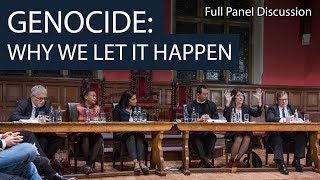
- Genocide: Why We Let It Happen: Panel
Event Start: 29th January 2018, 5:00pm Genocide: Why We Let It Happen Genocide leaves the darkest stain on the conscience of humanity, yet today we are again witnessing international passivity in the face of the genocide in Myanmar. Why have we failed to learn our lesson from these atrocities and why do we allow this stain on our conscience to continue to grow? With Holocaust Memorial Day on Saturday 27 January, we seek to reflect on how to apply the promise of 'never again' David Sheffer: American lawyer and diplomat who, as US Ambassador-at-Large for War Crimes, helped create the International Criminal Tribunals for the former Yugoslavia and Rwanda Alice Musabende : A survivor of the Rwandan genocide, now an expert on the dynamics of peacebuilding in the context of post-conflict countries Mukesh Kapila : As the whistleblower on the Darfur atrocities, he is an expert on genocide prevention and international diplomacy Maung Zarni : A Burmese human rights activist and academic, he has been denounced as an "enemy of the State" for his opposition to the Myanmar genocide Ellen Kennedy : Director at the Centre for Holocaust and Genocide Studies, and founder and Executive Director of World Without Genocide (c) 2018 The Oxford Union
- Myanmar bulldozes what is left of Rohingya Muslim villages
First, their villages were burned to the ground. Now, Myanmar’s government is using bulldozers to literally erase them from the earth — in a vast operation rights groups say is destroying crucial evidence of mass atrocities against the nation’s ethnic Rohingya Muslim minority. Satellite images of Myanmar’s troubled Rakhine state, released to The Associated Press by Colorado-based DigitalGlobe on Friday, show that dozens of empty villages and hamlets have been completely leveled by authorities in recent weeks — far more than previously reported. The villages were all set ablaze in the wake of violence last August, when a brutal clearance operation by security forces drove hundreds of thousands of Rohingya into exile in Bangladesh. While Myanmar’s government claims it’s simply trying to rebuild a devastated region, the operation has raised deep concern among human rights advocates, who say the government is destroying what amounts to scores of crime scenes before any credible investigation takes place. The operation has also horrified the Rohingya, who believe the government is intentionally eviscerating the dwindling remnants of their culture to make it nearly impossible for them to return. One displaced Rohingya woman, whose village was among those razed, said she recently visited her former home in Myin Hlut and was shocked by what she saw. Most houses had been torched last year, but now, “everything is gone, not even the trees are left,” the woman, named Zubairia, told AP by telephone. “They just bulldozed everything … I could hardly recognize it.” The 18-year-old said other homes in the same area that had been abandoned but not damaged were also flattened. “All the memories that I had there are gone,” she said. “They’ve been erased.” Myanmar’s armed forces are accused not just of burning Muslim villages with the help of Buddhist mobs, but of carrying out massacres, rapes and widespread looting. The latest crisis in Rakhine state began in August after Rohingya insurgents launched a series of unprecedented attacks on security posts. https://www.washingtontimes.com/multimedia/image/myanmar_bulldozing_history_81798jpg-39a11jpg/ (c) 2018 The Washington Times
- Syria war: Russia says no agreement on ceasefire resolution
Russia has said there is no agreement on a UN Security Council resolution to bring in a 30-day truce in Syria. Russia's UN ambassador, Vassily Nebenzia, told the council in New York his country had presented amendments. Speaking at an emergency meeting of the council, he called for "feasible" rather than "populist" action. Calls for a truce have grown louder as civilians in the besieged rebel enclave of the Eastern Ghouta come under more intensive bombardment. What does the resolution say? The draft, put forward by Kuwait and Sweden, calls for a 30-day nationwide truce to go into effect 72 hours after adoption. Medical evacuations and aid deliveries would start 48 hours after that. But any ceasefire would not apply to the Islamic State group, al-Qaeda and the al-Nusra Front. Russian Foreign Minister Sergei Lavrov has made clear that Hayat Tahrir al-Sham, an al-Qaeda-linked alliance that has a presence in the Eastern Ghouta, must not be included. Mr Lavrov said he also wanted to exclude rebel groups in the enclave who are "co-operating" with Hayat Tahrir al-Sham and shelling nearby government-held areas. The United States, the UK and France are calling for the resolution to be approved without delay. What are the Russian Objectives? Russia's UN ambassador, whose country is one of the five powers that can veto a resolution, stressed the need for something that would actually work. "The ceasefire carries great significance in principle and not merely for the delivery of humanitarian assistance," he said. "The challenge is how to achieve this. And here what we need is not symbolism, not decisions for the sake of decisions, but rather measures that are undertaken that are commensurate with conditions on the ground." Russia is a key backer of Syria's President Basher al-Assad in the civil war and the suspicion among Western powers is that Moscow is stalling to allow their ally to deal a final blow to rebel forces. Deputy US ambassador to the UN Kelley Currie accused Russia of standing in the way of "any meaningful effort" to halt the fighting in the Eastern Ghouta. how bad is the situation in Eastern Ghouta? For the fifth day running, Syrian government forces carried out a wave of air and artillery strikes. The number killed since Sunday has risen to at least 403, the Syrian Observatory for Human Rights monitoring group says, as 46 more died on Thursday. Barrel bombs and shell fire have rained down in what the UN has described as "hell on earth" for the 393,000 people trapped there. The Syria Civil Defence, whose rescue workers are widely known as the White Helmets, said residential areas in the town of Douma came under sustained attack, first from ground-to-ground rockets and then government and Russian jets. Spokesman Siraj Mahmoud also asserted that the organisation was being deliberately targeted by government aircraft, with four rescuers killed since Sunday night. "Everyone knows it is an extermination," he told the Associated Press. The Syrian state news agency meanwhile reported that a child was killed and six civilians wounded in the government-controlled Barzeh district of Damascus by rebel shellfire. Army units responded with "precision strikes", destroying a number of rebel positions and inflicting heavy losses, it said. The UN humanitarian co-ordinator for Syria, Panos Moumtzis, echoed calls for a ceasefire. Referring to the harrowing images coming out of the Eastern Ghouta, he said: "If this is not going to convince [UN security] council members, council states, of the need for a ceasefire, honestly we don't know what is it that would convince them." The Syrian government has denied targeting civilians and insisted it is trying to liberate the Eastern Ghouta from "terrorists" - a term it has used to describe both jihadist militants and the mainstream rebel groups that dominate the enclave. Aid groups report dozens of hospitals being put out of action since Sunday. Médecins Sans Frontières (MSF) said the government's siege was also preventing medics from obtaining essential life-saving supplies, warning that its facilities had completely run out of supplies of blood bags, general anaesthetic drugs and intravenous antibiotics. Separately, Iran's Deputy Foreign Minister, Abbas Araghchi, has told the BBC "fear of war is everywhere in our region" and at the same time described the situation with Iran's Syrian ally as "very complicated". http://www.bbc.com/news/world-middle-east-43155105 (c) 2018 BBC
- Poland’s new ‘Holocaust law’ comes up against massacre of Jews in 1941
JEDWABNE, Poland — The Jews who survived the axes were burned alive in a barn on the outskirts of town. The Germans had just recaptured the area from the Soviets, but it was not the Germans who bolted the doors, poured the gasoline and lit the fire. On July 10, 1941, villagers here turned against their neighbors — although some would later claim they were taking orders from the Germans. Szczepan Sulewski, a retired baker, remembers running over from a neighboring village to watch the incineration of the Jews. Now 88, he does not remember why the Jews had to burn; he remembers only the screams and how difficult it was, as a boy of 10, to catch a glimpse of the fire. “Everybody lived well with the Jews,” he said in his living room filled with cigarette smoke. A nervous grin played on his face. “You could do business with the Jews.” What happened at Jedwabne, where more than 300 Jews perished, profoundly challenges a national narrative that portrays Poland as a victim: first of Nazi Germany, then of Soviet Russia. Disputes over the massacre seemed to reach an uneasy truce more than a decade ago, but a new “Holocaust law” has exploded the powder keg of historical memory again. All of a sudden, it seems, Jedwabne never happened. The muddy path to the barn is yet another road to nowhere. Starting in March, publicly invoking Polish complicity in Nazi atrocities will be a punishable offense. Israel has likened the provision to “Holocaust denial,” and the United States says it is an attack on “academic inquiry.” In no small fashion, the law has thrust Poland into a bitter debate over the nature of its history and, to an even greater extent, the nature of its identity. “There is no nation that has a totally clear conscience,” said Adam Michnik, 71, the editor in chief of the Gazeta Wyborcza, Poland’s largest daily newspaper and a former leader of the anti-Communist opposition. “Every nation had its Ku Klux Klan, and this was ours.” The government disagrees: Poland is a nation of victims, and victims only. Since it rose to power in 2015, the populist right-wing Law and Justice party has shown a clear interest in reshaping the way history is presented and understood. In the past two years, the government has sanitized the Museum of the Second World War in Gdansk to emphasize Polish heroism, commissioned a new Warsaw museum to venerate the “cursed soldiers” who continued fighting Communism after 1945, and sought to recast the history of the Solidarity movement. “Currently, the history of World War II in the West concentrates on the Holocaust. But other aspects — other victims — are forgotten,” said Mateusz Szpytma, the deputy president of Poland’s Institute of National Remembrance, a government-funded research organization devoted to investigating crimes committed on Polish soil between 1939 and 1989. “As a nation, we as Poles — we are the victims of the Second World War, but if you emphasize only our negative relations with the Jews, and in such articles where the only word used is ‘Nazi’ and not ‘German,’ what you’re seeing now is essentially a self-defense mechanism,” he said. Polish identity has leaned heavily on collective suffering and even a sense of martyrdom, sociologists say. In the 19th century, the romantic poet Adam Mickiewicz, a towering figure here who is a mainstay on nearly every school reading list, called his perennially occupied country the “Christ of Nations” whose suffering would somehow save Europe. Many appear to have internalized the metaphor. As elsewhere in Eastern Europe, 45 years of Communist rule also took a toll on the Polish view of history: The postwar government exploited anti-Nazi sentiment, invoking a black-and-white version of a war against foreign fascism. Even in the face of naked Polish anti-Semitism — as in the 1946 Kielce pogrom and a 1968 anti-Jewish purge — the collective understanding of the past never strayed far from Polish victimhood. “National narratives — national mythologies — are very difficult to change,” said Geneviève Zubrzycki, a sociologist who has written extensively on nationalism and religion in postwar Poland. “It’s very difficult to be both martyr and perpetrator.” Similar controversies, Zubrzycki said, have erupted for decades: The Carmelite nuns who opened a convent near Auschwitz in the mid-1980s and the crosses displayed at Auschwitz in the late 1990s were attempts to assert Polish control over a place the world had declared a site of Jewish suffering. But the new “Holocaust law” represents a “crucial difference,” said the historian Jan Gross, whose best-selling 2000 book on the Jedwabne massacre, “Neighbors,” triggered the most intense debate over Poland’s wartime past, at least until now. “You have now empowered a regime that is openly drawing on xenophobic nationalism in Polish society as a means of legitimizing its power,” he said in a telephone interview. “And the main pull of this xenophobic nationalism is anti-Semitism.” This, for many historians, is the root of the law — which, they say, subtly and falsely equates Polish and Jewish suffering. “Every Jew who was born a Jew was doomed to die. That wasn’t the case with the Poles,” said Pawel Spiewak, the director of the Jewish Historical Institute in Warsaw. Then there are the numbers. The government says 6 million Polish citizens were killed during the war — a figure often cited to show the immensity of Polish suffering, one that some scholars see as imprecise but that conveniently matches the approximate number of Jews murdered in the Holocaust. But of that number, 3 million to 3.2 million were Jewish Poles. Given that nearly 10 percent of Poland’s prewar total population was Jewish, many scholars object to any separation of Jewish history from Polish history in that period. “One of the stunning things is that the Holocaust has been mentally externalized for Poles,” Gross said. “It’s as if something happened to ‘them,’ not to ‘us,’ even though it’s really the most dramatic episode of Polish history — 3 million Polish citizens were killed in the most brutal way imaginable, in a very short span of time. But in common parlance, this is somehow the story of someone else, of non-Poles.” Anna Zalewska, Poland’s minister of education, has described Jedwabne on national television as an event that has engendered “many understandings and very biased opinions.” A new high school curriculum devotes 15 lessons to World War II — only one of which deals with the Holocaust. Many educators fear a rising tide of revisionism. “When we read the curriculum, what we see is either that we were brave and good or that we lost everything in dramatic circumstances — that’s the picture of Poles we get. There’s no grayness,” said Slawomir Broniarz, the president of the Polish teachers union, which has formally condemned the new law. “Suddenly we are back to Communist times, and everything is ideology.” Jan Wróbel, a popular journalist who also teaches history in a Warsaw charter school, said that the government’s obsession with World War II reminds him of his own days as a student — and of how much potential there can be for jarring misconceptions. “I’m 54. In my school, which was a normal Polish school, I generally thought that in Auschwitz most of the victims were Polish,” he said. “I can’t remember the moment anyone told me that, but it was never clear that it was predominantly Jews.” Some teachers say they will continue discussing Jedwabne and other examples of Polish complicity in the Holocaust. “I just tell them that the Poles were there, and that they committed this crime — and that this is all based on facts, on sources,” said Artur Sierawski, who teaches history in a Warsaw public high school. “Usually they’re surprised, and silent for a while.” But the urban-rural divide is as strong in Poland as everywhere, and Jedwabne — today a town of fewer than 3,000 inhabitants — is far from Warsaw. Teachers here applaud the new law as a corrective that will end what they see as the smearing of their home. “If someone asks us what happened here, what should we say? I tell them about the Soviet occupation, that the Jews worked with the Soviets, that they greeted the Soviets with flowers,” said Stanislaw Zebrowski, 57, who teaches history in a nearby middle school. The belief that Jews overwhelmingly sided with the Soviets is deeply ingrained in Polish narratives of the war. But it remains a matter of contentious debate among historians, given that Jews also suffered handily under Soviet occupation. The Jews, Zebrowski said, “helped the Soviets by pointing out people who were later sent to camps in Siberia.” Members of his own family were among those deported, and he said that Jews probably had been responsible. “I don’t feel bad about that,” he was quick to add. © 2018 | The Washington Post
- Banned UN Envoy, Rohingya Activists to Join Conference on 'Myanmar Genocide'
The UN’s special envoy on human rights in Myanmar will deliver a keynote address at an international conference in Berlin on Monday to push European leaders to do more for the beleaguered Rohingya. According to a description of the event by its organizers, “The Berlin Conference on Myanmar Genocide aims to inform German civil society and European public about the ongoing genocide of Rohingya people in Myanmar. “It is hoped that the conference will help influence public opinion, which in turn will demand the EU leaders take their shared political and human responsibility in order to make the call ‘never again!’ a reality.” The conference will be joined by international scholars, human rights activists and Rohingya lobbyists based outside of Myanmar. Yanghee Lee, the UN’s human rights envoy to Myanmar, was barred from returning to the country in December after the civilian government and the military accused her of biased reporting on the crisis in Rakhine State in favor of the Rohingya. The special rapporteur’s mandate requires two visits to Myanmar a year in order to report to the UN Human Rights Council and General Assembly. Since taking up the post in June 2014, Ms. Lee has visited Myanmar six times. She recently told the UK’s Channel 4 News that there were grounds for bringing Myanmar’s de facto leader, Daw Aung San Suu Kyi, before an international tribunal for failing to intervene in the “clearance operation” the military launched in Rakhine following militant attacks on several police posts and an army base on Aug. 25 that killed 11 security personnel. The military crackdown that followed the attacks has driven some 690,000 Muslim Rohingya to seek refuge in neighboring Bangladesh amid reports of arson, murder and rape targeting their communities. Others joining the Berlin conference for discussions on a multicultural society and ending genocide in Myanmar will include Harn Yawnghwe, executive director of the Brussels-based Euro-Burma Office, and Maung Zarni, a Buddhist Rohingya lobbyist. Harn Yawnghwe is the son of Myanmar’s first president, Sao Shwe Thaike. His organization provides funding to ethnic and civil society organizations in Myanmar. He attracted criticism from within Myanmar last year for suggesting that the government hold talks with the Arakan Rohingya Salvation Army, which organized the August attacks.. He was also attacked for being a Rohingya lobbyist based on pictures of him with other Rohingya and members of the Organization of Islamic Cooperation at a meeting on the Rohingya crisis in Saudi Arabia. In an interview with The Irrawaddy last year, Harn Yawnghwe said that meeting was in 2010 and that it was meant to persuade the Rohingya to eschew terrorism and seek a political solution to their problems. The conference will also be joined by other Rohingya activists including Ro Nay San Lwin, editor of Rohingya Blogger, Ro Hla Kyaw, of the European Rohingya Council in The Netherlands, and Ro Tun Khin, president of the Burmese Rohingya Organization UK. Separately, more than 100 UK parliamentarians have called on their government to declare that Myanmar’s military should be referred to the International Criminal Court for its “security operations” in Rakhine, which the UN’s human rights office has described as ethnic cleansing and possibly genocide. They wrote to UK Foreign Secretary Boris Johnson on Wednesday seeking measures in line with their call, according to Bangladeshi media reports. “It’s time for the British government to unequivocally state that the situation in Myanmar should be referred to the International Criminal Court,” they said. https://www.irrawaddy.com/news/burma/banned-un-envoy-rohingya-activists-to-join-conference-on-myanmar-genocide.html (c) 2018 Irrawaddy
- Saudi Arabia and the UAE are gobbling up Yemen
BRIGHTLY painted dhows bob on the waves of the Arabian Sea. Fishermen auction the morning’s catch of swordfish, tuna and manta rays. Sardines dry in the sun, fodder for the camels that pad through the street. Life used to be simple in the port of Ghayda, the capital of Mahra governorate, tucked in Yemen’s far east. The arrival of soldiers from Saudi Arabia and the United Arab Emirates (UAE) is complicating things. Abd Rabbo Mansour Hadi, Yemen’s president, invited them into the country to repel Houthi rebels, who pushed him out in 2015. The Houthis control about a fifth of the territory. Saudi and Emirati forces hold much of the rest. But as their grip tightens, Yemen fractures. Saudi and Emirati officials say their deployments across the country are part of their war effort. But join the dots and Saudi Arabia’s positions match the incense trade route that long ran overland from the Indian Ocean to Arabia. The kingdom appears to be carving a new corridor to the coast. Meanwhile, the UAE’s actions in Yemen appear part of a larger strategy to gobble up ports along some of the world’s busiest shipping routes. The Saudis, operating out of Ghayda’s airport, which they took in November, have bought favour with tribal sheikhs in the east and south by dispensing weapons, cars and Saudi passports. They aim to block Iranian arms shipments at the seaport. In Seiyun, to the west, they train fighters loyal to Mr Hadi. They are also working closely with Ali Mohsen, Yemen’s vice president, and his allies in Islah, an Islamist movement, to rebuild Yemen’s army, which the Houthis routed when they took the capital, Sana’a, in 2014. Source: Reuters The UAE has been even more active. Early last year the Emirates Red Crescent launched a humanitarian mission in Ghayda—by August the Emirati army had taken over the mission. The UAE has captured a string of southern ports, such as Mukalla, Aden and Mokha. It controls Yemen’s only gas-liquefaction plant, at Balhaf, and an oil-export terminal, at al-Shihr. The strategic island of Socotra looks increasingly like an Emirati base. The UAE also runs two military camps in the remote Hadramawt region, where its troops have trained some 25,000 local fighters. In securing the ports, say analysts, the UAE’s goal is to enhance the position of its own port at Jebel Ali, the region’s largest, either by stifling competition or directing traffic in its direction. Many welcome the Saudis and Emiratis. “Forget such outmoded notions of sovereignty,” says Abdelhadi Tamimi, an official in Hadramawt. “We can all profit from trade.” The UAE is financing hospitals and a new power plant in the energy-starved region. Officials in Seiyun hail a new counter-terrorism force, trained by the Saudis, as a bulwark against al-Qaeda. Locals also say Emirati-trained fighters are more disciplined than Yemeni soldiers and fleece them less at checkpoints. But others fear a creeping loss of control. The Saudis and Emiratis run their own detention centres and keep local officials in the dark. Smugglers in Mahra complain of a loss of business, as the newcomers crack down. Many in the region speak Mahri, an ancient Semitic tongue, and fear that the Gulfies will impose Arabic. The handing out of passports causes alarm. Socotra has 60,000 people and Mahra perhaps 160,000. In theory both could be annexed. Meanwhile, tension is increasing between Saudi and Emirati proxies. While Saudi Arabia seeks to stand up the old northern-based army under Mr Mohsen, the UAE trains fighters from the south, many of whom would like to re-establish South Yemen, which merged with the more populous north in 1990. Emirati-backed separatists took control of Aden last month. Some believe the move had Saudi assent and is part of a divide-and-rule strategy by the two Gulf states. The many new Gulf-backed militias are accelerating Yemen’s fragmentation. Tribal leaders are exploiting the chaos. Pretenders claiming to represent the duwailat, or principalities, that made up the British protectorate of Aden are dusting off old flags. A self-declared council led by Abdullah al-Afrar, who calls himself sultan of Mahra and Socotra, has vowed to resist the Saudi-led “occupation”. “We fear Yemen will never be united again,” says Mr Afrar. (c) 2018 The Economist
- PEN slams Turkey’s ‘repression’ of Kurdish language, culture
As the world is celebrating International Mother Language Day, a global association of writers is condemning Turkey’s “sustained repression of Kurdish culture and language.” PEN International slammed Turkey for its crackdown on Kurdish media, the “principal victims” in widespread arrests and restrictions imposed after the July 2016 attempted coup and following the breakdown of the PKK peace process. “Most pro-Kurdish and Kurdish-language media outlets have now been closed down” and some 50 Kurdish journalists are in jail, PEN stated. International Mother Language Day was introduced by the United Nations in 2000 “to promote linguistic and cultural diversity and multilingualism.” The theme of this year’s day is promoting development through linguistic diversity. “To foster sustainable development, learners must have access to education in their mother tongue and in other languages,” the UN stated. “Local languages, especially minority and indigenous, transmit cultures, values and traditional knowledge, thus play an important role in promoting sustainable futures.” http://www.rudaw.net/english/middleeast/turkey/21022018 (c) 2018 Rudaw
- Vectors of Violence: Persecution and Complacency in Nazi Germany and the Great Plains
Vectors of Violence: Persecution and Complacency in Nazi Germany and the Great Plains Although different in many ways, the history of racism in Nazi Germany and the Plains region of the United States illuminates some universal phenomena that manifested in distinct historic persecution of individuals considered “others” in society. Join us in Omaha for this important conversation on Tuesday, March 27, and Wednesday, March 28. Tuesday, March 27, 7 p.m. Panel Discussion Power, Persecution, and Pain: Reflections on Violence in Society Wednesday, March 28, 9:30 a.m. Pedagogy Roundtable Approaching Difficult Topics in the Classroom Barbara Weitz Community Engagement Center, Room 201 6400 South, University Drive Road North University of Nebraska Omaha Omaha, Nebraska On Wednesday at 1 p.m., participants are invited to stay for a consultation with staff about Museum resources and to discuss the most effective programming for their campuses. These programs are free and open to the public. Reserve your seat and view the full agenda. For more information, please contact Dr. Kierra Crago-Schneider at kcrago-schneider@ushmm.org or Kasey De Goey at kaseydavis@unomaha.edu. This program is made possible by a generous grant from the Robert and Myra Kraft Family Foundation to the United States Holocaust Memorial Museum. This event is also co-sponsored by the Sam & Frances Fried Holocaust & Genocide Academy in conjunction with the University of Nebraska Omaha. Keep Holocaust memory alive to inspire citizens and leaders to confront hatred, prevent genocide, and promote human dignity in a constantly changing world. Visit ushmm.org/campaign to learn more. Change Your Email Preferences Tell Us How We Are Doing Share your feedback on the Museum's email content and how we may better serve you. Fill out the survey. Unsubscribe | Update Your Preferences | Contact Us | Privacy Policy You are receiving this message because president@genocidewatch.org subscribed to our email list. Staying active on the US Holocaust Memorial Museum's email list is the best way we have to stay in contact with supporters like you. Thank you for being a critical part of our work. UNITED STATES HOLOCAUST MEMORIAL MUSEUM 100 Raoul Wallenberg Place, SW Washington, DC 20024-2126 Main telephone: 202.488.0400 TTY: 202.488.0406 (c) 2018 The United States Holocaust Memorial Museum
- Amnesty's Annual Report Offers a Scathing Assessment of the World's Human Rights
The survey of 159 countries and territories accuses governments across the globe of “shamelessly” backsliding on human rights, cracking down on dissent, and instituting measures that ensured the further persecution of marginalized groups throughout 2017. In last year’s report, Amnesty said the big question was how far the world would let atrocities go before intervening. The tragic answer arrived in Myanmar, where, the rights watchdog says, world leaders failed to stop the consequences of normalized discrimination and scapegoating as mass atrocities unfolded. The military’s ethnic cleansing campaign sent nearly 700,000 Muslim Rohingya fleeing across the border to neighboring Bangladesh. Survivors have testified to witnessing mass slaughter, systematic sexualized violence and the deliberate razing of their villages. “The appalling injustices meted out to the Rohingya may have been especially visible in 2017, but the trend of leaders and politicians demonizing whole groups of people based on their identity reverberated across the globe,” it says. Roseann Rife, Amnesty’s East Asia research director, said, “It’s been clear from the conflicts in Syria and Myanmar that when the international community is reluctant to step in and intervene, we see these atrocities escalate.” She added that under Trump, the U.S. has moved away from advocating for human rights, and no other world leaders have stepped in “to fill that void.” Trump has attacked the rights of women and girls, migrants and refugees and members of the LGBTI community since his inauguration on Jan. 20 last year, the report alleges. The Trump administration’s decision to ban entry to people from six Muslim-majority countries was “transparently hateful,” and set a precedent for the year, Salil Shetty, secretary general of Amnesty International, said in a statement. However, as world leaders like “Duterte, Maduro, Putin, Trump and Xi are callously undermining the rights of millions,” activists have pushed back and mobilized in greater numbers, Amnesty says. International protest movements like the Women’s March and #MeToo, and mass demonstrations in Poland, Zimbabwe and India all reflect what the report termed “a new era of social activism.” At the same time, Amnesty warns that as we enter 2018, the 70th anniversary of the Universal Declaration of Human Rights, and even the continued right to peaceful protest cannot be guaranteed, or taken for granted. “Governments think they can declare open season on human rights activists. They may shut down our newspapers, undermine judges and jail activists, but we refuse to be silenced,” said Shetty. http://time.com/5167995/amnesty-2018-state-of-worlds-human-rights-report/ (c) 2018 Time
- Violated! Women in Holocaust and Genocide
A GROUP ART EXHIBITION BY REMEMBER THE WOMEN INSTITUTE Ronald Feldman Gallery 31 Mercer Street SoHo New York City April 12-May 12, 2018 SAVE THE DATE The exhibition opens to the public at the Ronald Feldman Gallery, 31 Mercer Street, SoHo, 6 PM on Thursday, April 12 -Yom HaShoah, continuing for a month Remember the Women Institute invites you to our trailblazing art exhibition that includes two artworks done inside Nazi concentration camps. These two small drawings, created in secret and borrowed from the Ghetto Fighters' House, Israel, join works by 28 other artists, including world renowned Judy Chicago, Nancy Spero, and Boris Lurie. The 47 cutting-edge works addressing sexual violation in a variety of media and styles are by artists from Israel, the United States, and elsewhere. The artists are: Rostam Aghala, Ofri Akavia, Judy Chicago, Ayana Friedman, Regina José Galindo, Nechama Golan, Muriel (Nezhnie) Helfman, Shosh Kormosh, Mitch Lewis, Judith Weinshall Liberman, Ella Liebermann-Shiber,Boris Lurie, Haim Maor, Naomi Markel, Anat Masad, Mary Mihelic, Dvora Morag, Halina Olomucki, Zeev Porath (Wilhelm Ochs), Rachel Roggel, Manasse Shingiro, Hana Shir, Li Shir, Nancy Spero, Linda Stein, Yocheved Weinfeld, Gil Yefman, Gil Yefman with the Kuchinate African Refugee Women's Collective, Racheli Yosef, Safet Zec, and Dvora (Veg) Zelichov. SAVE THE DATE' Join us for an afternoon of theater at 2:00 PM, Sunday, April 15, at the Ronald Feldman Gallery Events presented during the exhibition include a matinee of dramatic readings at 2:00 PM on Sunday, April 15. The readings are: The Spoken and the Unspoken, a play written by Cynthia L. Cooper that dramatizes our work about sexual violence during the Holocaust; and excerpts from In the Underworld, written by Germaine Tillion in the Ravensbrück women's concentration camp and performed by the students of Dr. Meghan Brodie, Ursinus College. The presentation is part of the National Jewish Theater Foundation/Holocaust Theater International Initiative Remembrance Readings. (Details about the program and reserving your place are forthcoming.) Exhibition Team: Exhibition Curator Dr. Batya Brutin, Exhibition Coordinator Dr. Rochelle G. Saidel, with Rebecca Pristoop, Dr. Sonja Hedgepeth, and Karen Shulman. Exhibition Honorary Committee: Dr. Constance Chen, Dr. Susan Chevlowe, Elissa Cohen, Joan Dean, Dr. Eva Fogelman, Marisa Fox-Bevilacqua, Patti Kenner, Hon. Carolyn B. Maloney, Mindy Mangot, Jessica Neuwirth, Consolee Nishimwe, Hon. Amy R. Paulin, Letty Cottin Pogrebin, Dr. Julie Ratner, Jean Bloch Rosensaft, Hon. Linda B. Rosenthal, Sheri Sandler, Shiri Sandler, Rachel Lulov Segall , Lorraine Sheinberg, Gloria Steinem, Marcy Syms, Diane Von Furstenberg, Jenny Warburg, Lynda Weinman Exhibition Institutional Partners: Cardozo Law Institute in Holocaust and Human Rights; Consulate General of Israel, New York; Free Yezidi Foundation; Genocide Survivors Foundation; Ghetto Fighters' House (Lohamei Haghetaot); Kuchinate Workshop; Kupferberg Holocaust Center at Queensborough Community College, CUNY; Ronald Feldman Gallery; Yahad-In Unum The exhibition is being funded by tax-deductible gifts to Remember the Women Institute, a 501(c)(3) not-for-profit organization. (c) 2018 Remember the Women Institute
- In solidarity with Civil Society in Hungary
On 13 February 2018, the Hungarian government tabled to Parliament a proposed legislative pack of three laws, commonly referred to as “Stop Soros”. The newly proposed legislation would further restrict Hungarian civil society ability to carry out their work, by requiring organizations that “support migration” to obtain national security clearance and a government permit to perform basic functions. The proposed law would also require organizations to pay a tax of 25% of any foreign funding aimed at “supporting migration”. Failure to do so, would subject them to steps so serious that they could lead to exorbitant fines, bankruptcy, and the dissolving of the NGO involved. These come in a context of already shrinking space for civil society in Hungary and contravene Hungary’s obligations under international law to protect the right to freedom of association, expression and movement. We believe the new proposals represent the latest initiative in the Hungarian government's escalating effort to crackdown on the legitimate work of civil society groups in Hungary seeking to promote and defend human rights, provide legal and social services to people in need in the country, and publicly express dissenting opinions in the press and online. As defenders of rights and freedoms, we want people everywhere to be able to speak out without being attacked, threatened or jailed. Open debate on matters relating to government policies and practice is necessary in every society, and human rights defenders should not face criminalization for voicing their sometimes dissenting voices. Countries need to put laws in place which keep human rights defenders safe from harm, rather than introducing repressive laws that aim to silence those who speak out. Human rights defenders defend the rights of people in their own communities and their countries, and in doing so they protect all of our rights, globally. Human rights defenders are often the last line of defence for a free and just society and undertake immense personal risks and sacrifices to do their work. We stand in solidarity with civil society and human rights defenders in Hungary. They are courageous people, committed to creating a fairer society. Without their courage, the world we live in would be less fair, less just and less equal. We are calling on the Hungarian Parliament to reject the proposed laws in their entirety and let the NGOs and defenders continue their work, instead of defending themselves against such attacks. The below listed organizations declare their support and solidarity with non-governmental organizations and human rights defenders in Hungary: ILGA – Europe Civil Liberties Union for Europe (Liberties) Human Rights Watch AEDH - Association Europeenne de Droits de l'Homme FIDH, within the framework of the Observatory for the Protection of Human Rights Defenders World Organisation against Torture, within the framework of the Observatory for the Protection of Human Rights Defenders Light for the World Funders’ Initiative for Civil Society Urgent Action Fund for Women's Human Rights CONCORD - European Confederation of Relief and development NGOs Human Rights First Transgender Europe Greenpeace Central and Eastern Europe International Civil Society Centre Reporters sans Frontières ENAR - European Network Against Racism European Volunteer Centre Civil Society Europe Protection International - Belgium çavaria vzw - Belgium 11.11.11. - Belgium Artsen zonder Vakantie – Belgium Vluchtelingenwerk Vlaanderen - Belgium Liga voor mensenrechten – Belgium WWF Belgium - Belgium ACAT - Belgique/ Belgie/ Belgium Volonteurope Belgium - Belgium CROSOL - Croatian Platform for International Citizen Solidarity - Croatia Centre for Peace Studies from Zagreb – Croatia GONG – Croatia Brod Ecological Society-BED - Croatia Documenta – Center for Dealing with the Past – Croatia CESI-Center for Education, Counselling and Research – Croatia Human Rights House Zagreb – Croatia Rehabilitation center for stress and trauma – Croatia Adra Česká republika – Czech Republic Open Society Fund/ Nadace OSF Praha – Czech Republic Transparency International ČR– Czech Republic Člověk v tísni – People in Need – Czech Republic Forum 2000 - The Forum 2000 Foundation - Czech Republic META – Společnost pro příležitosti mladých migrantů - Association for opportunities of young migrants - Czech Republic Most pro o.p.s. - poradna pro cizince – Czech Republic SIMI – Sdružení pro integraci a migraci – Association for integration and migration- Czech Republic Glopolis – Glopolis - Czech Republic Centrum pro integraci cizinců - Centre for Integration of Foreigners - Czech Republic Diakonie (Českobratrské církve evangelické) – Diaconia (Evangelical Church of Czech Brethren) - Czech Republic Most - Czech Republic Konsorcium nevládních organizací pracujících s migranty – Consortium of Migrants Assisting Organizations - Czech Republic DEMAS – Association for Democracy Assistance and Human Rights - Asociace pro podporu demokracie a lidských práv - Czech Republic Pavel Havlicek, Analyst at the Research Centre, Association for International Affairs Prague, Czech Republic Organizace pro pomoc uprchlíkům – Organization for aid to refugees Denmark Nyt Europa – Denmark Kehitysmaayhdistys Pääskyt ry - Finland Suomen Pakolaisapu | Finnish Refugee Council - Finland ETMU ry (Society for the Study of Ethnic Relations and International Migration) - Finland Suomen Nuorisoyhteistyö – Allianssi ry - Finland Suomen Setlementtiliitto - Finland Ensi- ja turvakotien liitto - Finland Suomen Mielenterveysseura ry - Finland Ihmisoikeusliitto ry - Finnish League for Human Rights - Finland Kehitysyhteistyöjärjestöjen EU-yhdistys Kehys ry - The Finnish NGDO Platform to the EU Kehys - Finland Vammaisten perus- ja ihmisoikeusjärjestö Kynnys ry - Finland Suomen somalialaisten liitto - Finland Seta LGBTIQ Rights in Finland - Finland Trasek ry - Finland LSVD – Germany HES – Germany ADRA Deutschland e.V - Germany BAfF e.V.-Bundesweite Arbeitsgemeinschaft Psychosozialer Zentren für Flüchtlinge und Folteropfer - Germany Forum Menschenrechte - Germany VENRO - Verband Entwicklungspolitik und humanitäre Hilfe deutscher Nichtregierungsorganisationen e.V. - Germany Solidaritätsdienst International e.V. (SODI) - Germany Adivasi-Koordination in Deutschland e.V. - Germany ACAT-Deutschland e.V. - Germany Missionsärztliches Institut Würzburg - Germany Deutsches Medikamenten-Hilfswerk action medeor e.V. - Germany Deutsche Kommission Justitia et Pax - Germany Germanwatch e.V. - Germany Welthaus Bielefeld e.V. – Germany Civil Liberties Union for Europe e.V." - Germany CILD - Italian Civil Liberties Advocacy Coalition – Italy Dr Andrea Gullotta, Memorial Italia Italy Antigone - Italy Front Line Defenders – Ireland Irish Nurses and Midwives organisation – Ireland Christian Aid Ireland – Ireland Transgender Equality Network Ireland - Ireland Latvian Platform for Development Cooperation - Latvia Latvia's Association for Family Planning and Sexual Health – Latvia ASTI (Association de Soutien aux Travailleurs Immigrés) - Luxembourg Passerell - Luxembourg ACAT Luxemburg - Luxembourg Reech eng Hand - Luxembourg Caritas Luxembourg - Luxembourg Aidsfonds – Netherlands Amsterdamse Diakonie – Netherlands Article 19 – Netherlands ASKV - Steunpunt Vluchtelingen – Netherlands Blikopeners – Netherlands Civicus – Netherlands Clara Wichmannfonds – Netherlands Dance4Life – Netherlands Dutch section of the International Commission of Jurists (NJCM) – Netherlands Free Press Unlimited – Netherlands Humanistisch Verbond – Netherlands Humanity House – Netherlands IMMO - instituut voor Mensenrechten en Medisch Onderzoek – Netherlands INLIA - International Network of Local Initiatives with Asylumseekers – Netherlands Justice and Peace Project – Netherlands KOMPASS – Netherlands La Strada - Netherlands Libereco - Partnership for Human Rights – Netherlands Milieudefensie – Netherlands Movies that Matter – Netherlands Netherlands Helsinki Committee – Netherlands Foundation Max van der Stoel - Netherlands NVJ - Nederlandse Vereniging van Journalisten – Netherlands Oxfam – Netherlands Partizan Publik – Netherlands Pax – Netherlands Power of Art House – Netherlands Privacy First – Netherlands Prospector – Netherlands Stichting LOS - Landelijk Ongedocumenteerden Steunpunt – Netherlands Stichting Vluchteling – Netherlands Stichting voor Vluchteling-Studenten – UAF – Netherlands The Amsterdam Gay Pride – Netherlands The Hague Peace Projects – Netherlands Transnational Institute (TNI) – Netherlands VLot - fonds voor vluchtelingen – Netherlands VluchtelingenWerk NL - Netherlands Fundacja im. Stefana Batorego - Poland Sieć Obywatelska Watchdog Polska - Poland Projekt: Polska - Poland Stowarzyszenie przeciw Antysemityzmowi i Ksenofobii Otwarta Rzeczpospolita - Poland Stowarzyszenie Interwencji Prawnej - Poland Instytut Spraw Publicznych - Poland Fundacja ePaństwo - Poland Panoptykon - Poland Polskie Towarzystwo Prawa Antydyskryminacyjnego - Poland Fundacja Pole Dialogu - Poland Polski Instytut Praw Człowieka I Biznesu - Poland Stowarzyszenie Willa Decjusza - Poland Pracownia Badań i Innowacji Społecznych "Stocznia - Poland Towarzystwo Edukacji Antydyskryminacyjnej - Poland Fundacja Autonomia - Poland Stowarzyszenie Klon/Jawor - Poland Małopolskie Towarzystwo Oświatowe z Nowego Sącza - Poland Fundacja Ari Ari - Poland Ogólnopolska Federacja Organizacji Pozarządowych - Poland Instytut Prawa i Społeczeństwa - Poland Fundacja Partners Polska – Poland Helsińska Fundacja Praw Człowieka - Poland Grupy Zagranica – Poland The Unit for Social Innovation & Research Shipyard - Poland INPRIS - Institute for Law and Society - Poland National Federation of Polish NGOs - Poland Centre for International Relations (CIR) - Poland Citizens Network Watchdog Poland - Poland Institute of Public Affairs - Poland Association against Anti-Semitism and Xenophobia Open Republic - Poland Stefan Batory Foundation Poland Danuta Przywara, President of the Board, Helsinki Foundation for Human Rights Poland Inițiativa România - Romania NGOs Federation for Children Romania - Romania RISE Romania - Romania Resource Center for Public Participation - CeRe (Romania) - Romania FONSS (The Federation of Non-Governmental Organisations for Social Services) - Romania Gabriela Tudor Foundation - Romania Mediawise Society Association - Romania The Civil Society Development Foundation - Romania Expert Forum - Romania Center for Independent Journalism - Romania Federatia Organizatiilor Neguvernamentale pentru Copil - Romania Asociatia One World Romania - Romania Asociatia Militia Spirituala - Romania ActiveWatch - Romania CENTRAS - Romania Asociatia Pro Democratia - Romania Agenția Impreuna - Romania Fundatia Estuar - Romania Dizabnet – Federatia prestatorilor pentru persoane cu dizabilitati - Romania The Swedish Organisation for Individual Relief - Romania Alaturi de Voi Romania – Romania Moscow Helsinki Group – Russia Igor Vladimirovich Batov, Chairman of the Council of the Pskov Regional Environmental Rights Human Rights Movement ʺFree Coastʺ, a member of the Public Chamber of the Pskov region - Russia Andrei Suslov, Center for Citizanship Education and Human Rights, Perm – Russia Evdokimova Natalia Leonidovna, Human Rights Council of St. Petersburg. - Russia Lilia Shibanova, member of the Moscow Helsinki Group Russia Bureau for Regional Outreach Campaigns - BROC Vladivostok, Russia Pride Kosice - Slovakia Central European Forum - Slovakia Human Rights League - Slovakia Slovak Humanitarian Council - Slovakia People in Need Slovakia - Slovakia Via Iuris - Slovakia Inakosť - Slovakia Transfuzia - Slovakia Bi-centrum - Slovakia EduRoma - Slovakia Centrum komunitneho organizovania - Centre for Community Organizing - Slovakia SLOGA, platforma nevladnih organizacij za razvoj, globalno učenje in humanitarno pomoč - Slovenia Društvo Odnos – Slovenia Mirovni inštitut – Slovenia Kulturno-umetniško društvo Mreža - Slovenia Društvo za uveljavljanje enakosti in pluralnosti Vita Activa – Slovenia Društvo informacijski center Legebitra - Slovenia TransAkcija - Slovenia Society for awareness raising and protection - center of antidiscrimination (OVCA) - Slovenia Društvo za nenasilno komunikacijo - Association for nonviolent communications - Slovenia Focus, društvo za sonaraven razvoj - Focus, association for sustainable development - Slovenia Rights International Spain - Spain Asociación Katío - Spain Ecologistas en Acción – Spain AIETI – Asociacion de Investigacion y Especializacion Sobre Temas Iberoamericanos APDHE - Spain ICID - Spain Comité Monseñor Óscar Romero de Madrid - Spain Mujeres de Negro contra la Guerra – Madrid - Spain Acción Verapaz - Spain Colectivo Ansur - Spain Calala Fondo de Mujeres – Spain Global Witness - Spain Human Rights House Foundation (HRHF) - Switzerland ACAT-Schweiz Suisse Svizzera - Switzerland Pylyp Orlyk Institute of Democracy - Ukraine La Strada - Ukraine Kharkiv Human Rights Group - Ukraine Suspilni Ekolohichni Initsiatyvy - Ukraine Kharkiv Regional Foundation "Public Alternative" - Ukraine Human Rights Information Centre - Ukraine Kyiv Educational Centre "Prostir Tolerantnosti" - Ukraine Human Rights Centre "All Rights" - Ukraine Ternopil Human Rights Group - Ukraine Vostok SOS - Ukraine EHA "Green World" - Ukraine Adaptatsiynyi Cholovichyi Tsentr - Ukraine Helsinski Initiative – XXI - Ukraine Center for Civil Liberties - Ukraine Ekolohichna Hrupa Pechenihy - Ukraine Romano radio Chiriklo - Ukraine Civil Initiative Center - Ukraine Centre for Applied Human Rights at the University of York - United Kingdom CIVILIS Derechos Humanos - Venezuela Acción Solidaria on HIV/aids - Venezuela Asociación Civil Fuerza, Unión, Justicia, Solidaridad y Paz - Venezuela Programa de Educación-Acción en Derechos Humanos - Venezuela Centro Comunitario de Aprendizaje – Venezuela Comité de Familiares de Víctimas de los Sucesos de Febrero y Marzo de 1989 - Venezuela Centro de Justicia y Paz - Venezuela https://rsf.org/en/news/solidarity-civil-society-hungary (c) 2018 Reporters without Borders