

Fire surge in 2025 threatened isolated peoples in Brazil
June 24, 2026
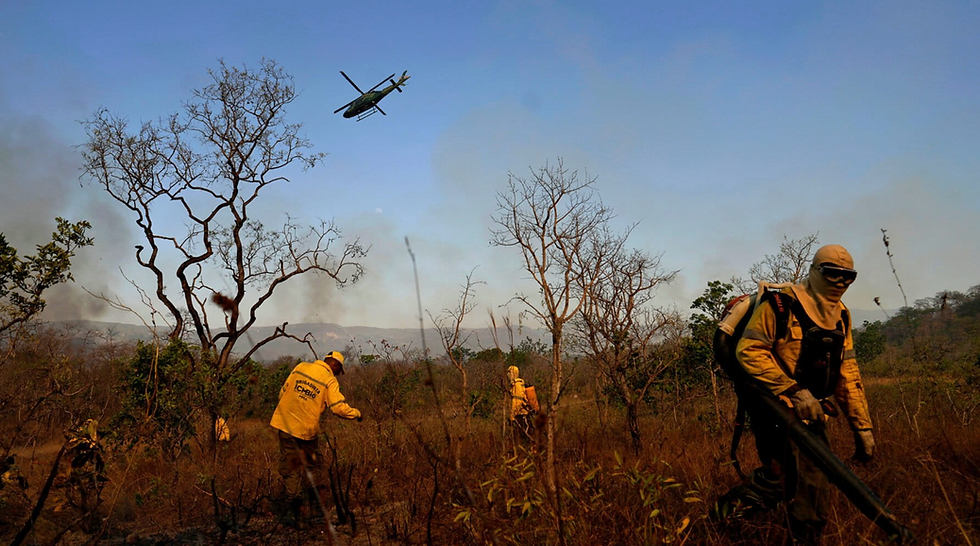
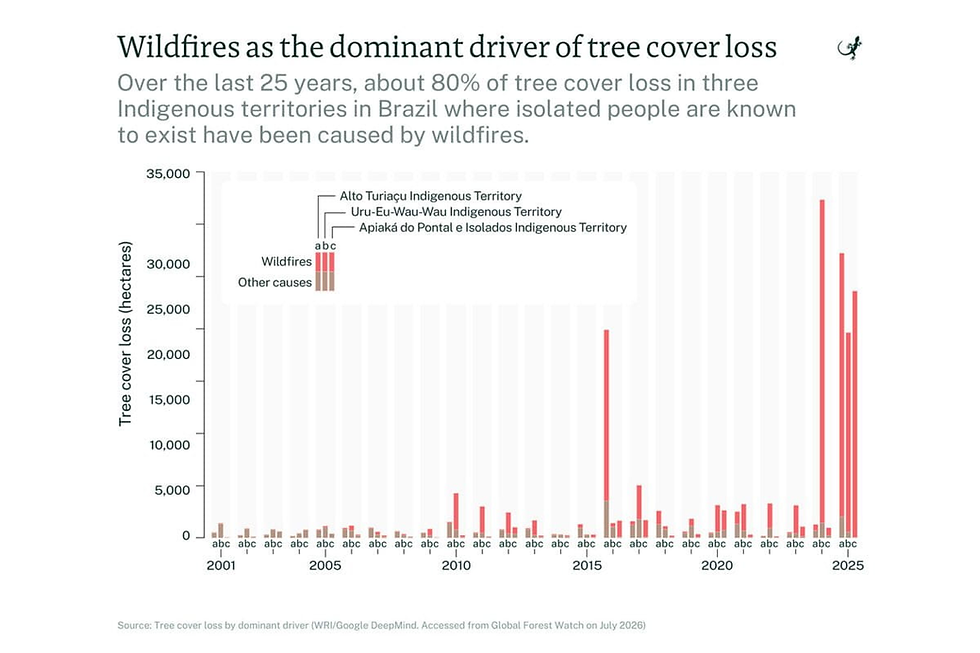
In 2025, fires were responsible for a significant spike in forest loss in three territories in Brazil that are home to Indigenous peoples living in voluntary isolation, according to Global Forest Watch data analyzed by Mongabay.
Indigenous leaders from the Alto Turiaçu, Uru-Eu-Wau-Wau, and Apiaká do Pontal e Isolados Indigenous territories, told Mongabay that fire is a growing threat to their way of life and the isolated Indigenous people who share the same lands. It affects their productive practices and destroys the biodiversity and vegetation they depend on for hunting and gathering, thereby leading to food insecurity. Damage to health, such as respiratory problems caused by the smoke, is another impact frequently mentioned by sources Mongabay spoke to.
“The communities suffer from health problems caused by the smoke, difficulties in mobility, and food insecurity because several planting areas are affected,” Almir Narayamoga Suruí, a Paiter Suruí Indigenous community member from the Sete de Setembro Indigenous Territory that straddles the Amazonian states of Rondônia and Mato Grosso, told Mongabay via WhatsApp. “Culturally, the impact is also very strong because the forest for us is not just a natural resource; it is part of our spirituality, our history, and our identity. When an area of the forest is destroyed, we also lose part of our memory and the traditional knowledge transmitted by our ancestors.”
Mongabay looked at forest loss and its dominant drivers across territories in Brazil with recognized isolated Indigenous peoples, using Global Forest Watch (GFW) drivers data that rely on a model with a 90.5% accuracy rate. Three territories stood out.


The 530,525-hectare (1.31-million-acre) Alto Turiaçu Indigenous Territory, which straddles the states of Maranhão and Pará, saw a dramatic increase in forest loss in 2025 from the previous year. GFW data show the area lost 27,243 hectares (67,319 acres) of tree cover in 2025, of which nearly all, or about 93%, was caused by fire. Most of this loss was in primary forests.
Itahu Ka’apor, a Ka’apor leader of the Tuxa Ta Pame community inside the territory, told Mongabay that fires in 2025 caused serious damage to forests. “Many game animals died,” he said via WhatsApp. “Vines and straw that we use to build our houses were also affected.”
Ka’apor added that fires pose an even greater threat to the isolated Indigenous people who live within Alto Turiaçu, known as the Isolados do Igarapé Jararaca people. This is because they depend fully on fish and game, including large rodents like pacas and agoutis, to survive.
Madalena Borges, Maranhão state coordinator for the Indigenist Missionary Council (CIMI), a Catholic Church-affiliated group that advocates for Indigenous rights, told Mongabay via WhatsApp that her organization had received reports of accidents as a result of fires. In Alto Turiaçu, for instance, a 15-year-old Ka’apor youth suffered severe burns on his feet, Borges said.
The Uru-Eu-Wau-Wau Indigenous Territory, which covers some 1.87 million hectares (4.61 million acres) in Rondônia state, is home to several Indigenous people from different tribes, such as the Japaú, Amondawa, Oro Towati (Oro Win), and Cabixi, as well as an estimated four distinct groups of isolated, uncontacted Indigenous people.
Uru-Eu-Wau-Wau also saw a huge spike in forest loss in 2025 compared to the previous year, amounting to 19,639 hectares (48,529 acres). Fire was the dominant driver, responsible for 97% of that total loss last year. Like in Alto Turiaçu, most of this loss was in primary forests.

Ivaneide “Neidinha” Bandeira Cardozo, an inhabitant of Uru-Eu-Wau-Wau and coordinator of the Kanindé Ethno-environmental Defense Association, told Mongabay via WhatsApp that they suffered similar impacts to the Indigenous people in Alto Turiaçu. She cited animal deaths and respiratory illnesses, especially in babies and the elderly. She said fire usually means that an area within the territory is being illegally occupied, which puts all their lives in danger.
“By killing the forest, the advancing fire kills the [isolated] peoples’ food supply, burns their huts and puts them in fear of being burned alive,” she said. “Besides, they certainly suffer from respiratory diseases that can lead to death. It also signifies the advance of land grabbing, and thus the loss of Indigenous territory.”
There are also social impacts, as community members are forced to put out fires and seek medical treatment for affected family members, rather than organizing their communities. Fires also have a similar impact on culture, Neidinha said, as cultural activities and the transfer of knowledge between elders and youths are often severely disrupted when fires hit. Ritual sites, which are also important for the education of younger community members, have also been destroyed.
“Important areas for wildlife preservation and an entire natural pharmacy are lost, because with the death of trees and animals, knowledge of remedies and the climate balance that keeps everything alive dies,” Neidinha added.
A similar trend was seen in the 982,324-hectare (2.43-million-acre) Apiaká do Pontal e Isolados Indigenous Territory in the state of Mato Grosso. GFW data show the area lost 23,618 hectares (58,361 acres) of forest in 2025; 99.7% of this was lost to fire, nearly all of it primary forest.
Fires across the Brazilian Amazon
Other territories across the Brazilian Amazon were also affected by fires in 2025, with records of social, cultural and environmental impacts similar to those described in Alto Turiaçu, Uru-Eu-Wau-Wau, and Apiaká do Pontal e Isolados.
Almir Suruí said that a fire in 2025 destroyed vegetation and animals across his community’s ancestral land, endangering villages and Indigenous families.
“What struck me most was the desperation of the communities trying to protect their homes and the forest with few resources,” he said. “I was also deeply affected by seeing animals fleeing the fire and sacred areas being affected. Many warriors and leaders mobilized day and night to fight the fires and protect the territory.”
As El Niño conditions develop in the tropical Pacific, experts warn that the climate phenomenon may lead to warmer temperatures and drier conditions across the Amazon Basin, making it more prone to fires.
“This will not only increase the incidence of respiratory and cardiovascular diseases due to the emission of fine particulates, but also release large amounts of greenhouse gases into the atmosphere, generating a feedback [loop] that amplifies Earth’s warming,” Florencia Sangermano, an associate professor at the School of Climate, Environment, and Society at Clark University in the U.S., told Mongabay by email.


The upcoming El Niño is predicted to grow into a “very strong” event, according to the U.S. National Oceanic and Atmospheric Administration, even more than the one in 2023-2024 that led to record-breaking fires.
To mitigate the worst effects, said Sangermano, there’s a need to protect forests and reduce deforestation, as this will allow for the recirculation of moisture and filtering of particulate matter, therefore reducing the incidence of fire-related diseases.
© 2026 Copyright Conservation news. Mongabay is a U.S.-based non-profit conservation and environmental science news platform.


