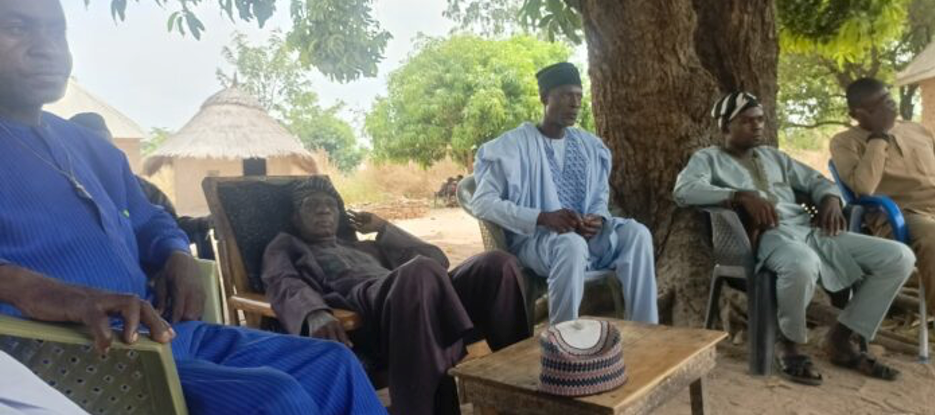
Fulani abduct 166 Nigerian Christians. Gov't denies facts.
Nigeria’s Official Strategy of Denial of Another Church Attack
TruthNigeria
January 21, 2026
By Mary Kiara

Cherubim and Saraphim Church was vandalized during the attack. Photo by Mike Odeh James.
Officials dismissed eyewitness accounts and delayed confirmation as Christian worshippers were marched into captivity.
(Kaduna) – When armed Fulani militants stormed three churches in Kurmin Wali, southern Kaduna State, during Sunday worship on January 18, congregants fled into surrounding forests, captives were marched away at gunpoint, and survivors began calling security agencies for help.
Within hours, Nigeria’s security officials publicly declared that no kidnapping had occurred. For more on how the media amplified the official narrative see: How Nigeria’s Mainstream Media Amplified Official Denials of a Mass Kidnapping.
Two days later, police confirmed that at least 166 Christian worshippers had been abducted.
What unfolded between those statements, the denials, dismissals, and eventual reversal has become a case study in how violence against Christians in Nigeria is first questioned, then minimized, and only later acknowledged, often after critical time has been lost.
Eyewitnesses Speak, Officials Deny
Church leaders and residents reported that Fulani ethnic militants arrived on motorcycles around 9 a.m., split into groups, and attacked three churches simultaneously.
“They surrounded the church and warned that anyone who ran would be shot,” said Yunana Dauji, secretary of a Cherubim and Seraphim congregation in Kurmin Wali.
Despite these accounts, Kaduna State Police Commissioner Muhammad Rabiu initially dismissed the reports as falsehoods spread by what he called “conflict entrepreneurs,” publicly challenging critics to “produce names.”
“We mobilized police and other security forces to Kurmin Wali and found no evidence of any attack.” Rabiu told reporters.
Local government officials echoed the claim, insisting no kidnapping had occurred.
However, TruthNigeria sent a reporter to the village and produced names from survivors and escapees of the kidnapping.
Verification Comes After the Damage
On Tuesday night, the Nigerian Police Force reversed course, issuing a statement confirming that a mass abduction had taken place.
Police spokesman Benjamin Hundeyin said earlier remarks were intended to “prevent panic” while facts were being verified.
By then, survivors said, abductors had already moved captives deeper into forest terrain.
“Nigeria’s police are under pressure to project control,” said Dave Oladapo, a security expert. “In that environment, some incidents are denied first and acknowledged later. Unfortunately, that delay benefits attackers, not victims.”
Why Denial Comes First
Human rights observers say the Kurmin Wali response follows a familiar pattern.
“When incidents involve churches, denial is often the default response,” Anuhe Aba, a Journalist told TruthNigeria. “Eyewitnesses are treated as unreliable until the state confirms what already happened.”
The abduction came amid weeks of documented attacks across Nigeria’s Middle Belt, including killings, church raids, and mass kidnappings.
According to the Open Doors World Watch List 2025, Nigeria accounted for 72 percent of Christians killed worldwide for their faith last year.
Yet Nigerian officials continue to reject religious framing, describing the violence as generalized criminality.
Narrative Before Rescue
The chairman of the Christian Association of Nigeria in the north, John Joseph Hayab, said security agencies were notified immediately after the attack, making the denials especially troubling.
“The moment the incident happened, security agencies were informed,” Hayab said. “Instead of pursuing the kidnappers, time was spent disputing whether the crime even occurred.”
Hayab said denial undermined rescue efforts.
“The time spent disputing numbers should have been used to pursue the abductors. Instead, they were allowed to move freely.”
Civil society investigators attempting to visit Kurmin Wali were later blocked by a military convoy, according to Christian Solidarity Worldwide Nigeria.
From Denial to Quiet Confirmation
After confirmation, police announced deployments and search operations.
Officials said earlier denials had been “misinterpreted” and were merely provisional statements pending verification.
“Earlier remarks were not a denial of the incident but a measured response pending confirmation of details from the field, including the identities and number of those affected.”
No accountability was announced.
The absence of consequences drew comparisons to earlier incidents in which official denials were later reversed.
“This mirrors what happened after the 2020 Lekki Toll Gate shootings,” said Samira Ruth, a Lagos-based activist. “The government and security operatives denied what the world could already see.”
“Nigeria has a problem with accountability and we see it all the time.”
Isa Sanusi, director Amnesty International Nigeria has accused the Bola Tinubu government of not doing enough to safeguard the lives of citizens.
“This clearly shows President Bola Tinubu and his government have no effective plan to end years of atrocities by armed groups and gunmen that killed thousands of people.”
Why Ambiguity Works
Media analysts say ambiguity is not accidental, it is strategic.
“When facts are contested long enough, public urgency fades,” Aba said. “Without consensus, democratic societies stall.”
The tactic is not unique to Nigeria.
In the 1930s, New York Times correspondent Walter Duranty dismissed reports of mass starvation in Ukraine, helping obscure one of the 20th century’s worst atrocities.
Today, critics say similar dynamics appear when eyewitness testimony is subordinated to official reassurance.
Seun Ambrose, a global affairs analyst told TruthNigeria, “Duranty did not need to disprove eyewitness reports of famine in Ukraine; he simply introduced doubt, amplified official denials, and delayed moral clarity. That delay cost millions of lives.”
Ambrose said Nigeria’s reported $9 million lobbying contract in Washington reflects a similar logic.
“You don’t spend that kind of money to change facts,” he said. “You spend it to confuse policymakers long enough that action never comes.”
“The objective is ambiguity. If lawmakers are unsure whether persecution is real or exaggerated, they default to inaction. That is the payoff.”
As of this writing, 166 worshippers remain in captivity.
Their abduction is no longer disputed.
But the time lost to denial, hours when rescue might have been possible cannot be recovered.
Mary Kiara is a conflict reporter for TruthNigeria.
Copyright 2026 TruthNigeria