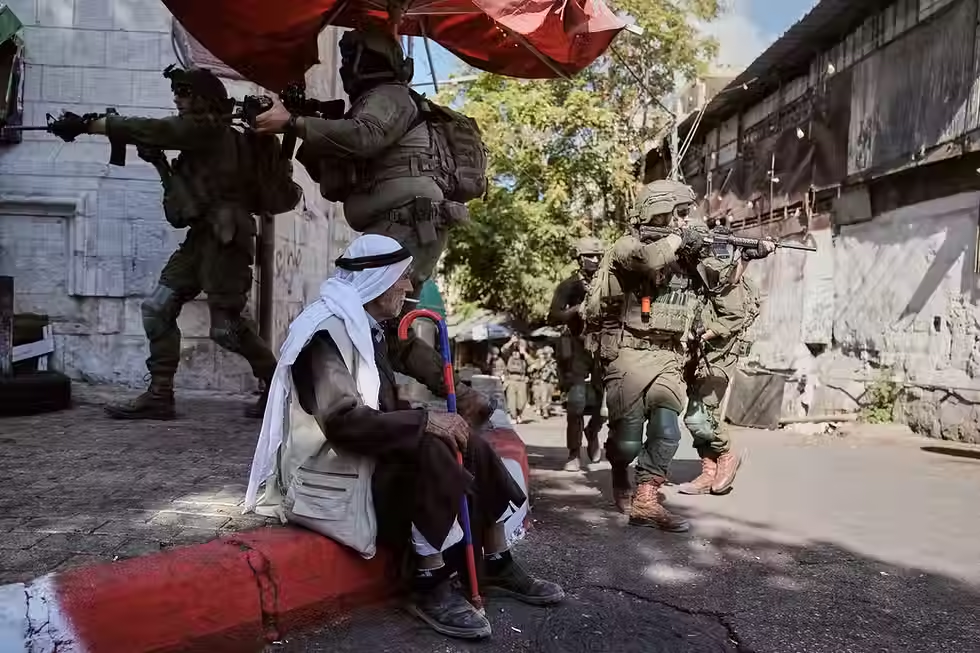
Ireland-Israel football matches opposed by critics
By Raf Diallo
September 26, 2026
On Sunday evening in Hungary's second largest city, the Republic of Ireland will play the most talked about match of this expanded international window.
But unlike other anticipated ties such as Germany's trip to the Netherlands or England hosting Spain, many of the players involved are unhappy the game in Debrecen is even happening.
Ireland midfielder Jason Knight said after Thursday's defeat in Kosovo that the controversial UEFA Nations League game against Israel should not be happening, echoing the comments of his manager Heimir Hallgrimsson, who said many of the players "felt really uncomfortable playing".
For their part the Israeli FA and fans are furious with Ireland's attitude towards the Israel match series and their team.
The very modern and complex football rivalry between Ireland and Israel has made headlines across the globe, with fans at home divided on whether or not this game, or the return match seven days hence, should be going ahead.
A football dispute rooted in a human catastrophe in Gaza has its origins in a vote almost a year ago, before Ireland and Israel were pitted against each other.
Last November, the FAI voted to submit a motion to UEFA that, if passed by European football's governing body, would have resulted in Israel being banned from its club and international competitions.
The proposed grounds for the vote cited two alleged violations of UEFA statutes by Israel's Football Association (IFA), namely organising clubs in occupied Palestinian territories without the consent of the Palestinian FA; and the alleged failure of the IFA to enforce an effective anti-racism policy.
It came two months after a panel of experts appointed by the United Nations called for Israel to be excluded from international football competitions.
Earlier that same September an independent UN commission report had concluded that a genocide was and continued to be committed by Israel against Palestinians in Gaza.
While the aforementioned FAI motion may have been passed at an EGM two months later, the association's president Paul Cooke did say that the Republic of Ireland would play Israel if they were pitted against them in any UEFA-mandated matches.
By the time, February arrived this year, Ireland already knew that they were going to be one of the quartet of teams in the draw for League B of the UEFA Nations League.
Israel, which had dropped down from League A, were also in League B, leaving a 25% chance the teams would be drawn together.
And that is exactly what happened during the draw in Brussels. Along with Austria and Kosovo, the Boys in Green had been pitted against Israel in Group B3, setting in motion a debate which has raged across various mediums ever since.

Calls for a boycott of the Israel matches followed immediately. Speaking to RTÉ's Morning Ireland, Bohemians chief commercial officer Daniel Lambert said: "As we saw with the Dunnes Stores workers and Mary Manning, there's an opportunity here for Ireland.
"To do the right thing and to show other nations and show our young people that Ireland won't be complicit - and not play (Israel).
"I think (boycotting the matches is) the right thing to do. I don't think anyone could say it isn't the right thing to do.
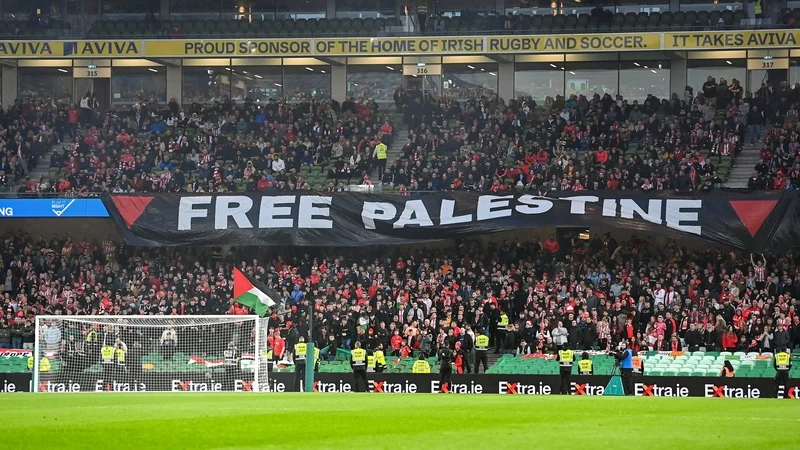
However, the FAI maintained its stance that the games would still be played and at that stage, the 4 October home against Israel was slated for Aviva Stadium.
In a letter to its members, Irish football's governing body warned that "serious consequences" would result from forfeiting the games, which would "materially harm the long-term sporting interests of Irish football".
The association's CEO David Courell added that they were left with "one viable option - which is to play in these matches".
The focus on the Nations League moved into the narrative background the following month due to the highly-anticipated World Cup play-off semi-final against Czech Republic.
But after the late March defeat in Prague and the subsequent Aviva Stadium friendly against North Macedonia, the future came back into focus with renewed impetus.
The next time the Boys in Green played at Lansdowne Road, their 28 May friendly against Qatar was paused on numerous occasions amid a tennis ball protest staged by the Stop The Game campaign."

In the aftermath, Ireland manager Heimir Hallgrimsson said he respected the right to protest but opined that a boycott would prove costly for Ireland from a football perspective, while he also reiterated his stance that moving the home game from Dublin would give an advantage to Israel.
Two days later, opposition parties brought motions before the Dáil calling on the Government to support a boycott of the Israel matches. For its part, the Government indicated that it supported the FAI's decision to partake in the games.
At the end of June, the FAI confirmed that the home game on 4 October would be moved from Aviva Stadium to the TSC Arena in Backa Topola, Serbia where it would be played behind closed doors. UEFA had already underlined that the 27 September away match would be staged in Debrecen, Hungary.
An FAI EGM followed on 8 July where a motion in favour of proceeding with the matches against Israel was passed. Seventy-five delegates voted in favour compared to 32 against, with three abstentions.
Irish Sport for Palestine who have led the Stop The Game campaign expressed disappointment at the outcome, saying that it "does not reflect the will of the Irish public or professional players".
The FAI subsequently confirmed that no tickets would be sold to Republic of Ireland supporters for the game. In contrast, Israel would sell some tickets to their own supporters for their designated 'home' game in Hungary this Sunday.
On 17 September, Hallgrimsson was back in front of the media to reveal his squad for the combined September and October window.
He did outline that he had spoken to each player individually to gauge their thoughts on joining up with the squad considering the contentious nature of two of the matches. The Icelandic native added that while "none of us feel comfortable playing these games", they would go ahead and play them.
But it was comments made to the Sunday newspapers that day which led to a furious reaction from the Israeli FA.
"I've said before, we’re not playing with genocide, we’re playing against genocide. We’re playing against Israel, we’re not playing with Israel," Hallgrimsson said.
The Israeli FA took to social media and claimed the comments embody "stupidity, ignorance and hypocrisy".
That in turn prompted an intervention from the Taoiseach Micheál Martin at the United Nations in New York, who condemned the IFA's words about Hallgrimsson as "unacceptable" and called for their remarks to be withdrawn.
With the FAI keeping national team media commitments to the minimum required by UEFA, Hallgrimsson did not address the furor until Wednesday's press conference in Pristina ahead of the group opener against Kosovo.
The Ireland manager expressed gratitude at the support he had received but did go on to say that "it was not clever from me to take the attention like this".
While the spotlight was on the manager, the external onus had also moved on to the players and their collective stance. A Stop The Game protest had taken place outside their team hotel in Castleknock on the eve of their flight to Kosovo.
RTÉ, meanwhile, had confirmed that it will provide stripped back coverage that will meet its contractual obligations to broadcast the two games against Israel.
Dara O'Shea, who is captaining Ireland in this window, emphasised that from a players' point of view, the Israel games going ahead was "not our decision".
The defender was keen to keep the focus on the Kosovo game until Friday when the squad would convene to discuss how they would approach the first Israel game in Debrecen.
The next Ireland press conference is due to take place this morning at the Nagyerdei Stadion, which might give an indication as to what players have collectively decided to do in regard to protocols like pre-match handshakes.
But perhaps it will only be on Sunday, with the eyes of the world on a regional Hungarian city, when all becomes clear.
© RTÉ 2026.