

Special Report: The Persecution of Afghanistan’s Hazaras

Updated: Oct 4
By August Wyma and Sophia Khan
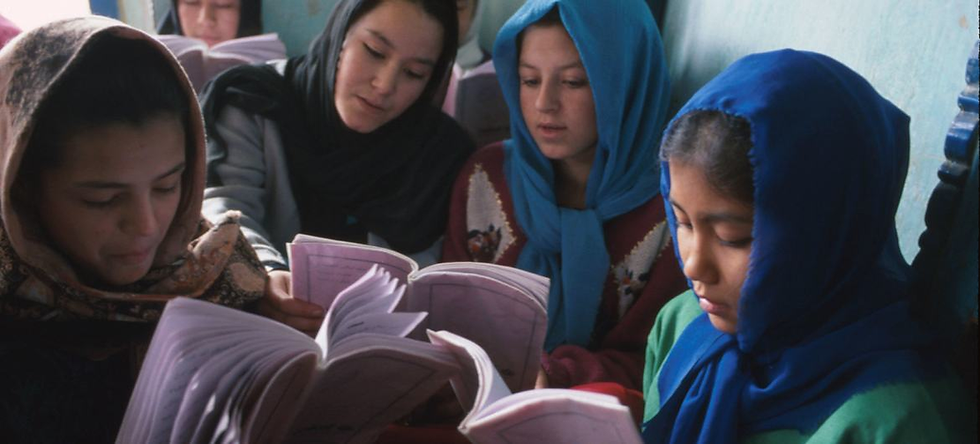
Girls read from their textbooks at the Dasht-e-Barchi Education Centre in Kabul, Afghanistan.
(Credit:UNICEF/Shehzad Noorani)
Afghanistan is a religiously and ethnically diverse country whose modern history has been shaped by attempted intervention, political instability, and national identity struggles. Within such circumstances, the Hazara people in Afghanistan have endured over a century of systematic persecution because of their distinct ethnic and religious identities. This report examines the ongoing Hazara genocide by tracing its historical roots from mass oppression under Amir Abdur Rahman Khan in the late nineteenth century to contemporary attacks by the Taliban, Islamic State–Khorasan Province (ISKP), and other perpetrators. By outlining major atrocities and the structures that have enabled persecution and impunity, this report will emphasize the urgent need for international protection, accountability, and the meaningful inclusion of Hazara survivors and civil-society organizations in responses to these crimes.
The Hazaras in Afghanistan
The Hazaras are one of Afghanistan’s principal ethnic minorities and have historically experienced political exclusion, forced displacement, and targeted violence. Most Hazaras speak Hazaragi, a dialect of Persian closely related to Dari, and practice Twelver Shia Islam. Smaller numbers of Hazaras follow Ismaili Shia Islam or Sunni Islam. Because Afghanistan’s population is predominantly Pashto and Sunni Muslim, the Hazaras have been historically perceived as outliers and exposed to intersecting forms of discrimination and persecution.
Although estimates of the Hazara population vary considerably in the absence of reliable census data, the community constitutes a significant part of Afghanistan’s ethnically and religiously diverse population. The historic center of the Hazara population is Hazarajat, a mountainous region in central Afghanistan. Although Hazarajat is not an official administrative unit, it encompasses Bamyan and Daikundi provinces, as well as parts of Ghazni, Uruzgan, Wardak, Parwan, Baghlan, Samangan, and Sar-e Pul. Substantial Hazara communities also reside in urban centers like the Dasht-e Barchi neighborhood of Kabul. Additionally, periods of conflict and persecution have contributed to large diaspora communities in neighboring Pakistan and Iran.
The persecution of the Hazaras is rooted in Afghanistan’s modern political formation. During the campaigns of Amir Abdur Rahman Khan in the late nineteenth century, Hazara communities were subjected to mass killing, enslavement, forced migration, and extensive land confiscation in Hazarajat between 1891 and 1893, in what is remembered as the Hazara War. By declaring Hazara “Shia infidels,” the Amir established a holy war, or jihad, against the unarmed Hazara people. These events established patterns of exclusion and genocidal intent that continued throughout much of the twentieth century into the Afghan Civil War of the late 1990s. Although the Afghan war was not entirely an ethnic conflict, loyalties formed along ethnic lines, and human rights organizations extensively documented the targeting of Hazaras. These recurring atrocities demonstrate that the persecution of the Hazaras was not confined to a single historical episode but developed into an enduring pattern of violence, dispossession, and impunity.
The Hazaras in Today’s Afghanistan
After the Soviet Union invaded Afghanistan in 1979, the country struggled to prevent Islamic fundamentalist groups from entering the state apparatus. Mujahideen groups rapidly filled the power vacuum left by the Soviets in the late 1980s and shaped the subsequent decades of civil war, tyranny, and extremism. The Taliban became the most successful of these groups and first took control of Kabul in 1996. The Taliban’s rise also made the group one of the principal actors in the genocide of Hazaras.
The Taliban temporarily lost power after the United States’ (US) 2001 invasion but returned with vigor following President Biden’s 2021 withdrawal. During both the first and second Taliban regimes, Hazaras experienced widespread oppression, often amounting to concerns over genocide. In August 1998, Taliban militia forces captured Mazar-I-Sharif and violently targeted large numbers of civilians, most of whom were Hazara, Tajik, and Uzbek. In its report, Human Rights Watch (HRW) estimates that at least 2,000 civilians were killed, while thousands were intentionally disappeared or sent into captivity. According to HRW, religious intolerance and the desire to suppress potential dissent were the most likely motives for the massacre. This event remains a strong example of the Taliban’s genocidal intent.
The period of US-backed governments between 2001 and 2021 was unique in its capacity to promote Hazara representation but failed to eliminate the oppression of Hazaras in any complete manner. Between January 2017 and June 2021, the United Nations (UN) recorded over 65 incidents that targeted Hazaras in Afghanistan, amounting to over 750 civilian deaths.
Again, with the establishment of the second Taliban regime, Hazaras’ living conditions worsened. ISKP’s simultaneous growth in influence contributed to this decline. Although ISKP is not necessarily aligned with the Taliban, its anti-Shia ideology has seemingly compounded Hazara vulnerability in the regions where it operates. In May 2020, as American influence in the region was already fading, fundamentalists attacked a maternity ward in a Hazara neighborhood of Kabul, killing 14 people, including two babies. In 2021, attackers bombed the Seyed al-Shaheda Girls' School, killing 85 female students, most of them Hazara. It is important to note that neither the Taliban nor ISKP has proven to have perpetrated these acts of genocidal violence, although certain sources infer their participation. Nonetheless, their political power and discriminatory doctrines towards non-Sunni populations create the conditions for further atrocities towards Hazaras in the region.
Recent findings from the UN Assistance Mission in Afghanistan (UNAMA) continue to emphasize the horrific living conditions Hazaras face in Afghanistan. In April 2026, 12 civilians were killed at a Shia shrine in Herat province. On June 18, 2026, 45 Shia men were detained for simply displaying Ashura flags in Kabul. Along with UNAMA’s reporting, independent reports from organizations such as the New Lines Institute help document the most recent developments in the Hazara genocide. The report highlights a variety of attacks, new legislation imposed by the Taliban, and other factors producing genocidal conditions. According to its figures, ISKP appears to be the principal perpetrator of physical violence and often claims responsibility for deadly attacks, including the 2023 attack on a Dasht-e Barchi sports club. Meanwhile, the Taliban uses more varied forms of violence. By exploiting political leverage, the Taliban can also perpetrate less overt forms of oppression, such as forced migration and apartheid. For instance, the report describes how the Taliban has destroyed police infrastructure in Hazara-populated neighborhoods over the last five years to manufacture anarchy. It also documents the forced displacement of Hazara residents from Pusht-e Asmidan village in Al Badr District, Sar-e Pul province in 2023.
As this report entered its editing phase, another major attack on the Hazara community injured more than 40 children when a grenade detonated at a school in the Dasht-e Barchi neighborhood. The attack demonstrates why the long-running Hazara genocide remains an urgent concern for genocide prevention today.
The Intersectional Targeting of Hazara Women and Girls
Hazara women and girls have been targeted disproportionately because of their intersecting ethnic, religious, and gender identities. As Hazaras, they belong to the marginalized predominantly Shia Muslims in a majority Sunni country, while as women and girls, they are subjected to the Taliban system of gender-based discrimination, exclusion, and persecution. In a 2025 report, the UN Special Rapporteur on Afghanistan stated that abuses against women from minority communities should be examined as persecution on the intersecting grounds of gender, religion, and ethnicity.
Amir Abdur Rahmans Khan’s campaigns in the late 1800s subjected Hazara women to enslavement, forced displacement, and gendered violence. Women were affected not only as individual victims but also as members of a community whose population, territory, and social structures were being systematically dismantled. Moreover, human rights organizations documented the rape and abduction of Hazara women during the February 1993 Afshar operation in western Kabul. Across these periods, perpetrators sold Hazara women as slaves under the Amir, exposed them to violence during struggles among fundamentalist groups, and increasingly targeted them under the Taliban and ISKP.
Such killings and serious bodily or mental harm inflicted upon Hazara women and girls may constitute prohibited genocidal acts when they are accompanied by an intent to destroy the Hazara ethnic or religious group, in whole or in substantial part. Attacks on young women, students, and community institutions can also damage a group’s ability to sustain its social, educational, and cultural life across generations. Hazara women may also encounter distinct barriers in obtaining protection, healthcare, and humanitarian assistance. Moreover, movement restrictions and cultural expectations can prevent women from travelling to medical facilities without a male relative, while poverty and the limited infrastructure of Hazara-populated regions create additional obstacles. Survivors of bombings, displacement, sexual violence, or arbitrary detention may consequently be unable to obtain appropriate medical treatment, psychosocial support, or legal remedies.
Economic Concerns
Afghanistan’s economic condition compounds the hardships Hazaras face. Living standards remain very low: according to the UN in 2023, Afghanistan had a Human Development Index rating of .496, ranking 181 out of 193 countries. As in other impoverished countries, including Sudan and Myanmar, underlying poverty intensifies the effects of sociopolitical persecution on vulnerable communities. Therefore, justice-seeking efforts for the Hazaras must address economic hardship alongside sociopolitical persecution, just as they must account for the intersectional oppression of Hazara women.
Recent aggression by Kuchis towards Hazara farmland in the Behsud district of central Maidan Wardak province illustrates how poverty and persecution compound one another. The Kuchis are a Pashtun population in Afghanistan known for a nomadic or seminomadic lifestyle. Reports indicate that Kuchis often target Hazara farmland while migrating and act with exceptional impunity because of the sociocultural discrimination Hazaras face. These attacks carry severe economic consequences. Kuchis reportedly damage crops, sabotage water supplies, and forcibly displace communities. These acts create unsustainable economic conditions and intentionally deprive Hazaras of the stability required for long-term community survival in an already impoverished nation.
Fears of Civil Conflict
Escalating violence between the Taliban and counter-Taliban groups within Afghanistan is a final element worth highlighting. As mentioned, ISKP has experienced exceptional growth in the region since 2021, while other groups, such as the National Resistance Front (NRF), the Homeland Soldiers Front (HSF), and the Afghanistan Freedom Front (AFF), also remain active. These groups have engaged in violent attacks against the Taliban. For example, the ISKP routinely targets high-profile Taliban members through suicide bombings. In the third week of February 2025, ISKP bombed both a bank in Kunduz province and the Taliban’s Ministry of Urban Development in Kabul with the aim of killing Taliban officials.
Although clashes between the Taliban and opposing militant forces do not directly target Hazaras, war creates conditions in which genocide can flourish. If armed violence continues to escalate or the Taliban begins to lose its monopoly over Afghanistan’s political infrastructure, desperation and instability will likely increase. Because Hazaras remain distinctively marginalized, renewed conflict could increase both the incentive and the impunity for genocidal violence against them.
Conclusion
The persecution of the Hazaras is not a collection of isolated events but an enduring pattern of violence, exclusion, and impunity. Although the perpetrators have shifted through history, the consequences have remained consistent. The Hazara community continues to face the loss of life and territory, destruction of community structures, forced displacement, and exclusion from Afghanistan’s political, economic, and social life. Deliberate ISKP attacks, discriminatory Taliban policies, and the de facto authorities’ failure to provide adequate protection make further atrocities foreseeable.
Genocide Watch recommends:
International accountability mechanisms must investigate the Taliban’s role in enabling attacks on Hazaras, including its dismantling of police infrastructure in Hazara-populated districts and its failure to protect Shia religious gatherings and schools from attacks.
The UN Secretary-General and UNAMA must formally investigate and report on ISKP’s attacks on Hazara civilians, with findings referred to the UN Human Rights Council.
Donor states and UN agencies must fund gender-responsive humanitarian services, including mobile health clinics and psychological support programs, to address the obstacles Hazara women and girls face under the Taliban.
Any external economic measures aimed at pressuring the Taliban must be assessed for their effect on the national economy to avoid collective punishment that disproportionately harms Hazara communities.
Report:


