THE CALL, TEDX TALK BY Dr. GREGORY STANTON, 2017

Updated: Jul 28

Dr. Gregory H Stanton
The Call
By Gregory Stanton
TEDx Talk
April 22, 2017
George Washington University
Washington, DC
The first time I saw Genocide was in Cambodia in 1980. Church World Service and CARE asked me and my wife, Mary Ellen, to go to Cambodia to set up a relief program.
I had not sought the job. At first I didn't want to go. We wanted to start a family and thought that service in Cambodia would postpone our dream. Little did we know.
But I made a fateful promise. I said I’d pray about it.
I don't hear voices or see burning bushes. But I do know God's inspiration. Every important decision in my life has been preceded by prayer. This time the direction was consistent and clear. As my favorite Labor Law professor, Jack Getman, who is Jewish, told me, “Greg, you have to go. You’ve been called.”
I thought I was called to distribute rice, rice seed, vaccines, and school supplies. What I did not expect was that I had been called to witness the aftermath of the Cambodian genocide. It was a call that changed my life.
In the months before I left for Cambodia I read the accounts of the Khmer Rouge killing fields. The Khmer Rouge were a Maoist communist regime that ruled Cambodia from 1975 to 1979.
The Khmer Rouge killed two million Cambodians, a quarter of the population. They committed every crime against humanity in the book. They committed genocide.
Genocide is the crime of crimes. It is the intentional destruction, in whole or in part, of a national, ethnic, racial, or religious group. It is the worst crime against all of humanity because it literally diminishes the diversity of the human race. The Convention for the Prevention and Punishment of the Crime of Genocide was the first human rights treaty passed by the United Nations in 1948. But no one had ever been convicted of genocide.

Monivong Boulevard, Phnom Penh, midday, 1980, public domain photo
When my wife and I arrived in Cambodia, the capital city was nearly empty. The people had been driven out by the Khmer Rouge. With empty oxcarts, starving farmers limped into Phnom Penh searching for food.
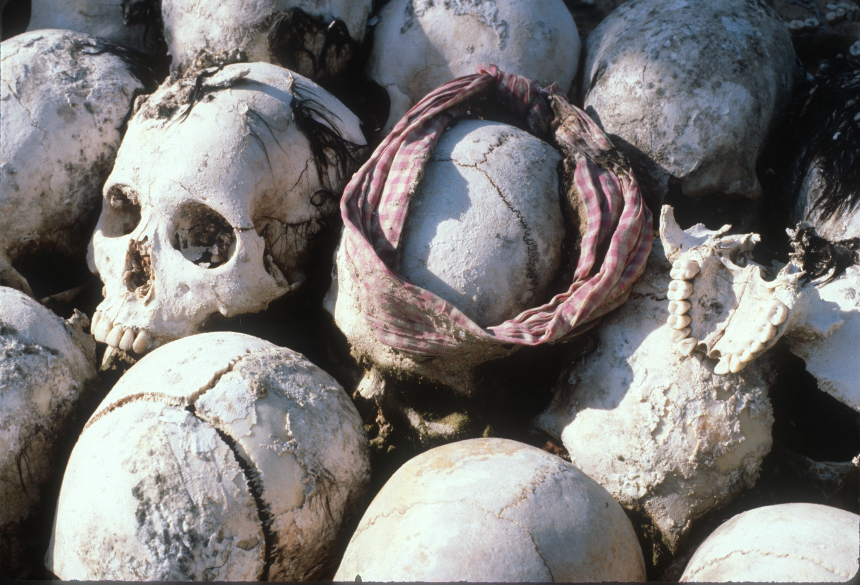
Choeng Ek mass grave, Phnom Penh, Cambodia 1980 © 1980 Gregory H Stanton
I was among the first Westerners to see the newly opened mass grave at Choeng Ek, where the Khmer Rouge buried over 7000 victims of the Tuol Sleng extermination prison in Phnom Penh. There were so many bodies that the decomposition was not yet complete. Flesh still clung to human bones. The stench of death seared my nostrils.
I found a Mickey Mouse T-shirt on a tiny skeleton. I wept. Who could commit such monstrous crimes?
The stories of survivors still haunt me. Every Cambodian had lost family members. Their stories crushed my soul.

Cham woman in blue and white checked khroma (scarf) 1980. © 1980 Gregory H Stanton
Sop Pidas, a Cham Muslim grandmother told me through her tears how she had lost her entire family when the Khmer Rouge on one terrible night in 1977 beat 5000 Chams to death. Her husband, a leader in the Cham Muslim community, was singled out and soaked with gasoline before he was set on fire. Her infant grandchild was murdered by dashing her brains out against a tree.
Gai Marianne, another Cham Muslim woman, told me that she had helped her sister-in-law suckle her newborn infant. Both women and their babies were evacuated to a new commune, but the sister-in-law fell behind, leaving Gai Marianne to care for both babies. A Khmer Rouge soldier took the sister-in-law’s eight-week-old baby and threw him into the jungle to die. “You have no need for two small babies,” he explained.

Cham man in blue and white checked khroma (scarf) 1980. © 1980 Gregory H Stanton

Cham man in blue and white checked khroma (scarf) 1980. © 1980 Gregory H Stanton
Cham Muslims and the Vietnamese minority were singled out for extermination. Cham children were taken away from their parents, put into youth communes, and all Chams were forbidden to speak the Cham language. This intentional destruction of part of the Cham ethnic and religious group was clear genocide under the Genocide Convention.
The stories of the orphans were the hardest to drive out of my mind. Chuan Phalla told me how she had survived only by hiding under the body of her dead sister in a mass grave. The orphaned son of the Phnom Penh train station master had watched the Khmer Rouge disembowel his parents before his eyes. They left a hole in his heart that couldn't be filled by all his tears.
Returning to Yale Law school in 1981, I should have been elated to come home. A bright future lay ahead. Instead I slid into a deep depression.
I finally consulted a Yale psychiatrist, who told me, “After what you’ve seen, if you weren’t depressed, there would be something wrong with you. Depression is repressed anger. What are you angry about?”
“I'm mad as hell that the Khmer Rouge got away with mass murder,” I said.
She looked me in the eye. “What are you going to do about it?”
It was then I realized that instead of turning my anger destructively upon myself, I should find a way to bring the Khmer Rouge to justice.
My law professors, Myres McDougal and Michael Reisman suggested that I contact New York human rights organizations to see if they would help. None of them would.
I went back to Professor McDougal and told him I had struck out.
Professor McDougal was the leading international lawyer in the world. He was also a Mississippi gentleman.
He leaned back in his chair and said, “Well, Greg, why don’t you do it?
I said, “But I’m just a law student.”
He replied, “Yes, son, but you’re a Yale law student!” It was the height of Ivy League arrogance. But it was another call.
I went back to Cambodia in 1982 to get permission to gather the evidence. The Cambodian Genocide Project was born.
I learned why international law is weak. Paper treaties aren’t law unless they’re enforced. Genocide continues and its perpetrators escape with impunity because of the failure of political will to enforce the law.
In 1992, with Senator Robb we drafted the Cambodian Genocide Justice Act in order to reverse US foreign policy and order the State Department to support trials for the Khmer Rouge.
I knew that if the Cambodian Genocide Justice Act had any hope of implementation, someone would have to get inside the State Department to make it happen. So I took the Foreign Service exam and joined the State Department in 1992.
In 1994, during my Consular year in Bangkok, genocide struck again. The Rwandan Genocide killed 800,000 people in just 100 days. The Director General of the Foreign Service came to Bangkok for a conference, and we got to talking while floating down the Chao Phraya river on a dinner cruise. She turned to me and said, “Greg, you’re the only Foreign Service Officer I have who is an expert on genocide. I want you back in Washington now.”
The State Department sent me to Rwanda with the UN Commission of Inquiry. We recommended setting up an international tribunal. I drafted the UN Security Council Resolutions that established the International Criminal Tribunal for Rwanda. It indicted ninety-three people and convicted sixty-two for genocide and other crimes against humanity before it closed in 2015. It delivered the world’s first conviction for genocide. The Genocide Convention finally became real law.
The Rwanda and Yugoslav tribunals opened the way for creation of a tribunal to try the Khmer Rouge. I wrote a State Department paper proposing that the UN and Cambodian government create a mixed tribunal, with both UN and Cambodian appointed judges. The Extraordinary Chambers in the Courts of Cambodia were created in 2006 and I drafted their rules.
The Khmer Rouge Tribunal has convicted three top leaders: Duch, the commander of Tuol Sleng prison, who signed the death warrants for the people whose skeletons I saw at the Choeng Ek mass grave; Nuon Chea, the head of the whole death camp system; and Khieu Samphan, the ideologist who planned the Khmer Rouge genocidal state. Last year, it was satisfying to sit in the courtroom and see them in the dock.
Genocides in the twentieth century killed more people than all the international and civil wars combined: over two hundred million people.
Tribunals come too late, after the victims are dead. Genocide must be prevented. After working in the State Department I realized that we cannot depend on governments to prevent genocide.
Yet in 1999, there was not one organization in the world, not one coalition devoted solely to the prevention of genocide.
We needed a mass movement against genocide.
In 1999, I founded Genocide Watch and the Alliance Against Genocide, the first anti-genocide organization and coalition. The Alliance now has seventy member organizations around the world.
I believe the Alliance Against Genocide in the 21st century will someday be seen in the same way we see the anti-slavery movement of the 19th century. It is time in human history to end genocide, the worst of all crimes against humanity.
Those who say we cannot overcome this curse upon mankind are no more right than those who said slavery could not be abolished. It is a matter of human will. And we make that human will. As Archbishop Tutu is fond of saying, “God is a God of justice. But to do justice, God depends on us.”
It was a call to do justice that I answered in 1980 when I went to Cambodia. I had no idea what paths that call would lead me down. And I do not yet know where this call to do justice will lead us in the future.
But neither did the wise men when they were called to the birthplace of a Jewish baby in Bethlehem. There's an old evangelical saying, “God has a wonderful plan for your life.” I've always been tempted to reply, “Yes but I wish God would show me the map.”
A map would have been a much easier way to find Bethlehem than a star. But it wouldn't have required any faith. Ultimately, reaching our goal, fulfilling our call, depends on our faith.
I have faith that we will succeed in our struggle against genocide whenever I look at our daughter.
On November 16, 1980, a month before we left Cambodia, a newborn baby was abandoned at the entry to the National Pediatric Hospital. The chief doctor couldn't keep her at the hospital where an epidemic of hemorrhagic fever was raging. At the orphanages, newborns had only a fifty percent chance of survival.
So the doctor brought her back to our hotel, walked into our prayer service that Sunday morning, and laid her in my wife's arms. She asked us to care for the child until the government could determine what to do.
We had told no one of our hopes to start a family, and certainly didn't expect to adopt a baby in Cambodia, which no foreigner had done since 1975. We were the wrong nationality, wrong religion, wrong ideology, and wrong race. Our own country still had Cambodia on its “enemies” list, under the “Trading with the Enemy Act.” All the barriers known to man stood between us.
But there is a personal force in the world that changes hearts, and that can also change the course of history.

Elizabeth Chantana Stanton, one month old, December 1980. © 1980 Gregory H Stanton
So we bundled her up in a zip-open Grasshopper suitcase made into a bed, and took her to the Foreign Ministry. The Deputy Foreign Minister strolled in and when he saw her, he was clearly moved. We explained what had happened, and our desire to adopt her. He began to speak to her in Khmer. “You are in God's hands. I will pray for you.”
Her adoption certificate was signed by the man who later became the Foreign Minister of Cambodia.
We named her Elizabeth Chantana, which in Khmer means gift of God. We returned to the United States on Christmas Eve, 1980, and she was baptized by my father Rev. Howard Stanton, at the Christmas Eve service in the First Presbyterian Church, Racine, Wisconsin.
When I went back to Cambodia in 1982 to found the Cambodian Genocide Project, I asked the officials at the Foreign Ministry, “Why did you let us adopt her?” They said, “Because we knew that she needed you. And we knew that you needed her.”
That is love.
They loved us.
Love is God's force personally expressed. Justice is God's force socially expressed.
Evil and genocide and death are not the most powerful forces in Cambodia or Rwanda or anywhere else.
Love is more powerful than evil.
Justice is stronger than genocide.
Life triumphs over death.
Cambodia and Rwanda have come back to life.
And to us a child was given, our gift of God, a testimony to the ultimate Force of a love that transcends all boundaries.
The same Force that steered the star of Bethlehem.
Wise men and women still follow its call.
Cambodia has come back to life.

Cambodian boy carrying his baby sister. © 1980 Gregory H Stanton

Cambodian children 1980. © 1980 Gregory H Stanton


Text: Creative commons copyright 2026 Gregory H Stanton. May be republished freely, in its entirety and without any alterations, with attribution to Gregory H Stanton.
Photos: copyright © 1980 Gregory H Stanton