

The Human Rights Crisis in Ethiopia, May 15, 2026

Updated: May 18
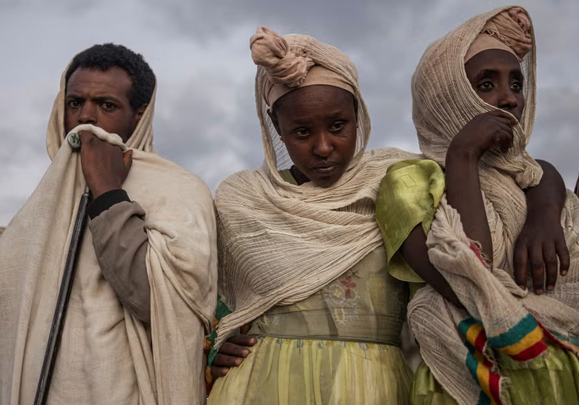
Ethiopian Orthodox pilgrims rest at a campsite in Lalibela in the Amhara region, two months after the Ethiopian military regained control of the town from Fano militia, January 7, 2024.
©2024 Michele Spatari / AFP via Getty Images
Why the Human Rights Crisis in Ethiopia Matters
Public Conference, Kennedy Caucus Room, Russell US Senate Office Building, Capitol Hill.
May 15, 2026, 9:00 AM Eastern Time.
Washington, D.C. – This conference in English is open to anyone interested in peace, stability and democracy in Ethiopia and the Horn of Africa.
The forum will bring together community leaders, human rights advocates, and policy experts to discuss the deteriorating political and humanitarian situation in Ethiopia. The conference will highlight ongoing atrocities, systematic human rights violations, and the escalating persecution of Ethiopian Orthodox Christians and the continued suppression of fundamental freedoms.
This diverse group of participants intend to call for the immediate release of all political prisoners and detainees, like Tadios Tantu, Christian Tadele and hundreds of others.
Holding this conference at the United States Congress underscores the urgent need for greater international awareness and action to promote peace, justice, stability, religious freedom, and respect for international human rights laws and protocols in Ethiopia.
This conference seeks to amplify the voices of oppressed and marginalized Ethiopians by bringing urgent international attention to widespread human rights violations occurring throughout Ethiopia.
Special focus will be given to current systematic attacks and abuses targeting the Amhara community, the persecution of Ethiopian Orthodox Christians, the genocide against Tigrayans, and the increasing suppression of political dissent and freedom of expression.
The conference will serve as a platform to discuss the urgent need for constitutional reform, national reconciliation and peace, democratic governance, and long-term peace and stability in Ethiopia.
Holding this conference at the United States Congress is both intentional and strategic. Congress has historically played an important role in addressing international human rights crises and shaping U.S. foreign policy toward Ethiopia and the Horn of Africa.
We encourage all Ethiopians and friends of Ethiopia to attend and stand in solidarity with the victims of violence, persecution, and injustice.
Mesfin Mekonen, an Ethiopian American, Author of Washington Update, and a champion of human rights and constitutional democracy in Ethiopia and Aklog Birara, Ethiopian American, Vice Chairman of Global Alliance for the Rights of Ethiopians, commentator on political economy, author and former Senior Advisor with the World Bank express our sincere gratitude to Senator Chris Van Hollen and his dedicated staff for their generous assistance in helping secure a meeting space at the historic Kennedy Caucus Room in the Russell Senate Office Building.
Speech by Aklog Birara
The Urgency of Now: Ethiopia’s Human Rights Crisis Requires an International Response
Kennedy Caucus Room, Capitol Hill – May 15, 2026
Good Morning
My name is Aklog Birara.
Allow me to begin by expressing my heartfelt appreciation to Senator Van Hollen’s team for making this historic room available. I am grateful to my compatriot Mesfin Mekonnen for securing it, to Youm Fesseha of the American Ethiopian Public Affairs Committee for his cooperation, and to the Global Alliance for the Rights of Ethiopians (GARE), where I serve as a founding board member and Vice Chair, for spearheading this conference.
This room carries special personal meaning for me. Peace Corps volunteers educated me—part of a program initiated by President Kennedy. I would not be standing here today without that remarkable American investment in human potential.
Ethiopia’s human rights crisis refers to the degradation of human dignity and potential regardless of ethnicity of faith.
I thank Dr. Gregory Stanton, distinguished scholar, champion of human rights, an expert on justice and constitutional democracy, and founder and President of Genocide Watch, for taking time from his busy schedule to honor us as the keynote speaker. I value his insight and guidance.
His well documented presentation today offers Western policymakers, decision-makers, and global audiences the opportunity to fully appreciate the gravity of the human rights crisis in Ethiopia—and to act.
He concludes “The Constitution of 1995 will continue to produce wars and ethnic genocides. Those who want a strong Ethiopian federal nation in which Ethiopians are citizens of Ethiopia first and members of their ethnic group second must revise the 1995 constitution. Ethiopia must decide whether it will be a nation with central autocracy (the current state, my take), or a true federation. ----If one ethnic group imposes its interests on the country (the Abiy Ahmed PP model, mine), the next constitution will fail just as the 1995 Constitution has. In a few decades we will find ourselves back where we are today, asking what went wrong. If Prime Minster Abiy Ahmed’s government writes a new constitution, Abiy’s reputation as a violent tyrant among Amhara and Tigrayans will mean the new constitution will be regarded as illegitimate as the 1995 Constitution” imposed by the TPLF and its allies.
I agree with Dr. Stanton.
I commend photojournalist Jemal Countess, whose breakthrough field work has documented atrocities affecting Afar and Amhara populations that corporate and popular media have too often overlooked. His eyewitness reporting speaks truth to power and sheds light on the horrendous nature of the Ethiopian tragedy.
His on the ground observation concerning media coverage and lack of it of atrocities in the Afar, Amhara, Tigray and Wellega and the skewed distribution of humanitarian aid drew attention. He informed his audience about the personal danger he faced in reporting.
Please join me in applauding Dr. Gregory Stanton and journalist Jemal Countess for their thoughtful presentations. Thank you.
Why the urgency?
What makes Ethiopia’s atrocities—where an estimated one million two-hundred thousand innocent lives have thus far perished—so chilling is this: these acts are state-sponsored. Tigrean, Annuak and Amhara peoples as well as others endure this violence.
Atrocities do not have boundaries.
To put it mildly, Ethiopia faces an unprecedented crisis—political, social, economic, spiritual, psychological, environmental, and geopolitical. This convergence of crises poses an existential threat to this ancient country that hosts the African Union and multilateral organizations.
I would like to ask a question: What is the role of a government?
I had always believed that the primary role of any government is to defend human and national security and to promote the common good. Tragically, this is not the case in Ethiopia. The current government manages everything through an ethnic lens, corrupting institutions and distorting every aspect of life for citizenry. This undermines the multiethnic composition of Ethiopian society.
So, you may ask, “Why should the world care?”
Ethiopia’s collapse is not solely within its borders--- its consequences are already spreading.
First, this crisis matters because of the scale of human suffering.
Hundreds of thousands of innocent civilians killed in recent years, with estimates reaching into the hundreds of thousands to over one million when including indirect deaths from war, famine, and lack of healthcare.
In addition, well over 100,000 more lives lost in subsequent conflicts following the Tigray war.
Behind these numbers are human beings:
Families are torn apart;
Children orphaned;
Communities erased.
Entire populations made hopeless, living under fear, displacement, and loss.
The deliberate or indiscriminate killing of civilians, the destruction of livelihoods, and the erosion of basic human dignity demand international attention—not only as a matter of policy, but as a matter of moral responsibility.
At the same time, the implications extend far beyond Ethiopia.
The United Nations and international policy institutions warn that instability in Ethiopia risks:
1. Mass Migration and Humanitarian Pressure
Conflict and collapse are driving large-scale migration flows toward neighboring countries, North Africa, and Europe, placing strain on international systems and Ethiopia’s allies including America.
2. Regional Destabilization
Ethiopia sits at the center of a fragile region bordering Sudan, South Sudan, Somalia, and Eritrea. Continued instability risks wider conflict. This is a hotbed of constant conflict, war, and rivalry.
3. Security Risks and Extremism
Prolonged instability creates vacuums that extremist groups can exploit.
4. Erosion of International Norms
When large-scale violence against civilians occurs without consequence, like accountability, it weakens public confidence in global human rights standards and accountability frameworks.
5. Strategic Consequences
Ethiopia’s instability affects trade routes, diplomatic alignments, and geopolitical balance in one of the world’s most sensitive regions: the Red Sea Corridor.
The Ethiopian crises are both a human tragedy of immense scale and a growing international crisis.
Ethiopia is a Nation Under Strain. Today, it faces overlapping crises. Recent independent findings reinforce this crisis is ongoing:
1. Human Rights Watch (2026): confirms continued conflict and atrocities in Amhara.
2. The Lemkin Institute to Prevent Genocide issued Red Alerts concerning state-led genocide of Amhara.
3. Amnesty International (2026): proves no meaningful accountability for crimes.
4. United States Department of State: documents unlawful killings and abuses
5. Office of the High Commissioner for Human Rights: warns of ongoing violations.
6. The Global Centre for the Responsibility to Protect: strengthens evidence that hundreds of thousands killed and over four million displaced.
Granted, when it comes to Ethiopia facts remain elusive. Estimates vary, but analyses suggest the 2021–2022 war involving the Tigray People’s Liberation Front, the federal government of Ethiopia and Eritrea resulted in hundreds of thousands to potentially one million deaths when we include indirect causes.
In addition, to date well over 100,000 lives— estimates approaching 200,000—have been lost in subsequent conflicts across Amhara, Oromia, and other regions following the Tigray war.
To this day, no comprehensive accountability process implemented.
What Are the Root Causes of the Crisis?
My research findings are these:
Ethnic Governance, Stratification, and Targeted Repression
Ethiopia’s system has evolved into one where government authorities distribute power, resources including land and protection along ethnic lines.
Under the leadership of Abiy Ahmed and his ruling political party, state institutions and security forces used in ways that have resulted in widespread violence, repression, and exclusion affecting specific communities.
Amhara and other communities widely reported by these sources targeted through:
Mass arrests and detention
Extrajudicial killings enforced disappearances and abductions.
Displacements
Extrajudicial killings
Hate propaganda!
Systematic erosion of national institutions
These are persistent, recurring patterns conducted by state actors.
The result is that institutional and structural changes that favor one ethnic elite group over the rest are stronger today than they have been in Ethiopian history.
This system eviscerates democratic governance.
One of the adverse consequences is the following:
Cycles of Violence and Impunity
The absence of accountability has enabled continued violence.
Abiy Ahmed government's State of Emergency declared on August 4, 2023, strengthening and justifying the war against Amhara by federal government forces reflects the trend.
The effects are terrifying. The Collapse of Health and Education in Amhara shows intent.
Healthcare System Breakdown
a) Seventy-six percent of more than thirty-three million people affected adversely.
b) Sixty percent of facilities are non-functional.
c) Services reduced by 80 percent.
Human Rights Watch documents these.
Education System Devastation
a) 4.5 million children are out of school.
b) 4,600 schools destroyed.
c) Only 21% of children are in attendance.
The effects will be multigenerational.
The Centre for International Policy Studies (2025) concluded:
“The targeting of schools and educators… shows a pattern of targeted human atrocity” associated with war crimes, crimes against humanity, and genocide.
Dr. Gregory Stanton, founder and president of Genocide Watch concludes. “The Abiy government has committed genocides against Tigrayans, Amhara and others.”
How does the government of Ethiopia do these and more harmful acts?
362 drone strikes, 77 in February alone.
These state strikes caused 39,728 casualties, including 14,445 killed.
These state actions compound:
Killings
Disappearances
Mass detention of Amhara.
Breakdown of Democratic Legitimacy
In addition to Ethnic Governance, Stratification, and Targeted Repression, Systematic erosion of national institutions.
Ethiopia's democratic governance is eroded.
a) A central dimension of Ethiopia’s crisis is the erosion of credible democratic governance and electoral legitimacy.
b) While elections held in recent years, the conditions under which they occur raise serious concerns.
c) Elections conducted during active armed conflict across multiple regions do not generate confidence.
Substantial portions of the population are unable to vote due to displacement, insecurity, or lack of access.
Opposition leaders and political actors are detained, restricted, or unable to campaign freely.
Media and civil society are today operating under significant pressure and limitations.
As documented by the United States Department of State and human rights organizations, these conditions fundamentally undermine the credibility of electoral outcomes.
In practice, this means:
Elections do not reflect the will of the full population.
Political competition constrained or absent in key areas.
Governance lacks broad-based consent and legitimacy.
In my estimation, a government cannot claim democratic legitimacy while large segments of its population excluded from participation, silenced, jailed, or living under conditions of conflict.
The result is a system in which resolution of grievances through democratic processes remains elusive—fueling further instability, resistance, and violence.
Recommendations
The international community must move beyond statements and take concrete, coordinated action:
I suggest the following for consideration:
1. Accountability and Justice
a) Establish an UN-mandated independent investigative mechanism with authority to collect evidence for future prosecutions.
b) Support international or hybrid tribunals if domestic accountability fails,
c) Expand use of Global Magnitsky sanctions targeting senior officials, military commanders, and financiers, a topic my compatriot Youm Fesseha will address.
d) Require public reporting on human rights benchmarks tied to international engagement.
2. Immediate Civilian Protection
a) Demand an immediate cessation of air strikes and use of explosive weapons in populated areas.
b) Establish independent monitoring of civilian harm, including satellite and field verification.
c) Condition all security cooperation on compliance with international humanitarian law.
d) Guarantee unfettered humanitarian access and recovery across all regions.
e) Fund emergency restoration of healthcare systems, schools, and education infrastructure.
f) Support international NGOs operating in conflict zones without political interference.
3. Political and Structural Reform
Ethiopian society needs to heal. It needs to adapt to a rapidly changing global community.
I urge the international community to:
a) Press for an inclusive national dialogue on national reconciliation, peace, restorative justice involving all stakeholders.
b) Support reforms, strengthening rule of law, protection of minority rights, restoration of independent and national institutions.
c) Encourage constitutional and governance reforms addressing structural drivers of conflict.
This will not happen unless the international community is involved; and involvement coordinated.
4. International Coordination
I urge alignment of policy among these major influencers:
United States
European Union
African Union
UN &
GCC
One aspect is a willingness to prevent geopolitical competition from undermining human rights accountability.
Conclusion.
When the state becomes the source of conflict, injustice, lawlessness, graft, bribery, and corruption, the only option Ethiopian citizens have is to appeal to the international community or mobilize, organize, and overthrow the entire system and replace it with a democratic one.
It is on their behalf that we are making this appeal today. This is not only Ethiopia’s crisis.
It is a test of whether the international community will act in the face of sustained and escalating human suffering.


