Search Results
Search this site
6561 results found with an empty search
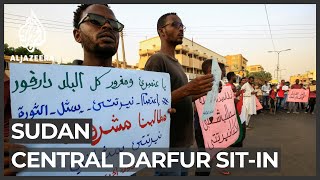
- Sudan: Growing protests against insecurity in central Darfur
Villagers in Darfur are demanding Sudan's government does more to protect them from militia attacks. Thousands of protesters in Sudan have been staging a sit-in outside the administrative headquarters in the town of Nertiti, central Darfur, for more than a week. They accuse the government of failing to protect them from militia attacks. Sudan's police chief and his deputy were sacked on the weekend. SOURCE: Al Jazeera's Hiba Morgan reports from Khartoum, Sudan.
- Ivory Coast on edge as high-stakes election looms
Tensions running high in lead-up to October polls, seen as major test of stability in world's top cocoa producer. Ivory Coast's October election was always likely to be tense - but President Alassane Ouattara's decision last month to seek a controversial third term has dramatically raised the stakes. After all, it was only on March 5 that Ouattara announced he would not stand for re-election, even as he insisted that constitutional amendments introduced in 2016 allowed him to run again. Pledging to "pass on the torch to a new generation", the 78-year-old a week later told a gathering of the governing RDHP party they "will be in good hands" as he backed Prime Minister Amadou Gon Coulibaly for president. The announcement of Coulibaly's candidacy seemed to end months of speculation that Ouattara would try to extend his stay, thus eliminating a great source of friction between the RDHP and the opposition ahead of the highly anticipated October 31 presidential election. But the relief was short-lived. On July 8, less than a week after his return to Ivory Coast from a two-month stay in France for medical treatment for recurring heart issues, the 61-year-old Coulibaly - a fervent Ouattara loyalist - fell ill during a cabinet meeting and passed away. The sudden death of the president's hand-picked successor created a leadership vacuum at RDHP; within hours, senior party officials began floating the idea of pressing Ouattara to reconsider. In the end, it was hardly a surprise when Ouattara declared on August 6 he would accept the RDHP's nomination to be its candidate - a decision he described as a "real sacrifice". The opposition, however, viewed it completely differently. Likening it to a "coup", Ouattara's furious opponents said his course reversal violated the constitution. Moreover, they warned, it risked a return to the turbulence of the past. The anger swiftly spilled onto the streets, too. Days of violent protests erupted in different parts of the country, leaving several opposition supporters dead and dozens arrested. Government opponents accused authorities of using excessive force to quell the demonstrations. Worryingly, a report by Amnesty International said police in the commercial capital of Abidjan had apparently allowed groups of machete-wielding men to attack those who defied a ban to protest against Ouattara's bid. The mounting tension has sparked fears the crisis would feed into long-simmering grievances, threatening almost 10 years of fragile peace in a country that has never seen a peaceful and democratic transfer of power. In 2002, a failed coup ignited a civil war that essentially split Ivory Coast in two, with the south controlled by then-President Laurent Gbagbo and the north in the hands of the Forces Nouvelles rebels. In 2010, a delayed presidential vote meant to draw a line under the conflict instead sparked months of post-election violence when Gbagbo refused to stand down after the electoral commission declared Ouattara the winner. At least 3,000 people were killed in the fighting that ensued between forces loyal to the two men, with both sides accused of committing atrocities. "We still remember the crisis of 2002, that of 2011 - [so] everybody is scared," said Sylvain N'Guessan, a political analyst in Abidjan, fearing that the rising level of tension building up to next month's vote could escalate into serious inter-communal violence. Jessica Moody, a researcher in the Department of War Studies at King's College London, shared the alarm. "This is an extremely big test for Ivory Coast," she said. "There is a high risk that the election will be contentious and will send the country back to war." Economic transformation Sliding into a violent power struggle would be a major setback for the world's biggest cocoa producer, where years of political stability and international support have fuelled a remarkable economic turnaround. A former top International Monetary Fund official, the Western-backed Ouattara has presided over a high-flying economy that has been expanding by an average of 8 percent annually since he took power in 2011 - before the coronavirus pandemic pumped the brakes this year. His economic stewardship, including a commitment to infrastructure construction, has won the confidence of international donors and investors alike, helping Ivory Coast to largely regain its historic role as the financial hub of francophone West Africa. But beneath the gleaming towers that have transformed Abidjan's skyline, deep economic and social inequalities continue to fester. According to the World Bank, nearly half of the country's 25 million people already lived in poverty well before the pandemic struck, leaving many more struggling to put food on the table. As war-time grievances over land ownership persist, large numbers of Ivorians remain disgruntled by their inability to benefit from the years of skyrocketing economic growth. "The rewards have not been as widespread and there is still significant poverty," said W. Gyude Moore, senior policy fellow at the Washington-based Center for Global Development and former public works minister for Liberia. "Rising inequality and high youth unemployment are breeding resentment," he added. Bubbling underneath the surface is also a lingering frustration over the unfulfilled promise of impartial justice in the post-war era, according to analysts. "In some ways, there was this image that Ouattara was sailing on a relatively calm sea for 10 years - but all the structural issues have not been addressed and are now coming back to the forefront," said Professor Jeremy Allouche, from the Institute of Development Studies, calling the country's national reconciliation "a disaster". 'Kick in the teeth' After ascending to the presidency, Ouattara had repeatedly pledged to ensure accountability for the crimes committed during the 2010-2011 violence. Nine years on, however, the transitional justice process has mainly targeted Gbagbo loyalists while those associated with Ouattara have largely been spared from prosecution. "Anger over the way that this post-conflict 'peacebuilding' process took place and the impunity it granted Ouattara supporters could easily boil over in this election," said Moody, who believes that many of those feeling marginalised under Ouattara's presidency will see the forthcoming polls "as a chance to finally change things". "The fact that Ouattara is standing for a third term is a kick in the teeth for these people and they will do anything to change it - not least since at this point they have very little to lose," she added. For Idayat Hassan, director of the Abuja-based Centre for Democracy and Development, "the fact that justice and true reconciliation was never served and the winner took all" after the war "are a recipe for disaster". "The threats are real and genuine," she said. Unsurprisingly, the showdown over Ouattara's eligibility has so far dominated the election debate, with the president's camp maintaining he has the right to run again as the 2016 constitutional changes effectively reset the countdown clock on his terms. However, the legality of Ouattara's re-election bid is not the only question surrounding the polls. Opposition leaders have long cast suspicion on the independence of the electoral commission, and there have also been complaints that voter registration has been a time-consuming and expensive process for many. Meanwhile, the government has faced accusations of "instrumentalising" the justice system into silencing opponents, including by blocking political heavyweights from standing in the election. Guillaume Soro - a former Ouattara ally and rebel commander who swept the president to power in 2011 - is in exile in France after prosecutors issued an arrest warrant against him in December last year, accusing him of plotting a coup. A few months later, the 48-year-old, who is thought to be popular among the country's growing young population, was convicted in absentia of embezzlement. Gbagbo, for his part, remains in Brussels following his acquittal last year of charges of crimes against humanity at the International Criminal Court in The Hague for the 2010-2011 bloodshed. Currently allowed to travel, he has been unable to return to Ivory Coast as the country's authorities have not issued the required travel documents. Stepping on home soil, however, could result in the 75-year-old being imprisoned due to his conviction in absentia, also for embezzlement, in a separate case. Even though both Soro and Gbagbo have been barred from running in the upcoming election because of their 20-year corruption sentences, supporters submitted candidacies in their name just before the expiration of the deadline last week. 'Turning point' One contender believed certain to run is 86-year-old former President Henri Konan Bedie, of the PDCI-RDA party, widely seen as the most likely challenger to possibly force a runoff against Ouattara. Another presidential hopeful is Pascal Affi N'Guessan, the nominee of Gbagbo's Ivorian Popular Front party, which faces internal divisions amid a struggle with some members loyal to the former president. The country's Constitutional Council now has until September 15 to announce how many out of a total of 44 applicants will make it to the final list of approved candidates. Allouche said the election marked "a clear turning point" in Ivory Coast's post-war era, with potentially big consequences for the stability of the country as well as the "larger trajectory of the state and democracy". Less than two months before the polls, however, there are still "too many uncertainties", including how those barred from running will react to their exclusion and what strategies they will put in place, he added. "We don't know what they [Soro and Gbagbo] are going to do behind the scenes … and we don't know how they're going to try and mobilise, or not, their troops," Allouche said. "Another big unknown is how the current regime is basically preparing in terms of violence, or not." In electoral terms, meanwhile, the fractured opposition's biggest challenge to date appears to be preventing an outright Ouattara victory - a likely scenario if all the major parties go ahead with their plans to field candidates on October 31. "The strategy of the RHDP is either to hope for the opposition to boycott the vote or to divide the opposition and its support base, so that they can easily win the election [in the first round]," said N'Guessan, the political analyst. Such a scenario would "probably reduce the potential for violence", added Moody. Published by Al Jazeera September 8, 2020 © 2020 Al Jazeera Media Network
- South Africa president says farm attacks not ‘racially motivated’
President Cyril Ramaphosa rejects claims by pressure groups that a spike in attacks on farms is ‘ethnic cleansing’. Ramaphosa asked all South Africans to resist any attempts to use crime on farms to mobilise communities along racial lines [File: Sumaya Hisham/Reuters] South Africa’s President Cyril Ramaphosa called for calm on Monday, rejecting claims by pressure groups representing the country’s white minority that a spike in deadly attacks on farms was “ethnic cleansing”. His appeal came after a group of mainly white farmers stormed a court on Wednesday during the hearing of two Black suspects accused of killing a 22-year-old farm manager. The lead instigator of the rioters, Andre Pienaar, 52, was subsequently jailed and charged with terrorism on Friday. Ramaphosa, in his weekly newsletter to the nation, strongly refuted claims that farm attacks were racially motivated. He instead characterised the attacks as a sad reminder that the country was still recovering from its dark past under the apartheid regime, which ended in the early 1990s. Contrary to the irresponsible claims of some lobby groups, killings on farms are not ethnic cleansing. They are not genocidal. They are acts of criminality and must be treated as such SOUTH AFRICA'S PRESIDENT CYRIL RAMAPHOSA “We would be naive to assume that race relations in farming communities have been harmonious since the advent of democracy,” Ramaphosa wrote. “Unless this is addressed in an open and honest manner, unless we are prepared to engage in dialogue, this will remain a festering wound that threatens social cohesion.” After condemning the murder of the young farm manager in the Free State province last month, Ramaphosa said the spectacle of white farmers storming a court to attack two Black suspects “opened up wounds that go back many generations”. The incident showed “just how easily the tinderbox of race hatred can be ignited,” he said. The president asked all South Africans to resist any attempts to use crime on farms to mobilise communities along racial lines. Expropriate white-owned land Murders on farms are an explosive issue in South Africa, where some white minority activist groups promote the idea that they are victims of a “white genocide” that aims to force landowners to flee. There are about 37,000 white farm operators or managers in South Africa, according to 2017 census figures. Roughly 70 per cent of privately owned farmland in South Africa is owned by whites, who make up less than 9 percent of the country’s population of 58 million. “The majority of victims of violent crime are Black and poor, and it is young Black men and women who are at a disproportionately greater risk of being murdered,” Ramaphosa said. South Africa has a high murder rate – in the 12 months up to April, police statistics show 21,325 murders, of which only 49 were white farmers. Nevertheless, claims of a “white genocide” in South Africa have gained traction among white supremacist groups across the world, and in 2018 they even caught the attention of US President Donald Trump, who in a tweet pledged to investigate South African farm murders. “Contrary to the irresponsible claims of some lobby groups, killings on farms are not ethnic cleansing. They are not genocidal. They are acts of criminality and must be treated as such,” Ramaphosa said. “The claim that violent crime on farms is part of an orchestrated campaign by Blacks to drive white farmers off their land is simply not borne out by fact,” Ramaphosa said. The government is preparing to expropriate white-owned land without compensation, as part of an effort to redress economic inequalities that remain stark a quarter of a century after the end of apartheid. © 2020 Al Jazeera Media Network
- Azerbaijan extends Armenian pullout deadline from Kalbajar
Residents of Armenian origin in Kalbajar district of Nagorno-Karabakh are on a mass exodus as Azerbaijan formally takes over. Armenia has begun handing over disputed territory to Azerbaijan as part of a peace accord that ended six weeks of fierce fighting over the disputed Nagorno-Karabakh region. Residents of the Kalbajar district, which has been controlled by ethnic Armenians for decades, began a mass exodus from the mountainous province in the days leading up to the official withdrawal date of November 15. But Azerbaijan on Sunday agreed to extend the deadline for Armenians to fully vacate for another 10 days. “Azerbaijan agreed to prolong the deadline for the withdrawal from Kalbajar of Armenian armed forces and of illegal Armenian settlers until November 25,” said President Ilham Aliyev’s foreign policy adviser, Hikmet Hajiyev. He said Aliyev had agreed on humanitarian grounds to grant an Armenian request for the delay following mediation by Russian President Vladimir Putin. “The weather is getting worse, there is only one road in that direction … and the capacity of the road is low,” Hajiyev was quoted as saying by local media. Uninhabitable Residents were seen piling their belongings into vehicles before leaving for Armenia. Some of the departing ethnic-Armenians said they had exhumed graves they feared would be desecrated by Azerbaijanis. Thick plumes of smoke rose over the valley near the village of Charektar after residents set their homes on fire – preferring to leave devastation in their wake and homes that would be uninhabitable. A Russian peacekeeping contingent deployed to Nagorno-Karabakh last week set up checkpoints and positions in the region’s administrative centre, Stepanakert, implementing the accord that sees Armenia cede the swaths of territory Azerbaijan’s forces gained in the fighting. Moscow’s peacekeeping mission, which the military said included soldiers previously stationed in Syria, comprises some 2,000 troops for a renewable five-year mission. Azerbaijan and Armenia, ex-Soviet rivals, agreed to end hostilities last week after several efforts by Russia, France, and the United States to reach a ceasefire fell through during the nearly two months of clashes. Al Jazeera’s Hoda Abdel-Hamid, reporting from Kalbajar, said the area was mostly abandoned as people loaded belongings onto vehicles and farmers herded livestock away. “There’s barely any life remaining in Kalbajar. Where these people are going to go, what their future looks like, this is still all up in the air,” she said. “It’s a big defeat, it’s a humiliation, and the people are angry.” ‘They are human beings’ A key part of the peace deal includes Armenia’s return of the districts of Kalbajar and Aghdam by November 20, and the Lachin by December 1. Hajiyev said the timetable for the Armenian withdrawal from the Aghdam and Lachin remained unchanged. All have been held by Armenians since a devastating war in the 1990s. Although the ceasefire ends the fighting, it aggravates ethnic animosity. Fleeing resident Garo Dadevusyan, who spoke as he bid farewell to his home of 21 years, noted the enmity that exists between the two peoples but said it was the governments that were to blame. “You think that I consider them [Azerbaijani] as only enemies? Yes, they are enemies and have always been enemies during the centuries. But despite that, they are human beings. It is all [the fault] of government,” he said before leaving his home. Queues of cars and trucks carrying residents jammed the road to Armenia. “They do not know what they are going to do next. Will they be able to put their children in school? How are they going to live? They do not know. This is what people told us,” said Abdel-Hamid. Hundreds of thousands of Azerbaijanis were displaced by the war over Nagorno-Karabakh that ended in 1994, and Armenians moved into the homes they vacated in Kalbajar. Al Jazeera’s Osama bin Javaid, reporting from the village of Tugana, Azerbaijan, near Kalbajar, said there was frustration over Armenian residents burning their homes as they fled. “Many people in Azerbaijan say these were their homes, to begin with. They say: ‘First they [Armenians] occupied them and now they are burning them,'” he said. It is unclear when any civilians might try to settle in the region, but returns could be wrenching, with settlers confronting the burned-out shells of houses – or worse. Aghdam, which is to be turned over next week, was once a city of about 40,000, but is now a sprawl of buildings destroyed in the first war, or later ruined by people scavenging for building materials. Armenian outrage Armenia conceded on Saturday that 2,317 fighters had been killed in clashes in which both sides accused the other of targeting civilian infrastructure. Azerbaijan has not revealed its military casualties, and the real death toll after weeks of fighting is expected to be much higher. Russian President Vladimir Putin on Friday said the number of fatalities on both sides had surpassed 4,000, and tens of thousands of people had been forced to flee their homes. Kalbajar was almost exclusively populated by ethnic Azerbaijanis who were expelled by ethnic Armenians in the 1990s war following the breakup of the Soviet Union, and the Armenian government controversially subsidised the region’s settlement by ethnic Armenians. The peace accord with Azerbaijan sparked protests in Armenia where demonstrators and opposition parties are calling for Prime Minister Nikol Pashinyan to resign. The former head of Armenia’s national security service, Artur Vanetsyan, was arrested on Saturday on charges of plotting to assassinate Pashinyan and seize power. Turkey, a key ally of Azerbaijan, was widely accused by Western countries, Russia, and Armenia of dispatching mercenaries from Syria to reinforce Azerbaijan’s army. Azerbaijan has pushed for Ankara’s involvement in the settlement and Turkish President Recep Tayyip Erdogan said last week his country would jointly supervise the ceasefire with Russia. But Russia has ruled out Turkey’s direct involvement in the peacekeeping mission and insisted Ankara would monitor the mission from an observation centre on Azerbaijani territory. See the full article and access the videos here. Al Jazeera © 2020
- South Africa anti-racism protests over ‘whites-only graduation party’
Tear gas fired outside Cape Town school after graduation party, allegedly organised by parents, was attended only by white students and teachers. People run away from tear gas during protest against alleged racism outside Brackenfell High School in Cape Town [Mike Hutchings/Reuters] The South African police have fired tear gas at opposition activists protesting against alleged racism at a Cape Town school after a so-called “whites-only” year-end dance party was organised off-site, reportedly by parents. Anti-riot police on Friday fired tear gas and water cannon at nearly 2,000 members of the radical left Economic Freedom Fighters (EFF) party who gathered near the school. “Police fired tears, stun grenade and used water cannon to prevent the protesters from approaching the school,” Al Jazeera’s Fahmida Miller reported from Cape Town. The protesters dispersed and regrouped a few blocks away. A man confronts the police during the protest outside Brackenfell High School in Cape Town [Mike Hutchings/Reuters] Miller said the protesters were “quite peaceful” and have accused the police of being heavy-handed. “They are also angry at the police and saying they won’t respond in the same manner against white protesters,” she said. Police later told the protest organisers only 100 people were allowed to march to the school. The protests were the latest in a string of demonstrations against alleged racism at Brackenfell High School following the party, which was held at a winery farm in Stellenbosch, east of Cape Town, on October 17. Prior to the event, a flyer was shared on a dedicated WhatsApp group that included several teachers, Black students from the school told local news website IOL. The flyer was not shared via regular class WhatsApp groups, one student told IOL, saying it was clear Black students were meant to be excluded. The school denies the event was an official function and maintains it was privately organised by parents. “The masked ball, referred to as a matric farewell, was a private party organised by the parents of matriculants, and did not fall under the control of the school at all,” the school’s governing body wrote in a letter to parents, according to IOL. “The function was held on a private venue and not at the school, as certain allegations claim. The governing body and staff of Brackenfell High School therefore distance themselves from any allegations that Brackenfell High School will condone or accommodate any events that are exclusively reserved for certain groups, and especially racial groups.” A few days after the party, EFF members tried to march to the school but were blocked by some of the students’ parents resulting in fistfights. Widely shared video footage showed dramatic scenes of angry white parents punching the EFF’s Black protesters on the streets on November 9. The confrontation disturbed President Cyril Ramaphosa who called for an investigation, describing the clashes as “deeply regrettable”. “The spectacle of parents and protesters coming to blows at the school gate is deeply unfortunate,” said Ramaphosa, adding the development brought “back hurtful memories of a past we should never seek to return to”. The clashes occurred a few weeks after similarly racially-charged protests in the central farming town of Senekal over the brutal murder of a white farm manager by suspected Black assailants. Despite the end of apartheid a generation ago, racial tensions in South Africa often remain high. © 2020 Al Jazeera Media Network
- Three female media workers shot to death in eastern Afghanistan
Young women gunned down in two separate attacks after leaving their television station. Three female media workers were shot dead in the eastern Afghan city of Jalalabad on Tuesday while heading home from work. Local broadcaster Enikass TV said the women killed were its employees. Zalmai Latifi, director at the station, said they were gunned down in two separate attacks after leaving the network. “They are all dead. They were going home from the office on foot when they were shot,” Latifi said. Two other people, apparently passersby, were wounded in the shootings. Latifi said the three women were recent high school graduates aged between 18 and 20. No group claimed responsibility for the attacks. Nangarhar police chief Juma Gul Hemat said an armed suspect was later taken into custody following the shootings, adding authorities were still looking for other culprits. “We arrested him as he was trying to escape,” said Hemat. “He has admitted he carried out the attack. He is a Taliban member.” However, Taliban spokesman Zabihullah Mujahid denied the group had any hand in the killings. ‘Contrary to teachings of Islam’ The three women dubbed popular and often emotion-laden dramas from Turkey and India into Afghanistan’s local languages of Dari and Pashtu, said the news editor of the privately-owned station Shokrullah Pasoon. In a statement, President Ashraf Ghani condemned the killings, saying “attacks on innocent compatriots, especially women, are contrary to the teachings of Islam, Afghan culture and the spirit of peace”. Journalists, religious scholars, activists and judges have all been targeted in a recent wave of political assassinations that have spread panic across Afghanistan and forced many into hiding – with some even fleeing the country. In January, 28-year-old Bismellah Adel Aimaq, the editor-in-chief of Sada-e-Ghor (Voice of Ghor) radio station, was killed near Firoz Koh city in the province of Ghor. In December, gunmen killed Malala Maiwand, a female news anchor at Enikass, and her driver in Jalalabad. An affiliate of the armed group ISIL (ISIS), based in eastern Afghanistan, claimed responsibility for the killing. The Afghan Journalists Safety Committee issued a statement condemning Tuesday’s killings and criticising government investigations of previous killings of journalists. Without elaborating, it said the investigations of past attacks are “not satisfactory at all, something that need to be changed”. The Vienna-based International Press Institute called the killings an “unspeakable act”. Dwindling peace process Afghanistan is considered one of the most dangerous countries in the world for media workers. Tuesday’s killings brought to 15 the number of media workers killed in the country in the last six months. The killings have increased since peace talks were launched last year between the Afghan government and the Taliban – the latest attempt to end decades of conflict. Afghan and US officials have blamed the Taliban for the wave of violence, but the group has denied the accusations. “These attacks are meant to intimidate, they are intended to make reporters cower. The culprits hope to stifle freedom of speech in a nation where the media has flourished during the past 20 years. This cannot be tolerated,” the US embassy in Kabul said in a statement. The killings come as the US special envoy to Afghanistan Zalmay Khalilzad returned to Kabul this week for meetings with Afghan leaders in a bid to revive a flagging peace process. Khalilzad’s arrival marks the first time he has returned to Afghanistan since US President Joe Biden took office in January and asked him to stay in his post. Donald Trump’s administration, eager to end the United States’ longest war, tasked the veteran diplomat with negotiating with the Taliban, culminating in a deal signed in Qatar on February 29 last year. © Al Jazeera 2021
- France bears ‘overwhelming responsibilities’ over Rwanda genocide
Report concludes there was ‘failure’ on the part of France over the genocide that saw about 800,000 people slaughtered in 1994. France bears “overwhelming responsibilities” over the 1994 genocide in Rwanda and was “blind” to preparations for the massacres, a report by historians said on Friday but added there was no evidence Paris was complicit in the killings. A historical commission set up by President Emmanuel Macron concluded there had been a “failure” on the part of France under former leader Francois Mitterrand over the genocide that saw about 800,000 people slaughtered, mainly from the ethnic Tutsi minority. Historian Vincent Duclert, who headed the commission, handed over the damning report to Macron at the Elysee Palace after years of accusations that France did not do enough to halt the killings and was even complicit in the crimes. The genocide between April and July of 1994 began after Rwanda’s Hutu president Juvenal Habyarimana, with whom Paris had cultivated close ties, was killed when his plane was shot down over Kigali on April 6. A quarter-century on, the issue still poisons modern relations between France and Rwanda under its controversial President Paul Kagame, a former Tutsi rebel who has ruled the mountainous nation in Africa’s Great Lakes region since the aftermath of the genocide. “Is France an accomplice to the genocide of the Tutsi? If by this we mean a willingness to join a genocidal operation, nothing in the archives that were examined demonstrates this,” the report’s conclusions said. “Nevertheless, for a long time, France was involved with a regime that encouraged racist massacres … It remained blind to the preparation of a genocide by the most radical elements of this regime.” The report criticized the French authorities under Mitterrand for adopting a “binary view” that set Habyarimana as a “Hutu ally” against an “enemy” of Tutsi forces backed by Uganda and then offering military intervention only “belatedly” when it was too late to halt the genocide. “The research, therefore, establishes a set of responsibilities, both serious and overwhelming,” it said. Journalist and author Andrew Wallis told Al Jazeera the report is “explosive stuff”. “The one thing that stood out for me was the fact they’re saying French intelligence knew it was Hutu extremists that shot President Habyarimana’s plane down, which was seen as the trigger for the genocide,” Wallis said. “A previous French judge’s report had denied that and put the blame on President Kagame’s RPF [Rwandan Patriotic Front party], and this misinformation has done the rounds for 27 years. It was in their archives that they knew this in fact was untrue.” ‘Personal relationship’ Macron ordered the creation of the commission in May 2019 to analyze France’s role in Rwanda from 1990-1994 through archival research. France notably led Operation Turquoise, a military-humanitarian intervention launched by Paris under a United Nations mandate between June and August 1994. Its critics say it was in reality aimed at supporting the genocidal Hutu government. There have also been repeated accusations that authorities in Paris helped suspects in the Rwanda genocide to escape while under French military protection. The report concluded that in July 1994 “murderers but also the masterminds of the genocide” were in a safe zone established by French forces in the west of the country “who the French political authorities refused to arrest”. Mitterrand and his inner circle were also fearful of the encroachment of English-speaking influence into francophone Africa under influence from Uganda and Kagame’s RPF. The report tells of French decision-makers trapped in “post-colonial” thinking who supported the “racist, corrupt and violent” regime of Habyarimana facing a Tutsi rebellion considered as directed from English-speaking Uganda. Mitterrand “maintained a strong, personal and direct relationship with the Rwandan head of state” Habyarimana, it said. “Hovering over Rwanda was the threat of an Anglo-Saxon world, represented by the RPF and Uganda, as well as their international allies.” French authorities behaved as if “acting in the face of a genocide was not in the realm of possibility” when there was a “moral obligation” to ensure genocides never happen again, the report said. The 15-member commission does not have any specialist on Rwanda, a move the French presidency argues was necessary to ensure complete neutrality. But the historians – who include experts on the Holocaust, the massacres of Armenians in World War I, and international criminal law – have been given access to archives, including those of Mitterrand himself, which were long closed off to researchers. A statement from the French presidency said Macron welcomed the report as marking “considerable progress in the understanding and description of France’s involvement in Rwanda”. Officials in Macron’s office said the inquiry was not just about improving relations with Rwanda but with the whole African continent, since other countries also have questions about what France did at the time. While he seeks to position France as an assertive player on the world stage, Macron has taken tentative steps to come to terms with once-taboo aspects of the country’s historical record, although many would like to see far bolder steps. Historian Benjamin Stora was tasked with examining France’s actions during Algeria’s war of independence and he called for a “truth commission” and other conciliatory actions in a major report delivered in January. Macron has ruled out an official apology for torture and other abuses carried out by French troops in Algeria. The contents of the Rwanda report are likely to have a major bearing on future relations between France and Rwanda, which Macron has said he wants to visit later this year. Access the full article here. Al Jazeera © 2021
- Israel-Palestine Conflict Escalation
Protests over the expulsion of Palestinian families and Israeli raids on Al-Aqsa Mosque compound preceded Israel’s heavy bombardment of Gaza. Days of heavy bombardment on the Gaza Strip intensified on Wednesday, with Israeli fighter jets bombing sites belonging to Palestinian armed groups, as well as police buildings and apartment blocks. Since the offensive began late on Monday, Gaza’s health ministry says at least 53 people have been killed, including 14 children. More than 300 others have been wounded. The Israeli army said about 1,500 rockets have been fired from Gaza towards various locations in Israel, killing at least six Israelis. The escalation is the most intense since the seven-week 2014 Israeli war on Gaza. Here’s what led to the most recent flare-up in violence. Sheikh Jarrah expulsions Anger has been growing over the forced expulsion of Palestinian families from the occupied East Jerusalem neighborhood of Sheikh Jarrah, who have been facing multiple court cases filed against them by several pro-settler organizations since 1972. These organizations claim that the land the families live on was originally under Jewish ownership, but Palestinians see this as an extension of an official Israeli policy to displace as many Palestinians from Jerusalem in order to retain a majority Jewish identity in the city. The United Nations has warned the planned expulsions could amount to “war crimes”. Protests and scuffles between Palestinians, Israeli settlers, and the Israeli police have steadily increased since the end of April. The Israeli court in October 2020 ruled that four Palestinian families should vacate their homes, and gave May 2 as the date for their forcible eviction. However, the court date has since been postponed twice. Recently, there have been confrontations as Palestinians gathered for iftar meals – the breaking of Ramadan fasts – at the homes of those being evicted. The families have since appealed to Israel’s Supreme Court. On Thursday night, at least 30 people were wounded and 15 arrested. Al-Aqsa compound clashes and raids On Friday, tens of thousands of Muslim worshippers filled the Al-Aqsa Mosque compound – Islam’s third holiest site – to pray on the final Friday of Ramadan, with many staying on to protest against the expulsions. Heavily deployed police fired rubber-coated bullets and stun grenades at protesters who responded by throwing stones. Some 205 Palestinians and 17 Israeli officers were wounded. After a violent weekend, Israeli security forces on Monday conducted a flash raid on the Al-Aqsa compound, again firing rubber-coated bullets, tear gas, and sound bombs at gathered worshippers, stoking international outrage and wounding more than 300 Palestinians. About 20 Israeli officers were also injured. Hamas later announced it had given an ultimatum for Israel to remove its security forces from the Al-Aqsa compound and Sheikh Jarrah neighborhood by 6 pm local time (15:00 GMT). Israeli air raids, Hamas rockets By early Tuesday morning, Hamas had fired some 200 rockets towards Israel, according to the Israeli military, including several targeted at Jerusalem, with many intercepted by Israel’s Iron Dome defense system. At least two Israelis were killed. Meanwhile, Israeli aerial attacks, which hit apartment buildings as well as other targets, killed at least 26 Palestinians, including children, health authorities in Gaza said on Tuesday. Despite international calls to de-escalate, Israeli Prime Minister Benjamin Netanyahu announced on Tuesday “both the might of the attacks and the frequency of the attacks will be increased” on Gaza. Hamas leader Ismail Haniya told mediators the group is “ready” if Israel increases its attacks on the besieged Gaza Strip, saying: “If they (Israel) want to escalate, the resistance is ready; and if they want to stop, the resistance is ready.” UN Special Coordinator for the Middle East Peace Process Tor Wennesland, meanwhile, has warned the situation is escalating towards “a full-scale war”. Access the full article here. Al Jazeera © 2021
- Genocide returns to Darfur
Rapid Support Forces and their Arab militia allies killed hundreds of Masalit civilians in West Darfur. A wounded man lies in a hospital run by Doctors Without Borders in the town of Adre on the Chad-Sudan border. Survivors of the ethnic violence said they saw Masalit men being shot or hacked to death with axes and machetes. REUTERS /El Tayeb Siddig November 28th, 2023 A new report by Human Rights Watch says hundreds of civilians from the west Darfur region of Sudan were killed by the paramilitary Rapid Support Forces and their allied militias. The rights group says the attacks may constitute war crimes. [Genocide Watch comment: As usual Human Rights Watch never calls genocide by its proper name, Genocide until it is over. This is GENOCIDE. Human Rights Watch is a genocide denier.] Earlier this month, there was a wave of violence targeting mostly members of the Masalit ethnic group after the RSF took over an army base in the state. © 2023 Al Jazeera Media Network
- Sri Lanka Muslims have reason to fear the new Rajapaksa era
On Saturday, November 16, 2019, Sri Lankans elected Gotabaya Rajapaksa, a former secretary of defence and brother of two-time former President Mahinda Rajapaksa, as their new president in an election that has seen rising religious tensions take centre stage. Gotabaya's election marked a return to majoritarian politics in the predominantly Buddhist South Asian island nation and left Sri Lanka's myriad minorities, especially the Muslims who constitute roughly 10 percent of the population, in a precarious position. Sri Lanka's President Gotabaya Rajapaksa waves at his supporters as he leaves, after the presidential swearing-in ceremony in Anuradhapura, Sri Lanka Nov 18, 2019 [Dinuka Liyanawatte/Reuters] He secured victory with an impressive 52.25 percent of the vote but achieved this result with hardly any support from Sri Lanka's minorities. This marked a significant shift in Sri Lankan politics since Muslims have long been perceived as "kingmakers" in the country and played a key role in determining the winners of presidential and parliamentary elections. In the 2015 presidential elections, for example, they formed a united front with Tamil and Sinhalese opposition groups to defeat then-President Mahinda. But this time around they failed to influence the result of the election and likely lost the opportunity to have a representative in the new cabinet that will be sworn-in in January 2020. But not having any representation in the cabinet is only the tip of an iceberg of problems awaiting Sri Lanka's Muslims following Gotabaya's election. The newly-elected president, who served as defence secretary under his authoritarian older brother between 2005-2015 and helped him bring an end to Sri Lanka's 26-year war with Tamil rebels, based his campaign for Saturday's election on providing strong leadership on national security issues in general and the perceived threat of "Muslim extremism" in particular. This raised concerns among Sri Lanka's human rights activists, who fear Gotabaya could repeat the human rights violations allegedly committed against minorities during his brother's tenure. Easter Sunday bombings behind Rajapaksa's rise Gotabaya's election victory came on the back of a series of coordinated bombings on Easter Sunday that killed at least 257 people and wounded hundreds of others. The attacks, which were claimed by a little known local Muslim armed group, caused the country's Sinhalese Buddhist majority to openly turn on the Muslim community. In the months that followed, as the International Crisis Group (ICG) documented in a recent report, Sinhalese Buddhist nationalists waged a campaign of "violence and hate" against Sri Lanka's Muslims, while "a weak and divided political leadership has either stood idly by or, worse, egged on the abuse". Large-scale violence was seen in Kurunegala, Kuliyapitiya and Minuwangoda among other places. As part of the Buddhist hardliners' campaign against Muslims, it is estimated that more than 30 mosques and Quranic schools, as well as 50 Muslim-owned shops and more than 100 houses, were attacked. Leading Buddhist monks, such as Venerable Rathna Himi and Galaboda Ghanasara, also openly criticised Muslims and encouraged violence against them. All this boosted the political fortunes of Gotabaya who seized the opportunity to position himself as the nation's protector against the "Muslim threat" and to run for president on a security ticket. The dramatic shift in Sri Lankan society's perception of Muslims and its decision to elect a strictly majoritarian leader like Gotabaya, however, cannot be tied solely to the Easter Sunday bombings. Tensions had long been simmering under the surface The growing anti-Muslim sentiment in Sri Lanka that at least partially led to the election of Gotabaya as president is the cumulative result of a set of insecurities specific to the Sinhalese majority. First, the Sinhalese believe that Muslims in Sri Lanka, who first arrived on the island as traders and continued to be involved in trade over the centuries, are economically better-off than the rest of the Sri Lankan population. This perception fosters a sense of unfair distribution of wealth and is one of the underlying causes behind the long-simmering tensions between the Sinhalese and Muslim communities, which led to bursts of communal violence even before the Easter Sunday attacks. Second, while the Sinhalese are clearly the majority in Sri Lanka, they carry significant demographic insecurities stemming from the fact that they are a minority in their wider neighbourhood, which is home to some 70 million Indian Tamils. As a result, even a decade after their victory against Tamil rebels, they still have deep-rooted fears about being "outnumbered" in their own homeland. Today, certain politicians and military leaders are using this deep-rooted fear to fuel not only anti-Tamil but also anti-Muslim sentiments in Sri Lanka in order to retain power and advantageous access to resources. Following the definitive defeat of Tamil separatists in 2009, the post-war economic and social challenges, particularly the lack of progress in terms of reconciliation and resettlement of displaced people, caused the Sri Lankan population to slowly cease its support for Mahinda's government. Sri Lankans raised questions about the need to maintain the very high levels of military expenditure, given that the threat posed by the Liberation Tigers of Tamil Eelam (LTTE) had been eliminated completely. The only way for the government to hold on to power at the time was to turn a blind eye to or even actively encourage the creation of "extremist" Buddhist groups, such as Bodu Bala Sena (BBS) and Ravana Balaya; groups which sought to represent the country's Muslim minority as the new enemy of the state and, in so doing, helped the government to justify its high military spending. Moreover, the creation of this new "threat" allowed Mahinda to ask the public to support the incumbent government that defeated the LTTE in the face of a new security crisis. While all these efforts did not prove enough to keep Mahinda in power - he lost the presidency in 2015 when the minorities he tried to turn into public enemies joined forces against him - it slowly paved the way for his brother's election some four years later. Even after Mahinda's removal from office, radical Buddhist groups continued to steer anti-Muslim feelings in the Sinhalese population. They even tried to use the desperate attempts by a very small number of Muslim-majority Rohingya to reach the shores of the island to convince the Sinhalese majority that Muslims present a threat to them. The BBS was very vocal of its criticism of the arrival of Rohingya refugees on the island and heavily lobbied the government to "send them back". The group argued that allowing the arrival of a small number of Rohingya refugees could pave the way for a major Muslim refugee influx which, they claimed, would cause a "religious imbalance" and a higher number of terror incidents on the island. These very same groups also led the attacks and boycotts on Muslim businesses following the Easter Sunday bombings. Third, Sri Lankan Muslims are treated with a growing sense of suspicion by the Sinhalese partly due to a rising conservative trend linked to religious influence from the Middle East. In early 1980, Following the entry of Saudi-funded mosques and satellite television channels proselytising Wahhabi ideals into the country, Muslims in Sri Lanka started to take on increasing signs of religious identity, beginning with the introduction of Hijab as part of school uniforms for girls in the 1980s. This caused alarm among the Sinhalese, who viewed the growing conservatism of the Sri Lankan Muslim community as a worrying sign of its descent into extremism. These insecurities, exacerbated by the fears triggered by the 9/11 attacks and the consequent mainstreaming of Islamophobia across the world, led the Sinhalese in Sri Lanka to grow increasingly suspicious of Muslims. With some politicians and nationalist groups using these fears and insecurities to gain favour in the eyes of the public, and fringe Muslim extremist groups targeting innocent civilians, these suspicions transformed into outright hostility and caused a return to majoritarian politics in the country. Following the election of Gotabaya as president, Muslims in Sri Lanka are facing the risk of being marginalised further. As he was elected on the premise of restoring security, Gotabaya is likely to bring forth a government that will play on Sinhalese fears about Muslims and prioritise security on the national agenda. In short, Muslims in Sri Lanka are likely to face a harsher crackdown under Gotabaya's leadership than ever before. Copyright 2019 Al Jazeera Sultan Barakat is Professor of Politics at the University of York. The views expressed in this article are the author's own and do not necessarily reflect Al Jazeera's editorial stance.
- "Not One Less" protest held despite lockdown in Argentina
Despite the nation's COVID-19 lockdown, many women still protested for gender reform in Buenos Aires, Argentina on June 4. Since the lockdown began, at least 57 women have been killed from femicide, which is the killing of women because of their gender. This movement, which originated in Argentina, has gained momentum in the last five years. Photo Credit: Al Jazeera
- Armed fighters free over 1,300 prisoners from DR Congo jail
Assault on Kangbayi central prison and military camp blamed on Ugandan armed group ADF by town’s mayor. Published by Al Jazeera on October 20, 2020. The armed group ADF has been blamed by Beni's mayor to have carried out the attack. [File: Goran Tomasevic/Reuters] Armed fighters freed more than 1,300 prisoners from a jail in Beni in east Democratic Republic of the Congo (DRC) in a coordinated attack that took place in the early hours of Tuesday. Only about 100 remained following the simultaneous assault on the Kangbayi central prison and on the military camp that provides security to it, said the town’s mayor Modeste Bakwanamaha, who blamed a rebel group operating in the area for the attack. He said that 20 of the escaped prisoners had already returned. “Unfortunately, the attackers, who came in large numbers, managed to break the door with electrical equipment,” Bakwanamaha told Reuters news agency by phone. No group immediately claimed responsibility for the attack but Bakwanamaha said: “We believe that it was the ADF who did this.” Two inmates were shot dead during the raid, which started at about 4.30 am local time (0230 GMT), police said on Twitter. The Allied Democratic Forces (ADF), a Ugandan armed group active in east DRC since the 1990s, has killed more than 1,000 civilians since the start of 2019, according to UN figures, despite repeated military campaigns aimed at destroying it. Kangbayi prison holds a variety of fighters including members of local defence forces and ADF fighters. Bakwanamaha said there were rumours ADF fighters in the prison were preparing a break-out in the days preceding the attack. A similar number of inmates escaped when the jail was attacked in June 2017. About six years ago, ADF started to attack villages, killing people using machetes and guns. They have also abducted hundreds over the years. UN officials say up to 500 civilians have been kidnapped in the last year and a half. Several attacks attributed to the ADF have also been claimed by Islamic State, although United Nations experts have found no evidence of a direct connection between the two groups. A year ago the army launched a large-scale counter-rebel campaign against the ADF. In response, the group abandoned its bases, split into smaller, more mobile groups, and retaliated against civilians. © 2020 Al Jazeera Media Network