Djibouti Country Report 2026

Updated: May 13

Djibouti Country Report
March 2026
By Larisa W Chikanya
Djibouti is a small republic of approximately 1.1 million people located at the southern entrance to the Red Sea, at the Bab el-Mandeb Strait, bordering Eritrea, Ethiopia, and Somalia. Its position along one of the world’s most strategic maritime routes has made it a hub for foreign military presence, hosting bases operated by the United States, France, China, Japan, and Italy. The country’s population is primarily divided between the Issa-Somali majority and the Afar minority, who make up roughly one-third of the population and are concentrated in northern and western regions.
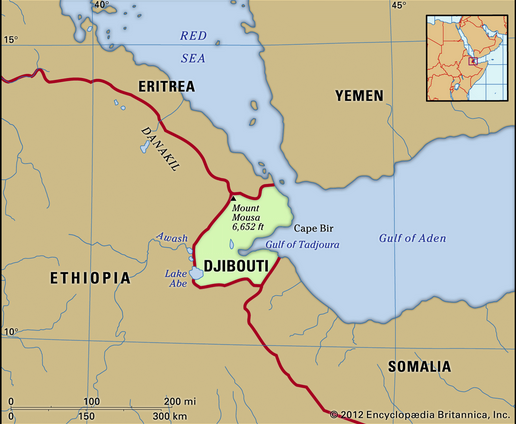
Map of Djibouti and surrounding nations. Source: Encyclopedia Britannica
Since independence from France in 1977, political power has remained concentrated within an Issa-dominated elite. Under President Hassan Gouled Aptidon, the country became a one-party state in 1981. During this period, human rights organizations documented the repression of political opponents, including arbitrary detention and torture.
In 1991, Afar armed groups formed the Front for the Restoration of Unity and Democracy (FRUD), launching an insurgency against the government. The civil war that followed (1991–2001) was characterized by serious human rights violations, including extrajudicial killings and abuses against civilians. French military support bolstered the Djibouti government. the civil war ended in 2001.
President Ismail Omar Guelleh, in power since 1999, has consolidated authority through constitutional amendments, including the removal of presidential term limits in 2010. The legacy of the civil war continues to shape Djibouti’s political and social environment. Long-standing grievances among Afar communities regarding political exclusion, land access, and representation remain largely unresolved.
Opposition parties face restrictions, and in 2008 the Mouvement pour le Renouveau Démocratique et le Développement (MRD) was dissolved by presidential decree. In 2020, the United Nations (U.N.) Human Rights Committee found this action violated the International Covenant on Civil and Political Rights, a ruling that has not been fully implemented.
Elections in 2011, 2016, and 2021 have been characterized by opposition boycotts and overwhelming victories for the incumbent, raising concerns about political competitiveness and democratic integrity. Cases of political repression continue to be reported. In 2021, Air Force Lieutenant Fouad Youssouf Ali was sentenced to ten years in prison after calling for an armed uprising, prompting concern from international human rights organizations.
Djibouti’s geopolitical importance has contributed to limited international pressure on governance issues. Foreign militaries maintain a strong presence in the country. They prioritize national and regional stability and counterterrorism cooperation over human rights concerns. Future instability seems likely in the absence of accountability for past abuses, combined with ongoing political restrictions and entrenched ethnic divisions.
Due to the government’s concentration of power within a narrow ruling elite, the systematic restriction of opposition parties and political participation, and the persistence of ethnic divisions between Issa and Afar communities, Genocide Watch considers Djibouti to be at Stage 3: Discrimination and Stage 5: Organization. Restrictions on civil society and media, and reinforcement of political and ethnic divisions place Djibouti at Stage 6: Polarization. The absence of accountability for past human rights violations, particularly those committed during the civil war, alongside the lack of transitional justice mechanisms, reflects Stage 10: Denial, continuing Djibouti's history of crimes against humanity.
Genocide Watch recommends that the Djibouti government should:
Comply with international human rights treaties;
Implement U.N. Human Rights Council recommendations;
Allow opposition parties to operate freely and safely;
Cooperate with an independent U.N. Human Rights Council review of Djibouti's past human rights violations, including those committed during the civil war;
Cooperate with monitoring by human rights NGOs of Djibouti's political freedoms and detention practices.