

Persecution in India: The Eighth Stage of Genocide

In part eight of our Ten Stages of Genocide in India Series, we explain how the eighth process/stage of
genocide, Persecution, is occurring in India.
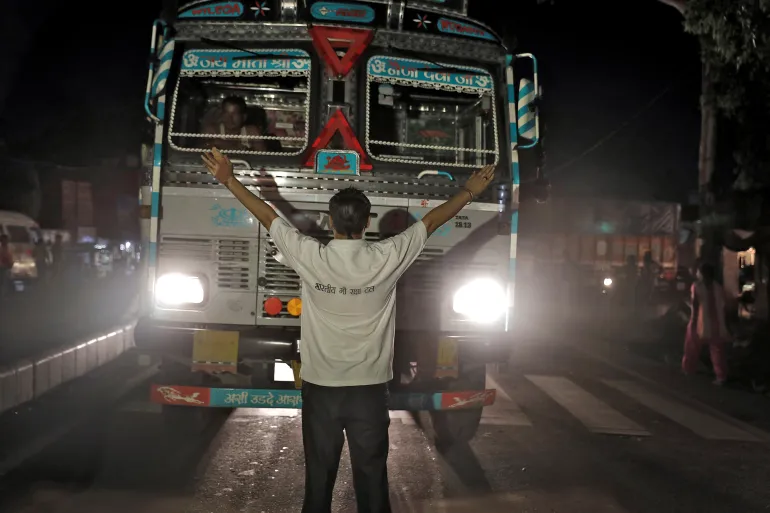
Pawan Pandit, a cow vigilante, stops a truck at a road block near Chandigarh, India [File: Cathal McNaughton/Reuters]
Persecution is the stage when the state or state-endorsed perpetrators commit destructive acts against a
targeted victim group. The group’s human rights are violated through extrajudicial killings, the
expropriation of assets, and forced displacement. The group may be segregated into ghettos or
deprived of food, water, and health care in displaced persons camps.
Persecution may also include cultural genocide, where victims are forcibly converted to a different
religion. An example of this is the forced conversion campaign that was carried out by ISIS during
the Yazidi Genocide in Iraq.
In India, acts of persecution against Indian Muslims have increased since Prime Minister Narendra
Modi and the BJP came to power in 2014. At the grassroots level, vigilante groups attack Muslims,
Christians, and other religious minorities. There has been a sharp increase in extrajudicial killings
against Indian Muslims. The courts and police are often complicit in these crimes. The perpetrators
are not arrested, or they face only minimal charges. They know they can commit their crimes with
impunity.
The extrajudicial killings of Muslims have been of special concern in states like Uttar Pradesh that
have outlawed cow slaughter. Many of these murders are perpetrated in cases of cow vigilantism.
Hindus consider cows to be sacred animals. Under Modi’s government, vigilante “cow protection”
groups have mushroomed. Since Modi first came into power in 2014, there have been over fifty
lynchings of Muslim men accused of cow slaughter.
An incident that illustrates the process of Persecution in India is the lynching of Mohammad Akhlaq in
Uttar Pradesh. He was a Muslim man who was murdered by a Hindu mob in Dadri, Uttar Pradesh
in 2015. Based on unsubstantiated rumors, Hindu vigilantes accused Akhlaq of storing and
consuming beef. A Hindu mob gathered around his house and brutally beat him to death. The Indian police made initial arrests within a week of the lynching. But they took three months to file charge sheets with a court. Bail was granted to the fifteen men accused of the lynching. Their release was met with public celebrations. In 2016, instead of indicting the killers, the court ordered criminal charges for cow slaughter against Akhlaq’s grieving family. In 2025, the BJP-led state government directed the local court to drop all charges against the killers.
The ghettoization of the Indian Muslim population is another sign of Persecution, the early warning
stage just before genocide. The state legislature in Gujarat facilitated the persecution of Indian Muslims by adopting and amending the Disturbed Areas Act. The Act was initially intended to stop
rushed sales of property during or in the aftermath of mob attacks, euphemistically called
“communal violence.”
State governments have the power to declare an area “disturbed,” which requires that property sales
between religious communities be suspended until the state Collector confirms that the buyer and
seller have both exercised free consent for a sale. In practice, the Disturbed Areas Act has become a
tool to prevent Muslims from buying houses or apartments in Hindu-majority neighborhoods. The
result has been segregation of Muslims into de facto ghettoes.
In 2020, the Disturbed Areas Act was amended to increase the punishment for buying or selling
property in areas where the state government has invoked the Disturbed Areas Act. The Home
Minister of Gujurat, Pradeepsinh Jadeja, explained that the amendment would “keep a check on
attempts to cause demographic imbalance”.
Muslims from all socioeconomic backgrounds have increasingly purchased property only in Muslim-
majority areas in cities like Juhapura. They have stopped buying property in Hindu areas, both for
their own safety and because the Act makes Muslims unable to purchase or live in Hindu majority

A Muslim resident walks past overflowing open sewage in the Juhapura area of Ahmedabad. | Sam Panthaky/AFP
Genocide Watch recognizes the impunity with which vigilante groups carry out violent attacks
against the Muslim population, anti-conversion laws in many states, and laws like the Disturbed
Areas Act as indicators that Indian Muslims currently face the genocidal process of persecution.
Genocide Watch recommends:
The Indian government must reform procedures for police in Muslim areas.
Many more Muslims should be hired into the Indian Police Service.
Police training should include fostering positive community relations between Muslims and Hindus, crowd control, and overcoming religious bias.
The Indian government should establish community response teams to investigate complaints about improper conduct of law enforcement agencies.
States should repeal their cow protection laws.
Following directives from the Indian Supreme Court on lynching and mob violence, states should enact and enforce laws prohibiting mob lynching.
The BJP must swiftly and publicly condemn crimes committed by Hindutva vigilante groups and direct police and courts to fully prosecute those involved in vigilante crimes.
Gujarat and other states should repeal the Disturbed Areas Act
Read Part One of the series here : The Ten Stages of Genocide in India - Classification
Read Part Two of the series here : The Ten Stages of Genocide in India - Symbolization
Read Part Three of the series here : The Ten Stages of Genocide in India - Discrimination
Read Part Four of the series here : The Ten Stages of Genocide in India - Dehumanization
Read Part Five of the series here: The Ten Stages of Genocide in India - Organization
Read Part Six of the series here: The Ten Stages of Genocide in India - Polarization
Read Part Seven of the series here: The Ten Stages of Genocide in India - Preparation


