

Special report: Gaza and the Ten Stages of Genocide

By Karolina Bonde, Genocide Watch
October 2026
Genocide is one of the most severe crimes in international law, defined as acts committed with the intent to destroy, in whole or in part, a national, ethnic, racial, or religious group. This crime does not begin with mass graves. It begins with language, law, and the slow erasure of a people's humanity. Dr. Gregory Stanton maps that process in Ten Stages of Genocide, a warning system built from the ashes of Rwanda, the Holocaust, Armenia, and more.
In September 2025, a United Nations (UN) commission concluded that Israel has committed genocide in Gaza, as did Amnesty International, B’tselem, Human Rights Watch, and the International Association of Genocide Scholars (IAGS). Genocide Watch has issued several Genocide Emergency Alerts.
The current Israeli assault in Gaza began after Oct. 7, 2023, following Hamas’s genocidal attacks in Israel, which killed more than 1,200 people and resulted in around 250 people being taken hostage. Israel’s military campaign has caused the deaths of more than 73,000 civilians and injured over 173,000 civilians. The violence has produced patterns of injury associated with intense combat.
Genocide is a process, not an event, that develops in nonlinear stages. These stages overlap, accelerate, and feed each other. In Gaza, we watched it unfold in real time, and this report illustrates how each stage was enacted. This short report cannot include every genocidal act deployed, nor should it be read as a definitive portrait of the genocide. It is offered instead as evidence that the full framework of the Ten Stages of Genocide was systematically employed.
I. Classification
All cultures have categories to separate people into "us and them." Bipolar societies that lack mixed categories are the most likely to have genocide. Removal or denial of a group's citizenship is a legal way to deny their civil and human rights.
In Gaza
Since 2004, Gaza has been subject to classification. Israel imposed a blockade by land, sea, and air, controlling the movement of all people and goods in and out of the territory. Palestinians in Gaza cannot travel without Israeli approval, and permits were difficult or impossible to get. Israeli courts formally classified Palestinians in Gaza as an “enemy entity,” thus removing civilians’ legal protections.
II. Symbolization
Names or other symbols are applied to classifications. When combined with hatred, symbols may be forced upon unwilling members of pariah groups. Examples include the yellow star for Jews under Nazi rule and the blue scarf for people from the Eastern Zone in Khmer Rouge Cambodia.
In Gaza
Since 1981, Israel has enforced a color-coded ID regime across occupied Palestinian territory, assigning green identity cards to Palestinians to restrict their freedom of movement and access to work, education, and healthcare, while marking them as a controlled population.
III. Discrimination
A dominant group uses law, custom, and political power to deny the rights of other groups, driven by an exclusionary ideology that legitimizes the victimization of weaker groups. This has been seen in the Nuremberg Laws of 1935, which stripped Jews of German citizenship, and the denial of citizenship to the Rohingya in Myanmar, which led to genocide in 2017.
In Gaza
In Israel/Palestine, discrimination is codified. Adalah, the Legal Centre for Arab Minority Rights in Israel, maintains a database of over 65 Israeli laws that discriminate directly or indirectly against Palestinians, limiting their rights across citizenship, political participation, land, housing, education, and detention. The cornerstone of this legal framework is the 2018 Nation-State Law, which states that the right to self-determination is the sole right of the Jewish people.
IV. Dehumanization
One group denies the humanity of the other, equating its members with animals, vermin, insects, or diseases. The majority is taught to regard the other as less than human and indoctrinated to believe that "we are better off without them.”
In Gaza
After Hamas’s attacks on Oct. 7, 2023, dehumanizing language was used at the highest levels of the Israeli state. Defense Minister Yoav Gallant declared: "We are fighting human animals and we are acting accordingly. There will be no electricity, no food, no fuel." Prime Minister Benjamin Netanyahu invoked the biblical Amalek, the enemy nation that God commanded King Saul to exterminate, framing Gaza's civilian population as an ancient evil to be annihilated.
Beyond such speeches, Amnesty International reviewed 102 statements from Israeli officials between October 2023 and June 2024 that dehumanized Palestinians or called for genocidal acts; 22 of them were from senior officials directly managing the offensive. Soldiers on the ground used the same language: verified footage shows them calling to "erase" Gaza and celebrating the destruction of homes, mosques, schools, and universities.
V. Organization
Genocide is always organized, often by the state. Special army units or militias are trained and armed. Plans are made for genocidal killings.
In Gaza
Israel's intelligence agencies, Mossad and Shin Bet, established a specialized operations center and elite military force, Nili. Additionally, Israel used two artificial intelligence targeting systems, Lavender and Gospel, according to investigations by two Israeli outlets, which were corroborated by The Guardian. Lavender marked people and placed them on a kill list, while Gospel marked buildings and structures. One intelligence officer described his role as a mere “rubber stamp” on the system's decisions, spending only seconds reviewing each recommendation and allowing up to 20 civilians to be killed in the process of pursuing a single low-level Hamas operative. Guided by Artificial Intelligence, Israeli airstrikes killed thousands of Palestinians, most of them women, children, or people not involved in fighting.
VI. Polarization
Extremists drive the groups apart. Hate groups broadcast polarizing propaganda. Laws may forbid intermarriage or social interaction. Extremist terrorism targets moderates, intimidating and silencing the center.
In Gaza
Alongside its military offensive, Israel has waged a parallel war online, and a coordinated barrage of disinformation has flooded social media. Pro-Israeli accounts used the terms "Pallywood" and "Gazawood" to suggest that reports from Gaza are exaggerated or manipulated, with claims being made that Palestinians use actors in crisis scenes and alter footage to mislead global audiences. Experts argue the terms are designed to dismiss the real suffering of Gaza's civilians.
Gazan journalists have been relentlessly defamed and threatened since the start of the offensive, from the circulation of doctored images to the creation of online platforms designed to discredit them. Israeli officials have played an active role in these smear campaigns, and accusations have been used to justify targeted attacks on reporters. As of June 2026, The Committee to Protect Journalists (CPJ) has documented 207 journalists and media workers killed by Israel in the war, including at least 64 killed in direct reprisal for their work, making it the deadliest conflict CPJ has recorded.
On March 30, 2026, Israel passed the Death Penalty for Terrorists Law, which applies exclusively to Palestinians and mandates restricted legal representation, death by hanging, and immunity for those who carry out executions. The UN Committee on the Elimination of Racial Discrimination warned that the law “perpetuates racial discrimination against Palestinians and amounts to a grave erosion of human rights.”
VII. Preparation
Perpetrator group leaders plan the "Final Solution" to the targeted group "question." They often use euphemisms to cloak their intentions, disguising genocide as self-defense. Armies are built, weapons bought, troops trained. The populace is indoctrinated with fear of the victim group.
In Gaza
From the outset, Israel framed its military assaults as acts of self-defense that targeted Hamas terrorists and their infrastructure, and it attributed civilian deaths to Hamas’ use of human shields. When called to justify its bombardment before the International Court of Justice in January 2024, Israel insisted it was engaged in a war against Hamas, not the Palestinian people. The language of counterterrorism provided a framework in which the destruction of an entire civilian population could be presented as a regrettable but necessary consequence of legitimate military operations.
On the ground, civilians were directed to designated "safe zones," only to be bombed there. Under international pressure, Israel designated Al-Mawasi a "safe zone" in October 2023, using leaflets, social media, and phone calls to direct people there. Those who arrived found it unfit for human habitation. The WHO chief called the designation "a recipe for disaster." Israel then attacked the camp throughout 2024, killing at least 90 people and wounding 300 others in July 2024 alone.
VIII. Persecution
The victim group's most basic human rights are systematically violated through extrajudicial killings, torture, and forced displacement. Death lists are drawn up. Sometimes they are segregated into ghettoes, deported to concentration camps, or confined to a famine-stricken region and starved. They are deliberately deprived of resources such as water or food, in order to slowly destroy the group. The perpetrators watch for any effective international response to such killing. If there is no reaction, they realize they can get away with genocide.
In Gaza
As mentioned above, Israeli officials made clear that they would deprive civilians in Gaza of food, water, and fuel, and those statements were reflected in subsequent military operations.
Israeli forces deliberately blocked the delivery of water, food, and fuel in several instances, depriving the civilian population of objects indispensable to their survival. The UN has also reported that Israeli authorities have severely undermined and weaponized Gazans’ access to water, sanitation, and hygiene.
Palestinians in Gaza have been systematically detained, tortured, and deported. The UN Special Rapporteur on Torture compiled 52 incidents of torture or ill-treatment and a further 33 incidents of sexual torture. At least 94 deaths in custody since October 2023 have not been investigated.
IX. Extermination
Extermination begins and quickly becomes the mass killing legally called "genocide." It is "extermination" to the killers because they do not believe their victims to be fully human. When it is sponsored by the state, the armed forces often work with militias to do the killing. "Total war" does not differentiate civilians from combatants. Carpet bombing, firebombing, and bombing hospitals are war crimes and acts of genocide. Destruction of cultural and religious property is employed to annihilate the group's existence from history.\
In Gaza
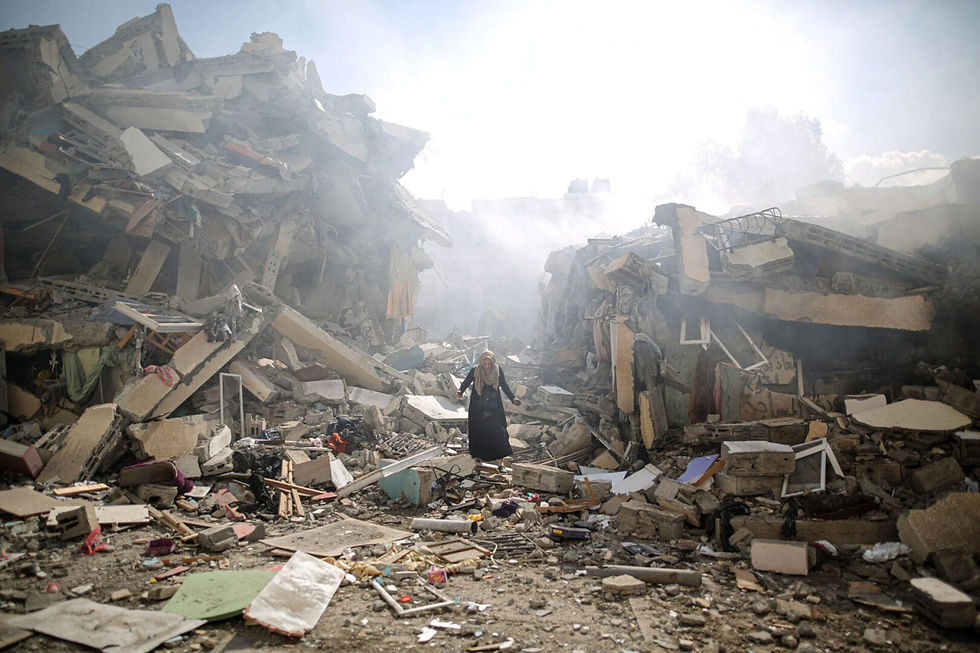
The speed and scale of destruction in Gaza is, in Amnesty International’s words, "unprecedented in this century." Within a year, Israel's military offensive had killed more than 69,000 Palestinians, including over 20,000 children, and injured over 170,000 more. Entire cities have been razed, critical infrastructure destroyed, and large swaths of the territory rendered uninhabitable.
Gaza's healthcare system has been systematically targeted. Over 1,400 healthcare workers have been killed since the beginning of the offensive, with hospitals and ambulances repeatedly struck. Amnesty International has also documented the killing of hundreds of Palestinians seeking food at militarized aid distribution sites, a pattern the UN has described as a "killing field.”
Amnesty International gathered compelling evidence documenting the use of white phosphorus artillery shells by the Israeli army in densely populated civilian areas in Gaza, many of which may be considered unlawful indiscriminate attacks.
X. DENIAL
Denial is the final stage, among the surest indicators of further genocidal massacres. Perpetrators dig up mass graves, burn bodies, cover up evidence, intimidate witnesses, and often blame what happened on the victims. During and after genocide, lawyers, diplomats, and others deny that these crimes meet the definition of genocide. They apply euphemisms like "ethnic cleansing." They question whether intent can be proven, ignoring thousands of murders.
In Gaza
Since the beginning of its military campaign in Gaza following the Hamas attacks of Oct. 7, 2023, the Israeli government has consistently rejected accusations that it is committing genocide. Genocide Watch identified 12 distinct tactics of denial employed by Israel.
Israel maintains that it is acting in self-defense while taking measures to minimize civilian casualties. Israeli officials argue that the objective is the defeat of Hamas and the rescue of hostages, not the destruction of the Palestinian people.
Israel and its supporters have challenged casualty figures and evidence presented by Palestinian authorities, UN agencies, and human rights organizations, arguing that information originating from Gaza may be influenced by Hamas and cannot always be independently verified. Israeli officials have frequently characterized criticism of Israel's actions as biased, antisemitic, or sympathetic to Hamas. Critics argue that these responses seek to undermine the credibility of investigators, journalists, humanitarian organizations, and international institutions documenting events in Gaza.
The Ten Stages of Genocide framework is designed to prevent genocide, not to document it after the fact. Prevention requires action at every stage. The international community had opportunities to intervene at each of the ten stages documented here, but it did not. Furthermore, Genocide Watch identified the United States as actively complicit in Israel's actions. History will record not only what was done to the Palestinian people, but what was permitted and enabled by those with the power to stop it.
Creative Commons Copyright 2026 Genocide Watch Inc. This article may be copied and reproduced freely with credit to Genocide Watch Inc. so long as it is copied or reproduced in its entirety without any alteration.
Report:


