Search Results
Search this site
7101 results found with an empty search
- Aung San Suu Kyi has 2 irreconciliable messages: one in English for world & another Burmese, for
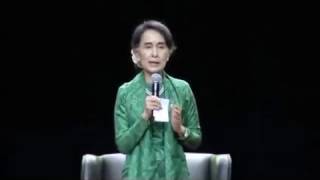
Compare Suu Kyi's Channel News Asia interview -- https://twitter.com/ChannelNewsAsia/status/804668896842129409?s=07 - which CNA just tweeted - very sweet, very soft, very honey-tongued with this home-crowd Burmese language message yesterday: https://www.youtube.com/watch?v=3H2xw-U066s&feature=youtu.be The English language translation - which can be verified independently by any bi-lingual Burmese - is cut and pasted here. Burmese Public Meeting with Aung San Suu Kyi, Singapore, 1 Dec 2016 Question in writing which Aung San Suu Kyi reads out loud: “Dear Mother We are all witness to the difficulties that confront your new government, most particularly the external fabrications (a specific reference to the Rohingya ethnic cleansing and genocide). We the Burmese are fully in support of Mother’s Government. So, here is my question: How do you perceive these (allegations of abuse and ethnic cleansing of Rohingya) fabrications that are causing you ‘challenges’? Can these fabricators succeed? As your Children, what types of preparations do you think we should be undertaking? In order to assuage the worries (about these fabrications) the Burmese public who love and adore you ask you to please let us, your children, know your view on these fabrications. Your loving son and a good Burmese citizen, who has been supporting you since I the age of 8 – in 1996.” Aung San Suu Kyi’s Answer: "Well, the fact that you know these (allegations of abuse of Rohingya) to be “fabrications” is already of major help to our government. If they are playing these tunes of fabrications you just play your own tune back to them. In the end what matters is that we are not swayed or influenced or buying into these fabrications. Let me stress this: as long as our Burmese public do not buy into these fabrications, these fabrications cannot really become any serious problems – beyond them becoming really annoying. But at the same time, all governments and all leaders can make mistakes. If our government need to make changes in the way we govern, I request you all, the public, to come forward boldly with suggestions and ideas which rest on good intentions. "
- Toward peace, reconciliation, and an end to genocide
Cambodians in outlying provinces were given an opportunity to watch live the most important verdict in the Khmer Rouge Trial to date prompting an outpouring of emotion, Julia Mayer writes. This month marks a momentous event in Cambodia’s modern history, and the lives of its people, with the handing down of a final verdict by the Extraordinary Chambers of Courts of Cambodia (ECCC) in the first case concerning two surviving senior officials from the Khmer Rouge regime, Nuon Chea and Khieu Samphan. The Documentation Centre of Cambodia organised live screenings of the decision, held mostly in Buddhist temples and monasteries, in seven remote rural locations, with the aim of providing access to otherwise hard-to-come-by information. Screenings took place in the far-flung provinces of Stung Treng and Mondulkiri, the nearer but isolated districts of the Takéo, Svay Rieng and Kandal provinces, as well as Kampong Chhnang and Kampong Cham which have the largest concentration of Muslims in the country. Briefings targeting ethnic minorities, marginalised peoples, ex-Khmer Rouge soldiers and cadre, villagers and school-aged students took place prior to the 9am pronouncement, which took one and a half hours to deliver. Following the verdict, forums were held for participants to express their reactions and opinions relating to justice, and the ongoing issue of healing and reconciliation. Each venue had at least two Documentation Centre representatives present to guide the participants through the history of the Khmer Rouge Tribunal and case-specific content. Documentation Centre staff also distributed materials including copies of Khamboly Dy’s A History of Democratic Kampuchea(2007 DC-Cam), which is a now a staple textbook for all secondary students in Years 9-12. A book specifically about the founding case against the surviving Khmer Rouge officials, known as 002, was also provided, as was a booklet on the history of the ECCC, including a summary of the Trial Chamber’s original judgment in case 002/01 (which narrowed the scope of 002). Elderly survivors from the Prek Phtoul commune in the south-western Takéo Province welcomed the news of the final verdict, in addition to the opportunity to discuss the hardships endured under the regime. “I believe this is about Karma because they did bad deeds, they were very cruel,” said Mrs Srey Yeng, 71. She recalled how at eight-months pregnant, she was assigned hard labour as part of the ‘four-year plan’ (1977-1980) where improbable tonnes of rice were expected to be yielded from war-scarred territory. When her three-year-old daughter became gravely ill with disease-related malnutrition, she requested permission from the collective leaders to attend to her. “You are not a doctor. You just keep working. Your children are looked after,” she remembers one saying. Yeng lost a total of ten family members, along with her daughter who died shortly after this incident. The estimated number of deaths from starvation, execution, disease and overwork, ranges anywhere from 1.7 – 2.2 million – just under a third of the population at that time. That suggests there is not a person living today who remains unaffected by the aftermath of the near four-year reign of terror. More than 40 years later, the yawning wounds of the era may have healed into palpable scars, though reconciliation has been met with a degree of incredulity and repudiation particularly among the younger generation. “I have often shared my experiences with my grandchildren, but I am never quite sure they believe me,” said Mrs Sok Phy, 79, echoing others who have found it a struggle to explain the extreme oppression endured. Accompanied by her grandchildren, Pech Keat, 72, points to a page in her copy of A History Of Democratic Kampuchea provided at the screening. “During Khmer Rouge regime, I worked like them. It was unimaginable hardship,” she tells them, hoping that the grainy, muted grey and brown photographs will work in some way as proof of her nightmarish existence under the regime. While the Khmer Rouge Tribunal has been heavily criticised for lengthy delays, arguably its greatest impact has been on valuing education as a means of genocide prevention. “One of the most significant effects has been in the form of generating discussion and raising awareness,” said Youk Chhang, Executive Director of the Documentation Centre of Cambodia. Additionally, revealing evidence to explain what happened during the period, in order to understand how it could ever have happened, highlights the importance of justice both in the present and for the sake of the future. “How can a country profess to have the courage to take on the problems of the present and future, if it does not even have the courage to face its past?” asked Chhang who has been instrumental in getting a genocide studies program up and running to heal a forty-year division between perpetrators and victims. To date, over half a million people have visited the tribunal, with a large percentage being mostly school-aged students from rural areas participating in the outreach program. The Khmer Rouge Study Tour is a one-day affair where interested parties such as NGOs and students visit the ECCC, the nearby Choeung Ek ‘Killing Fields’ and the Tuol Sleng Genocide Museum, the Khmer Rouge’s most notorious prison-security centre codenamed S-21. For the elderly and for those marginalised by distance and other circumstances, the live screenings importantly provided an opportunity to work toward healing and reconciliation within their own small communities, still very much plagued by social issues. “I do not want personal compensation,” says 51-year-old Mr Dang Sheang. “What I hope to see are the kind of education measures being put in place now, which will continue to serve as a reminder to younger generations to protect the country from mass atrocity. ________________________________ © Copyright 2016 New Mandala Julia Mayer is a Masters of Museum and Heritage Studies student at the Australian National University. She has lived in Malaysia, Indonesia, Vietnam and South Korea, and has written extensively on traditional arts, performances and cinema in the region. She is also the Asia Correspondent for Metro Magazine Australia.
- Aung San Suu Kyi in Defiance of World Opinion On the (Rohingya): "externally fabricated problem
The Singapore based Burmese held a massive town-hall meeting with AungSanSuuKyi this evening in Singapore. She discussed her 21st Century Panglong, telling the audience that the problem for lack of peace is mis-understanding among top leaders. The ethnic armed organizations who have not signed peace "lack courage and wisdom to make peace'. Overall, the thrust and tone of her entire speech is essentially economic/developmental nationalism: making Burma great, again! To wild and thunderous cheers, she promised to make Burma an envy of Asia, overtaking Singapore economically in the next 20 years. Now on to the subject that concerns me: the Rohingya. My heart sank even deeper listening to the Q and A (she read out questions submitted in writing) and here is the accurate transcription (my English translation, which I stand by 100 against the recorded Burmese language exchange. I think that actual Burmese exchanges will be on YouTube if people are interested in verifying my transcript below against the Burmese language exchange). asked directly re: fabricated issue (of #Rohingya): Q: We as Burmese are worried about the externally fabricated issue (implying in no uncertain terms Rohingya). How prepared is your leadership to deal with this fabricated campaign? We Burmese are fully behind you as our leader. ASSK: Well, the fact that you know this problem to be externally fabricated is already a very good national defence. They (fabricators of Rohingya crisis) are playing their tune to our ears. Too noisy now! (Laughing out loud). Well, we must have our own tune to play the world back. Q: I worry about the security of our borders. What is your government doing to make our borders secure and safe. A: In some places we have border walls. The walls we have built along the borders may not be tall or high enough. If we build stronger and taller walls it will cost the gov. a lot of $. But to protect our people we are prepared to spend as much as is necessary. 50% of the safety measures are like building walls. (the other 50 is non-material like citizens themselves not involved in cross-border illegal smuggling).
- Angola: New Media Law Threatens Free Speech
Update: On January 23, Angolan President Jose Eduardo Dos Santos signed the new media law that limits freedom of expression, despite opposition from the Journalists Union and other groups. The union said it would challenge the law before the Constitutional Court. (Johannesburg) – Angolan President José Eduardo dos Santos should refuse to sign a new media law until parliament revises provisions restricting the right to freedom of expression, Human Rights Watch said today. The law grants the government and ruling party expansive power to interfere with the work of journalists, and potentially to prevent reporting on corruption or human rights abuses. Angola's President José Eduardo dos Santos gives an interview to the media, which remains largely controlled by the ruling Popular Movement for the Liberation of Angola (MPLA), August 31, 2012. © 2012 Reuters Parliament passed the Press Law on November 18, 2016, with minimal debate, together with a new Television Law, Broadcast Law, Journalists Code of Conduct, and statutes of the recently established Angolan Regulatory Body for Social Communication (ERCA, Entidade Reguladora da Comunicação Social Angolana). The five laws constitute what the government called the Social Communication Legislative Package (Pacote legislativo da comunicação social). “Angola’s new media law is the latest threat to free expression and access to information in the country,” said Daniel Bekele, senior Africa advocacy director at Human Rights Watch. “President Dos Santos should uphold his commitment to human rights and refuse to sign these media restrictions into law.” A number of the Press Law’s articles violate Angola’s international obligations to respect media freedom, Human Rights Watch said. These include: Article 29 gives the Ministry of Social Communication the authority to oversee how media organizations carry out editorial guidelines and to punish violators with suspension of activities or fines; Article 35 imposes excessive fees to establish a media group of 35 million kwanzas for a news agency (US$211,000) and 75 million kwanzas (US$452,000) for a radio station; and Article 82 criminalizes publication of a text or image that is “offensive to individuals.” Under the penal code, defamation and slander are punishable with fines and imprisonment for up to six months. The law’s overly broad definition of defamation opens the door for the government to arbitrarily prosecute journalists who report about illegal or improper activity by officials and others, Human Rights Watch said. Criminal defamation laws should be abolished entirely, as they are open to easy abuse and can result in harsh consequences, including imprisonment. ECRA’s final draft statutes and the other media laws were unexpectedly put forward for discussion just days before their November 18 approval, catching many media professionals unaware. Journalists and media freedom activists have criticized the process as lacking consultation and transparency. “We were never officially informed about dates of the discussion or approval of this law – not even during the discussion of details,” Teixeira Candido, the head of the Angolan Journalism Union, told Human Rights Watch. Parliament approved the establishment of the regulatory body, together with the first drafts of the other four bills of the Social Communication Legislative Package, in August at the initiation of the ruling party, the Popular Movement for the Liberation of Angola (MPLA), which controls roughly 80 percent of the assembly’s seats. The first draft gave the body the authority to “enforce compliance with professional journalistic ethics” and to issue licenses to journalists, which are required for them to work. After criticism from the Journalism Union, however, the government agreed to limit this authority to a new body controlled by media professionals. Under the revised statute, six of the ERCA members are to be appointed jointly by the government and the party with the most seats in parliament. The journalism union nominates two members and the other political parties in parliament appoint the remaining three. The new media laws follow government officials’ complaints about what they consider an irresponsible media, including social media. In December 2015, President Dos Santos said, “Social networks should not be used to violate other people's rights, humiliate, slander or convey degrading or morally offensive content.” After parliament passed the recent package of laws, Social Communication Minister José Luis de Matos told the media that the new media law would ensure that journalists take more responsibility for their work because they “cannot assume that they have the right to do what they want.” Angolan political figures, including members of the government, have used the defamation provision of the old 2006 media law to crack down on critics. In 2008, Graça Campos, a journalist and editor of the weekly paper Angolense, was sentenced to a six-month suspended jail term for publishing articles accusing three former ministers of involvement in corruption. In March 2011, Armando Chicoca, a correspondent for Voice of America, was sentenced to a year in jail for articles critical of a judge in Namibe province. In February 2014, Queirós Chilúvia, another journalist, was sentenced to a six-month suspended jail term for investigating screams and cries for help emanating from a police station. In May 2015, Rafael Marques, a prominent journalist, was given a six-month suspended jail term for revealing killings and torture in the country’s diamond fields. The African Commission on Human and Peoples’ Rights has long called for the abolition of criminal defamation laws in the continent, saying that they open the way to abuse and can result in very harsh consequences for journalists who expose abuses of power, corruption, and human rights violations, all of which are rife in Angola. In 2014, in a landmark judgment Lohé Issa Konaté v. Burkina Faso, involving a criminal libel conviction of a Burkinabe journalist, the African Court on Human and Peoples’ Rights ruled that imprisonment for defamation violated the right to freedom of expression and that such laws should only be used in restricted circumstances. The court also ordered Burkina Faso to amend its criminal defamation laws. After 40 years of independence, the Angolan media remains largely controlled by the MPLA. The government owns the only radio and television stations that broadcast across the entire country, as well as the official news agency. Reporters Without Borders ranks Angola, 123rd out of 180, in its 2016 World Press Freedom Index. In August 2013, Human Rights Watch urged the government to repeal the country’s criminal defamation laws and stop using them to harass journalists. “The predominance of the Angolan government and the most powerful political party undermine the independence of the journalism regulatory body and risks making it a mechanism for censorship and control rather than media freedom,” Bekele said. “Unless this new media law is revised, the precarious situation of the media in Angola will only get worse.” __________________________________________________________________________________________________________________________________________________________ (c) 2017 Human Rights Watch
- Burma Edges Closer to Ethnic Cleansing
Witness all the hallmarks of the tragedies in Bosnia, Darfur, Kosovo, Rwanda. A human tragedy approaching ethnic cleansing is unfolding in Burma, and the world is chillingly silent. In recent weeks, hundreds of Muslim Rohingya people have been killed, and more than 30,000 displaced. Houses have been burned, hundreds of women raped and many others arbitrarily arrested. Access for humanitarian-aid organizations has been almost completely denied. Thousands have fled to neighboring Bangladesh, only to be sent back. Witness all the hallmarks of past tragedies: Bosnia, Darfur, Kosovo, Rwanda. This isn’t the first explosion of violence against the Rohingyas, who are among the world’s most persecuted minorities. For decades these Burma-based Muslims have been subjected to a campaign of grinding dehumanization. In 1982, they were stripped of their citizenship rights and rendered stateless, with restrictions on movement, marriage, education and religious freedom. The Burmese government and military claims that the Rohingyas are in fact illegal Bengali immigrants. But Bangladesh doesn’t recognize them. As some Rohingyas say, “We are trapped between a crocodile and a snake.” Their plight intensified in 2012 when two severe outbreaks of violence resulted in the displacement of hundreds of thousands and a new apartheid emerged between Rohingya Muslims and their Rakhine Buddhist neighbors. Conditions have since become increasingly dire. The latest episode was sparked by an Oct. 9 attack on Burmese border-police posts, which killed nine officers. While no conclusive findings have been made about the attack, Burma’s military alleges that a group of Rohingyas were the perpetrators. Even if that were true, the military’s response has been grossly disproportionate. Rounding up suspects, interrogating them and putting them on trial would be one thing. It’s quite another to reportedly unleash helicopter gunships on civilians, rape women and throw babies into a fire. According to one Rohingya interviewed by Amnesty International, the military “shot at people who were fleeing. They surrounded the village and started going from house to house. They were verbally abusing the people. They were threatening to rape the women.” Another witness described how her two sons were arbitrarily arrested: “It was early in the morning, the military surrounded our house, while some came in and forced me and my children to go outside. They tied my two sons up. They tied their hands behind their backs, and they were beaten badly. The military kicked them in the chest. I saw it myself. I was crying so loudly. When I cried, they pointed a gun at me. My children were begging the military not to hit them. They were beaten for around 30 minutes before being taken away.” She hasn’t seen them since. Two people may be able to prevent this crisis from further deteriorating: Burma’s de facto leader, Aung San Suu Kyi, and United Nations Secretary-General Ban Ki-moon. Ms. Suu Kyi is already facing increasing criticism for her failure to act, though she faces severe constraints. She won an electoral mandate last year and runs Burma’s first democratically led government in more than half a century, but the military still holds enormous power. Under Burma’s constitution, the ministries of home affairs, border affairs and defense remain in military hands. Her caution is thus understandable, denying the military any pretext to destabilize her new and fragile government. But the priority must be to save lives and prevent a humanitarian catastrophe. In September, Ms. Suu Kyi invited former U.N. chief Kofi Annan to head a commission and find solutions to the Rohingyas’ plight. But her response to the latest abuses has been disappointing. At the very least, she should lift all restrictions on humanitarian aid so that people can receive emergency assistance. She should allow access for journalists and human-rights monitors, and set up an independent, international inquiry to establish the truth about the current situation. She should call for an end to mass attacks on civilians. As for Mr. Ban, his visit and negotiations to lift the military regime’s block on international aid after Cyclone Nargis hit Burma in 2008 saved thousands of lives. In his final weeks in office, he should repeat this strategy: Go to Burma and, using his good offices, bring together Ms. Suu Kyi, the military and the Rakhine state authorities and insist on humanitarian access. John McKissick, head of the office of the United Nations High Commissioner for Refugees on the Bangladesh side of the border, has accused Burma’s government of ethnic cleansing. The U.N.’s special rapporteur on human rights in Burma, Yanghee Lee, has condemned the lockdown on Rakhine State as “unacceptable.” It’s time for action from the very top. It’s also time for the international community to speak out. If we fail to act, Rohingyas may starve to death if they aren’t killed by bullets first. We could end up as passive observers once again wringing our hands belatedly, saying “never again.” Let us act now before it’s too late. Mr. Ramos-Horta is a Nobel Peace Prize laureate and former president of East Timor. Mr. Rogers is the East Asia team leader at Christian Solidarity Worldwide and author of “Burma: A Nation at the Crossroads” (Random House, 2015).
- A Genocide in the Making
In the photo, a Rohingya refugee from Burma carries the body of a six-month-old boy who died in a Bangladeshi refugee camp on November 26. Photo credit: MUNIR UZ ZAMAN/AFP/Getty Images Last fall, Burmese voters elected their first democratic government in half a century. That inspired hope that the country’s long history of violence and oppression was finally taking a turn from the better. Now, just one year later, that promise has given way to dread. In a small pocket of western Burma, a new phase has begun in what threatens to become the genocide of the country’s Muslim Rohingya minority. Government security forces have responded with widespread violence to a series of coordinated attacks by militant Rohingya on police outposts since October 9. The military has created a 20 kilometer-square “operation zone” barring all independent journalists from the area. Despite the restrictions, numerous reports have emerged of rapes, torture, and extrajudicial killings of Rohingya civilians by the police and army as they sweep through villages in search of militants. The Rohingya have been refused citizenship by successive Burmese governments, who assert they are illegal Bengali immigrants. Control measures applied only to Rohingya have, for years, severely limited their access to healthcare and education. More than 120,000 already live in displacement camps following waves of violence in 2012 and 2013 in which ethnic Buddhist Rakhine razed their neighborhoods across Rakhine State. A recent escalation in the latest violence has raised the official death toll since the October crackdown to 134, although Rohingya advocacy groups put it at more than 420. Despite Bangladesh’s refusal to take refugees, several hundred are believed to have fled to camps there. A number who crossed the Naf River separating the two countries in the middle of November were gunned down mid-river. While a number of security personnel have been killed in skirmishes, the overwhelming majority of deaths have been Rohingya. The government has claimed that all are militants, but with independent media completely barred from the region, the claims have been impossible to verify. In recent decades, scholars of genocide have identified several likely indicators of mass killings. In recent decades, scholars of genocide have identified several likely indicators of mass killings. Several of those signs are now clearly in evidence in western Rakhine: The systematic dehumanization of the target group; their isolation inside camps and barricaded ghettos; and violent attacks on them involving the participation of security forces. These trends have intensified in recent weeks with the amplification of a narrative that singles out the Rohingya as a menacing alien presence in Burma. The new civilian government, elected in April amid jubilation that Burma was finally charting a passage towards democratic rule, has shown a worrying tolerance toward these ominous developments — at times borderingt on outright complicity. The blanket exclusion of independent journalists from the area in recent weeks has created a black hole in which security forces can attack villages, carry out arbitrary arrests, and block the movements of Rohingya, who are unable to leave their homes to access markets or to reach medical care. Satellite imagery released by Human Rights Watch shows that 1,250 Rohingya buildings in five villages have been destroyed by recent arson attacks. The government, led by Aung San Suu Kyi, has responded by saying that the Rohingya are burning their own homes to garner international sympathy. Presidential spokesman U Zaw Htay told journalists in late October that the government had initially deliberately blocked aid to Rohingya who had fled police and military sweeps to force them to return to their villages, where they could be investigated for possible involvement in the October attacks. This appears to be an attempt at starving them into submission, and suggests that the government believes all Rohingya to be suspects. This latest eruption of violence fits uneasily with the optimistic narrative of a changing Burma. In April 2016, the National League for Democracy, headed by Aung San Suu Kyi, was sworn into government. She immediately renewed efforts to broker ceasefires with warring ethnic armies in the north and east of the country, and later appointed former UN chief Kofi Annan to head an advisory commission to investigate and address human rights violations in the violence-torn Rakhine State. Despite the worsening crisis, Suu Kyi continually refuses to be drawn on the plight of the Rohingya. At best, she calls repeatedly, but vaguely, for rule of law to be respected in Rakhine State. She asked the U.S. Ambassador to Burma in May 2016 to refrain from using the word “Rohingya” lest it imply recognition of a group that the state in Burma long ago deemed to be an illegal presence in the country, and to whom it has refused citizenship and all associated state protections. The growing volume of criticism directed at the Nobel laureate’s position mirrors the increasing dangers facing the Rohingya. Since the violence of 2012 and 2013, when Rohingya and ethnic Buddhist Rakhine attacked each other in bouts of vicious bloodletting, Rohingya have been increasingly contained inside villages, camps, and barricaded ghettos. Their 1.3-million-strong population is allowed access to only one adequately equipped hospital in the state, and is completely barred from attending higher education. The latest violence will ensure a further tightening of those restrictions, with the UN warning that 160,000 Rohingya have been without aid since October 9. It was hoped that Suu Kyi’s government might improve conditions for the Rohingya, but recent events cast doubt on this. Demanding greater security for the maligned group would be politically costly. The ultra-nationalist Buddhist lobby in Burma has repeatedly branded the Rohingya as “terrorists” and “Islamizers,” and public opinion is pitched wholeheartedly against their being granted greater protections. Any criticism from Suu Kyi of the military’s actions in Rakhine State would be interpreted as a sign that she sympathizes with the Rohingya, and her support could fall. Accordingly, her National League for Democracy has made no attempt to rein in the hate speech. Nor has it called publicly for any control measures on the group to be removed. Meanwhile, rhetoric from officials has grown more ominous. It has dehumanized Rohingya in precisely the ways that, as we now know, historically pave the way for mass violence against marginalized groups. The Home Affairs Minister Kyaw Swe recently described the Rohingya presence as “an invasion” of “rapid Bengali breeders,” language that cast them as animals. When Aung Win, head of a governmental commission set up to investigate the October 9 attacks, declared that “all Bengali villages are military strongholds,” he cast the group as outsiders deserving of attack. Later he told the BBC it was highly unlikely that troops had raped Rohingya women on the grounds that they “are very dirty.” State media has weighed in too. On November 26 an opinion piece in the state-run Global New Light of Myanmar newspaper warned that the country was “facing the danger of the human fleas” that “we greatly loathe for their stench and for sucking our blood.” The Nazis had used the analogy of “fleas” to describe the Jews. An earlier opinion piece on November 1 was entitled “The Thorn Needs Removing If It Pierces!” It went on to speak of “trespassers” on Burma soil, and similarly warned of the threat they allegedly pose to the country’s sovereignty. This lightly veiled call, in print, for the cleansing of the Rohingya — published without government disapproval — suggests an alignment between the civilian government, the military, and ultra-nationalist Rakhine groups that will tolerate the very worst of humanitarian excesses against the Rohingya. By attacking the police outposts, a small fraction of the Rohingya population may have sealed the fate of the entire community. Punishment of the Rohingya has always been collective, despite the fact that collective punishment is illegal under international law. Groups tend to resort to armed conflict when institutional channels for negotiating grievances are closed off, and the decision to attack may have reflected a sense of resignation that, even in a democracy, the Rohingya would forever remain a pariah group. The response by the government and security forces — the targeting of an entire identity, rather than individuals who may have committed wrongdoing — marks a key stage in the turn to mass violence. Today we know enough about the conditions that give rise to genocide that no one in power can justifiably claim ignorance. An understanding of these processes is assumed among all modern leaders, Aung San Suu Kyi included. The democratic mandate handed to her civilian government a year ago has resulted in that most pernicious of democratic outcomes — a tyranny of the overwhelming majority against which a small and vulnerable population is now bracing itself. Rather than providing a pathway to harmony after decades of conflict, Burma’s transition has unleashed popular hatreds that no institution in the country seems either able or willing to rein in. Suu Kyi should know that inactivity in the face of genocidal actions can carry moral, legal, and even criminal responsibility. © 2016 Foreign Policy
- Iraqi Christians revisit ghost town abandoned by Islamic State
A damaged picture of Jesus and a CD from his daughter's wedding were pretty much all Iraqi Christian Said Shaba found when he returned to the ransacked house he had to flee when Islamic State arrived two and a half years ago. The militants stole a safe with his savings and set the two-storey house ablaze before Iraqi forces pushed them out a month ago from the northern town of Bartella as part of a campaign to retake nearby Mosul, the group's last stronghold in Iraq. With the jihadists using suicide car bombers to stop an army advance on Mosul located just 20 km (12 miles) away, Bartella remains a tense ghost town. Black army Humvees patrol the potholed streets where Islamic State fighters set homes on fire, while rows of shops and restaurants have been flattened during fighting. But tired of living with his seven-member family in a rented house in nearby Erbil, Shaba and other Christians came to check on their houses for the first time since fleeing Bartella in 2014 when Islamic State seized Mosul and much of Iraq's north. "They destroyed and stole everything. They even took away our safe," the 59-year-old said, pointing to a wardrobe in his bedroom where a safe containing $1,400 in local currency and dollars once stood. When rumors of an Islamic State offensive in August 2014 spread, Shaba drove his family to the safety of Erbil one morning, planning to return to take cash and documents. But he never made it back as the jihadists were already in control of Bartella by the afternoon. His petrol storage facility, the family's main source of income, a few blocks from his modest house, was destroyed during fighting, he said. Luckily, among the debris on the house's floor a picture of Jesus survived though militants tore out parts of the face. His wife Nidhal kissed the painting and put it on a wall in the ransacked reception room. A CD containing pictures of their daughter's wedding also made it through the occupation. "They have left nothing intact including windows, doors and walls," said Milano Yousuf, the daughter. "This CD is more important to me than all the furniture. It is irreplaceable." Returning for good to Bartella and other nearby towns is not option for now for thousands of civilians -- Christians and Muslims alike -- as the battle for Mosul drags on. The army has closed Bartella and other towns and villages, using them as forward base. Special forces commanders and U.S. officers, who have been backing the army campaign, met in the town on Wednesday. The Iraqis and the Americans arriving in Humvees declined to discuss the meeting, which took place amid heightened security. Dozens of army vehicles with mounted guns were parked on an unpaved square in the town. The army only lets in civilians selectively to inspect their houses and take some belongings, officers say. Still, many hope they can stay. Hundreds were queuing at a checkpoint, where officers sent many back for lack of paperwork. Shaba, the Christian entrepreneur, said he got his army permit to go home only through "wasta", or personal connections. "We need to make sure the places are safe, that Daesh left no bombs," said an Iraqi officer, using a derogatory Arabic term for Islamic State. Apart from Christians, there were also many Shi'ites, seen by Islamic State as heretics, trying to head home. "We are trying to see our house for the first time since we fled in August 2014," said 28-year-old Ahmed Ali, a Shi'ite who escaped with his 17-member family from their Bartella home when the militants approached. His cousin was killed by the Sunni fighters, he said. "Life has become very difficult, paying rents in Erbil with very little work," he said, standing with a veiled relative near the checkpoint where soldiers told civilians without permits go back. "We don't know whether our house still stands but we hope to go back soon, God willing." (Editing by Patrick Markey and Giles Elgood) © Reuters 2016
- ‘I can’t take it anymore’: Ohio State attacker said abuses of Burma’s Muslims led to ‘boiling point’
Participants in a vigil at Jacob's Porch pray after the attack of Ohio State University, who rammed his car into a crowd of pedestrians and attacked them with a butcher knife. (Paul Vernon/AFP/Getty Images) The Ohio State University student who carried out a knife attack on campus Monday wrote in a Facebook post shortly before the rampage that the abuse of a little-known Muslim community in Burma had driven him to the “boiling point,” writing, “I can’t take it anymore,” CNN reported. “Seeing my fellow Muslims being tortured, raped and killed in Burma has led to a boiling point,” Abdul Razak Ali Artan allegedly wrote on his Facebook page shortly before Monday’s rampage, where he injured 11 people with a butcher knife before police killed him. “America! Stop interfering with other countries,” he wrote. Artan’s Facebook post throws a little-known and long-persecuted Muslim community in western Burma, also known as Myanmar, into the spotlight. More than 1 million Rohingya Muslims live in Burma, but they have long been denied citizenship and other basic rights, and many from Burma’s Buddhist majority consider them illegal immigrants from Bangladesh. Aung San Suu Kyi — the Nobel laureate leading Burma’s new civilian government — has been criticized for refusing to use the term “Rohingya,” which she says is inflammatory. In recent weeks, thousands of Rohingya Muslims have been fleeing into the forests and neighboring Bangladesh on the heels of a brutal military crackdown that followed a terrorist attack on police posts Oct. 9, allegedly carried out by Rohingya militants. Human Rights Watch has alleged that the military has perpetrated a scorched-earth campaign, providing before-and-after satellite images that showed three villages completely burned. The death toll estimates vary, but several dozen have been killed since October, activists say. Earlier this week, a U.N. refugee agency official, John McKissick, was in the Bangladesh region of Cox’s Bazar — where more than 30,000 people, many of them Rohingya, have fled to — andtold the BBC that Burmese troops were “killing men, shooting them, slaughtering children, raping women, burning and looting houses, forcing these people to cross the river” into Bangladesh. He said that the “ultimate goal” of Burma's government is “ethnic cleansing of the Muslim minority.” Suu Kyi’s government dismissed his comments as “unjust allegations.” Suu Kyi, who was awarded in the Nobel Peace Prize in 1991 for her efforts to combat the military junta that ruled her country for decades, has been the subject of much international criticism for what some say is a failure to address the human rights abuses in her country. More than 100,000 Rohingya continue to be confined to squalid displaced-persons camps in Rakhine state, four years after violent clashes with their Buddhists neighbors that left more than 200 dead. They have little access to decent health care or education for their children, and their movements remain restricted, according to a U.N. report in June. Severely malnourished 25-day-old twins are held by her mother, a displaced Rohingya woman, in their house at a camp for internally displaced people in Rakhine state in 2014. The report cited a “pattern of gross human rights violations” against the Rohingya, acts that it said could rise to the level of “crimes against humanity” in a court. Suu Kyi told The Washington Post in an exclusive interview in October that it will “take time” to address the crisis and deflected charges that she had not done enough to intervene. “Things take time,” she said. “The situation in the Rakhine is a legacy of many, many decades of problems. It is not something that happened overnight. We’re not going to be able to resolve it overnight. It goes back even to the last century.” Suu Kyi’s government came to power in March after the country’s first election after decades of military rule, but the generals still retain enormous power and are in charge of the country’s security forces. Annie Gowen is The Post’s India bureau chief and has reported for the Post throughout South Asia and the Middle East. Copyright 2016 The Washington Post Company
- Duterte on Indictment: ‘Western court threats are bullsh*t, European lawyers
Philippine President Rodrigo Duterte. © Romeo Ranoco / Reuters Controversial Philippines leader Rodrigo Duterte has branded as “bullsh*t” Western threats to indict him in the International Criminal Court (ICC) over extrajudicial killings in the country’s war on drugs. He added that European lawyers have “brains like a pea.” In October, ICC prosecutor Fatou Bensouda said the court may have jurisdiction to prosecute those responsible for killings in the Philippines, adding that her office was looking for instances of state officials “ordering, requesting, encouraging or contributing” to crimes against humanity. During a speech on Monday, Duterte shared his thoughts on his possible international prosecution, typically not mincing his words. “You scare me that you will jail me? International Criminal Court? Bulls**t,” he said, as cited by Reuters. According to the Philippines president, Washington is behind the attempt to put him behind bars. “America itself is threatening to jail me in the International Criminal Court. It is not a signatory of that body. Why? Because at that time, they were afraid [former President George W.] Bush would face it,"he said. Unlike Manila, Washington never signed the Rome Statute and isn’t part of the Hague-based ICC. The US and its allies have no idea how grave the problem with the trade and use of methamphetamines was in the Philippines, Duterte said. Dealing with the issue was so important that he was ready to “rot in jail” in order to achieve his goal, he added. The Philippines leader also said he saw nothing wrong with threatening to kill bad elements of society, especially when it’s done to protect the country. "I will never allow my country to be thrown to the dogs. I said when I was a mayor, 'If you destroy my city with drugs, I will kill you,’” he added. "Simple as that... When was it a crime to say, 'I will kill you,' in protecting my country?" Duterte said. According to Philippines police figures, 2,500 people have been killed since Duterte became president on June 30 and launched his crackdown on the drugs trade. Around 1,900 people were slain in anti-drug operations by security forces, while the rest are believed to be victims of vigilantes and fighting between criminal gangs. Earlier in November, Duterte slammed the ICC, calling it useless and hinting that the Philippines may follow Russia’s example and withdraw from it. Duterte has made a name for himself thanks to his scathing remarks about the US, which used to be the Philippines top ally under his predecessor. Duterte called outgoing US President Barack Obama “a son of a whore” and told him to “go to hell” for his perceived attempts to lecture the Philippines. He announced the cancelation of military exercises between the Philippines and American forces, but softened his stance shortly afterwards. However, the Philippines leader welcomed Donald Trump’s election win, saying there were a lot of similarities between him and the US president-elect. Autonomous Nonprofit Organization “TV-Novosti”, 2005–2016. All rights reserved.
- " My Life I Don’t Want: Award Winning Animation on a Myanmar's Girl's Life"
"With the global human rights spotlight now on Myanmar, state counselor and 1991 Nobel Peace Prize recipient Aung San Suu Kyi might now know how to spend some of that ¥800 billion (about US$7.73 billion) aid package that the Japanese government just gave her… or perhaps the donor itself can direct where the money should be spent. However, before any aid can be disbursed the killing, raping, abduction, and burning of Rohingya villages will have to stop. For that to happen Aung San Suu Kyi would have to prove that the civilian government has any control at all over the Myanmar army, or whether the concept of a ruling civilian government is one that has not yet been realised in Myanmar. Given her silence on the Myanmar army’s rampage in Rahkine State on this and other occasions, it is not surprising that an online petition has been launched seeking to have her Nobel Peace Prize withdrawn." Read more: My Life I Don’t Want: Award Winning Animation on a Myanmar's Girl's Life http://aecnewstoday.com/2016/my-life-i-dont-want-award-winning-animation-on-a-myanmar-girls-life/#ixzz4QY9zZhNo Please copy and share within the spirit of fair use. We protect our copyrights. Citation link required back to source material. Follow us: @aecnewstoday on Twitter
- Myanmar's Srebrenica Moment has arrived
Civil society remains dead on genocide. Photo: UN Photo/David Ohana Myanmar's Srebenica Moment has arrived. The entire Burmese society has remained indifferent. Myanmar's "civil society" apparently exists only in grant applications for the 'donors' in the face of a genocide in its midst. It is spiritually and intellectually dead as far as the unfolding new phase of genocidal acts. https://twitter.com/Aliyeskii/status/797688436228521984 Here is a collection of videos of innocent Rohingya families fleeing attacks by the Tatmadaw THIS MORNING - 13 Nov 2016 (local time in Burma). For Myanmar Tatmadaw (military) is carrying out genocidal attacks this morning. Thank you for Jamila Hanan for compiling these links - and thank you, ultimately, to the Rohingya activists who risk their lives recording the genocide for the world to witness. https://twitter.com/nslwin/status/797614287774683136 https://twitter.com/nslwin/status/797617868812730368 https://twitter.com/Rafiquerhg/status/797623932442578944 https://twitter.com/Rafiquerhg/status/797626040961089536 https://twitter.com/nslwin/status/797633653593571328 https://twitter.com/nslwin/status/797634457389797376 https://twitter.com/Aungaungsittwe/status/797662575680815105 https://twitter.com/j_arkani/status/797675324746113024 https://twitter.com/Aungaungsittwe/status/797686339017654272 ============================= Here are satellite images from Human Rights Watch, from the last week's genocidal atatcks: Click the link to see the images of burned villages and their locations. https://www.hrw.org/news/2016/11/12/burma-massive-destruction-rohingya-villages November 12, 2016 9:25PM EST Burma: Massive Destruction in Rohingya Villages Satellite Images Show 430 Burned Buildings; UN-Aided Inquiry Needed (New York) – High-definition satellite imagery shows widespread fire-related destruction in ethnic Rohingya villages in Burma's Rakhine State, Human Rights Watch said today. The Burmese government should immediately invite the United Nations to assist in investigating reported destruction of villages in the area. Human Rights Watch identified a total of 430 destroyed buildings in three villages of Maungdaw District from an analysis of very high resolution satellite imagery recorded on the mornings of October 22, November 3, and November 10, 2016. © 2016 Human Rights Watch “New satellite images not only confirm the widespread destruction of Rohingya villages but show that it was even greater than we first thought,” said Brad Adams, Asia director at Human Rights Watch. “Burmese authorities should promptly establish a UN-assisted investigation as a first step toward ensuring justice and security for the victims.” Human Rights Watch identified a total of 430 destroyed buildings in three villages of northern Maungdaw district from an analysis of very high resolution satellite imagery recorded on the mornings of October 22, November 3, and November 10, 2016. Of this total, 85 buildings were destroyed in the village of Pyaung Pyit (Ngar Sar Kyu), 245 in Kyet Yoe Pyin, and 100 in Wa Peik (Kyee Kan Pyin). Damage signatures in each of the assessed villages were consistent with fire, including the presence of large burn scars and destroyed tree cover. Because of dense tree cover it is possible that the actual number of destroyed buildings is higher. Human Rights Watch identified a total of 430 destroyed buildings in three villages of Maungdaw District from an analysis of very high resolution satellite imagery recorded on the mornings of October 22, November 3, and November 10, 2016. Of this total, 85 buildings were destroyed in the village of Pyaung Pyit (Ngar Sar Kyu); 245 buildings were destroyed in the village of Kyet Yoe Pyin; and 100 buildings were destroyed in the village of Wa Peik (Kyee Kan Pyin). Damage signatures in each of the assessed villages were consistent with fire, including the presence of large burn scars and destroyed tree cover. In addition to satellite imagery reviewed by Human Rights Watch, reports by human rights organizations, the media, and members of a delegation of nine foreign ambassadors who visited some impacted areas on November 2-3 confirm that the damage was substantial. The delegation conducted no formal investigation or assessment but confirmed that they saw burned structures in several towns. The crisis follows violence on October 9 in which gunmen attacked three police outposts in Maungdaw township in northern Rakhine State near the Bangladesh border, leaving nine police officers dead. The government said that the attackers made off with dozens of weapons and thousands of rounds of ammunition. The Burmese government asserts the attack was carried out by a Rohingya group, but actual responsibility remains unclear. HRW Burma Destruction Assessment Immediately after the attacks, government forces declared Maungdaw an “operation zone” and began sweeps of the area to find the attackers and lost weapons. They severely restricted the freedom of movement of local populations and imposed extended curfews, which remain in place. A UN-assisted investigation needs to examine the deadly attacks on border guard posts on October 9, and allegations by the media and local groups that government security forces subsequently committed summary killings, sexual violence, torture, arbitrary arrests, arson, and other abuses against Rohingya villagers in Maungdaw district, Human Rights Watch said. On October 28, Reuters published interviews with Rohingya women who allege that Burmese soldiers raped them. The government also allegedly pressured the Myanmar Times to fire one of its editors who reported allegations of rape by Burmese army soldiers. Government-imposed restrictions on access to the area by journalists and human rights monitors continue to hinder impartial information gathering. A second attack on a border guard post in Maungdaw was reported to have occurred on November 3. The attack reportedly resulted in the death of one police officer. Burma is obligated under international law to conduct thorough, prompt, and impartial investigations of alleged human rights violations, prosecute those responsible, and provide adequate redress for victims of violations. Standards for such investigations can be found, for example, in the UN Principles on the Effective Prevention and Investigation of Extra-legal, Arbitrary and Summary Executions, and the UN Guidance on Commissions of Inquiry and Fact-Finding Missions. Burma’s failure to conduct such investigations in the past underscores the need for UN assistance, Human Rights Watch said. Reuters has reported that the military has ignored the civilian government’s request for more information about the situation. “The Burmese armed forces are not only keeping independent observers out of affected Rohingya areas, they apparently aren’t even telling their own government what happened,” Adams said. “The authorities need to allow the UN, the media, and rights monitors unfettered access into the area to determine what happened and what needs to be done.” The government recently granted the World Food Programme (WFP) access to four villages for a one-time food delivery. However, humanitarian aid groups continue to be denied full access, placing tens of thousands of already vulnerable people at greater risk. The vast majority of villages are not receiving any assistance, and the area remains sealed to humanitarian assessment teams and human rights groups. A statement by the UN Children’s Fund (UNICEF) on November 8 noted that the children in northern Rakhine State already suffer from high levels of deprivation and malnutrition. “Their futures depend on help from doctors, nurses, teachers and others who can provide them with nutrition, health and education services,” the statement said. The Burmese government should immediately deliver on its assurances to resume humanitarian aid to all impacted areas, Human Rights Watch said. “The Burmese government and military should immediately allow humanitarian access to vulnerable populations,” Adams said. “The UN and concerned governments need to dial up the pressure on the authorities to ensure aid reaches all affected areas as this crisis enters its second month.”
- Myanmar: UN expert warns of worsening rights situation after “lockdown” in Rakhine State
Myanmar: UN expert warns of worsening rights situation after “lockdown” in Rakhine State GENEVA (18 November 2016) – A United Nations expert has called on the Government of Myanmar to take immediate action to tackle the deteriorating human rights situation in northern Rakhine State. The Special Rapporteur on the human rights situation in Myanmar, Yanghee Lee, criticized the authorities for placing the region on “lockdown” for six weeks. She said a Government-led two-day visit to the area in early November by a UN official and nine ambassadors had produced only limited results in terms of addressing the humanitarian crisis. Ms. Lee expressed particular concern at reports from the area that the security operation had been stepped up since the international delegation conducted its visit. “The Government has now admitted using helicopter gunships in support of ground troops, and there are unverified claims of reprisals against villagers who had shared their grievances with the delegation,” said Ms. Lee. “The security forces must not be given carte blanche to step up their operations under the smokescreen of having allowed access to an international delegation. Urgent action is needed to bring resolution to the situation.” Tens of thousands of people have fled their homes amid a security operation triggered by armed attacks on border posts in October. Residents, including members of the Rohingya minority and other Muslim communities, are reported to have suffered serious human rights violations including torture, rape and sexual assault, summary executions, and the destruction of mosques and homes. Humanitarian programmes providing health, food, education and nutrition assistance have been suspended and civilians are reported to be caught up in military action including attacks by helicopter gunships. Ms. Lee said allegations of human rights abuses, including the alleged rape and sexual assault of women and girls, needed to be investigated. “State Counsellor Aung San Suu Kyi has recently stated that the Government is responding to the situation based on the principle of the rule of law. Yet I am unaware of any efforts on the part of the Government to look into the allegations of human rights violations,” said Ms. Lee. “It would appear, on the contrary, that the Government has mostly responded with a blanket denial. This begs the question as to whether relevant evidence is being preserved to enable perpetrators to be held to account for their wrongdoings. Pointing fingers without definitive answers should be avoided. However, it is crucial to recognize the issue at hand – as objectively as possible – and immediately embark on a transparent, non-partial, independent investigation.” “It is not acceptable that for six weeks there was a complete lockdown, with no access to the affected areas,” she added. Ms. Lee echoed a statement by the Chair of the Rakhine Advisory Commission, Kofi Annan, for all communities to renounce violence and for security services to act in full compliance with the rule of law. She expressed hope that even before the Commission publishes a report next year, the Government would start taking interim measures in line with past recommendations to prevent further restrictions and violations of human rights suffered by the Rohingya population as well as other religious and ethnic minorities. A group of UN human rights experts* has already urged the Government to address the growing reports of violations emerging from Rakhine, calling on the authorities to allow access for humanitarian groups; to conduct thorough and impartial investigations of killings; and to implement concerted efforts to fight and prevent acts of incitement to discrimination, hostility and violence against minorities. Ms. Lee stressed that the need for urgent action was undiminished. “In my address to the General Assembly last month, I reiterated the need for humanitarian access to resume as soon as possible so that the needs of those affected and displaced are met, particularly the most vulnerable,” she said. “Also of vital importance is for impartial and independent investigations to be undertaken to address the allegations of serious human rights violations, with their perpetrators held to account.” This statement has been endorsed by the Special Rapporteur on minority issues, Rita Izsak-Ndiaye. © United Nations 2016 _______________________________________________________________________________________ *Read the previous statement from the group of UN experts: http://www.ohchr.org/EN/NewsEvents/Pages/DisplayNews.aspx?NewsID=20742&LangID=E The UN Special Rapporteurs are part of what is known as the Special Procedures of the Human Rights Council. Special Procedures, the largest body of independent experts in the UN Human Rights, is the general name of the independent fact-finding and monitoring mechanisms of the Human Rights Council that address either specific country situations or thematic issues in all parts of the world. Special Procedures’ experts work on a voluntary basis; they are not UN staff and do not receive a salary for their work. They are independent from any government or organization and serve in their individual capacity. For more information, log on to: http://www.ohchr.org/EN/HRBodies/SP/Pages/Welcomepage.aspx UN Human Rights, country page – Myanmar: http://www.ohchr.org/EN/countries/AsiaRegion/Pages/MMIndex.aspx For more information and media requests, please contact Azwa Petra (+41 22 928 9103 / apetra@ohchr.org) For your news websites and social media: Multimedia content & key messages relating to our news releases are available on UN Human Rights social media channels, listed below. Please tag us using the proper handles: Twitter: @UNHumanRights Facebook: unitednationshumanrights Instagram: unitednationshumanrights Google+: unitednationshumanrights Youtube: unohchr