Search Results
Search this site
6501 results found with an empty search
- Aung San Suu Kyi has 2 irreconciliable messages: one in English for world & another Burmese, for
Compare Suu Kyi's Channel News Asia interview -- https://twitter.com/ChannelNewsAsia/status/804668896842129409?s=07 - which CNA just tweeted - very sweet, very soft, very honey-tongued with this home-crowd Burmese language message yesterday: https://www.youtube.com/watch?v=3H2xw-U066s&feature=youtu.be The English language translation - which can be verified independently by any bi-lingual Burmese - is cut and pasted here. Burmese Public Meeting with Aung San Suu Kyi, Singapore, 1 Dec 2016 Question in writing which Aung San Suu Kyi reads out loud: “Dear Mother We are all witness to the difficulties that confront your new government, most particularly the external fabrications (a specific reference to the Rohingya ethnic cleansing and genocide). We the Burmese are fully in support of Mother’s Government. So, here is my question: How do you perceive these (allegations of abuse and ethnic cleansing of Rohingya) fabrications that are causing you ‘challenges’? Can these fabricators succeed? As your Children, what types of preparations do you think we should be undertaking? In order to assuage the worries (about these fabrications) the Burmese public who love and adore you ask you to please let us, your children, know your view on these fabrications. Your loving son and a good Burmese citizen, who has been supporting you since I the age of 8 – in 1996.” Aung San Suu Kyi’s Answer: "Well, the fact that you know these (allegations of abuse of Rohingya) to be “fabrications” is already of major help to our government. If they are playing these tunes of fabrications you just play your own tune back to them. In the end what matters is that we are not swayed or influenced or buying into these fabrications. Let me stress this: as long as our Burmese public do not buy into these fabrications, these fabrications cannot really become any serious problems – beyond them becoming really annoying. But at the same time, all governments and all leaders can make mistakes. If our government need to make changes in the way we govern, I request you all, the public, to come forward boldly with suggestions and ideas which rest on good intentions. "
- Toward peace, reconciliation, and an end to genocide
Cambodians in outlying provinces were given an opportunity to watch live the most important verdict in the Khmer Rouge Trial to date prompting an outpouring of emotion, Julia Mayer writes. This month marks a momentous event in Cambodia’s modern history, and the lives of its people, with the handing down of a final verdict by the Extraordinary Chambers of Courts of Cambodia (ECCC) in the first case concerning two surviving senior officials from the Khmer Rouge regime, Nuon Chea and Khieu Samphan. The Documentation Centre of Cambodia organised live screenings of the decision, held mostly in Buddhist temples and monasteries, in seven remote rural locations, with the aim of providing access to otherwise hard-to-come-by information. Screenings took place in the far-flung provinces of Stung Treng and Mondulkiri, the nearer but isolated districts of the Takéo, Svay Rieng and Kandal provinces, as well as Kampong Chhnang and Kampong Cham which have the largest concentration of Muslims in the country. Briefings targeting ethnic minorities, marginalised peoples, ex-Khmer Rouge soldiers and cadre, villagers and school-aged students took place prior to the 9am pronouncement, which took one and a half hours to deliver. Following the verdict, forums were held for participants to express their reactions and opinions relating to justice, and the ongoing issue of healing and reconciliation. Each venue had at least two Documentation Centre representatives present to guide the participants through the history of the Khmer Rouge Tribunal and case-specific content. Documentation Centre staff also distributed materials including copies of Khamboly Dy’s A History of Democratic Kampuchea(2007 DC-Cam), which is a now a staple textbook for all secondary students in Years 9-12. A book specifically about the founding case against the surviving Khmer Rouge officials, known as 002, was also provided, as was a booklet on the history of the ECCC, including a summary of the Trial Chamber’s original judgment in case 002/01 (which narrowed the scope of 002). Elderly survivors from the Prek Phtoul commune in the south-western Takéo Province welcomed the news of the final verdict, in addition to the opportunity to discuss the hardships endured under the regime. “I believe this is about Karma because they did bad deeds, they were very cruel,” said Mrs Srey Yeng, 71. She recalled how at eight-months pregnant, she was assigned hard labour as part of the ‘four-year plan’ (1977-1980) where improbable tonnes of rice were expected to be yielded from war-scarred territory. When her three-year-old daughter became gravely ill with disease-related malnutrition, she requested permission from the collective leaders to attend to her. “You are not a doctor. You just keep working. Your children are looked after,” she remembers one saying. Yeng lost a total of ten family members, along with her daughter who died shortly after this incident. The estimated number of deaths from starvation, execution, disease and overwork, ranges anywhere from 1.7 – 2.2 million – just under a third of the population at that time. That suggests there is not a person living today who remains unaffected by the aftermath of the near four-year reign of terror. More than 40 years later, the yawning wounds of the era may have healed into palpable scars, though reconciliation has been met with a degree of incredulity and repudiation particularly among the younger generation. “I have often shared my experiences with my grandchildren, but I am never quite sure they believe me,” said Mrs Sok Phy, 79, echoing others who have found it a struggle to explain the extreme oppression endured. Accompanied by her grandchildren, Pech Keat, 72, points to a page in her copy of A History Of Democratic Kampuchea provided at the screening. “During Khmer Rouge regime, I worked like them. It was unimaginable hardship,” she tells them, hoping that the grainy, muted grey and brown photographs will work in some way as proof of her nightmarish existence under the regime. While the Khmer Rouge Tribunal has been heavily criticised for lengthy delays, arguably its greatest impact has been on valuing education as a means of genocide prevention. “One of the most significant effects has been in the form of generating discussion and raising awareness,” said Youk Chhang, Executive Director of the Documentation Centre of Cambodia. Additionally, revealing evidence to explain what happened during the period, in order to understand how it could ever have happened, highlights the importance of justice both in the present and for the sake of the future. “How can a country profess to have the courage to take on the problems of the present and future, if it does not even have the courage to face its past?” asked Chhang who has been instrumental in getting a genocide studies program up and running to heal a forty-year division between perpetrators and victims. To date, over half a million people have visited the tribunal, with a large percentage being mostly school-aged students from rural areas participating in the outreach program. The Khmer Rouge Study Tour is a one-day affair where interested parties such as NGOs and students visit the ECCC, the nearby Choeung Ek ‘Killing Fields’ and the Tuol Sleng Genocide Museum, the Khmer Rouge’s most notorious prison-security centre codenamed S-21. For the elderly and for those marginalised by distance and other circumstances, the live screenings importantly provided an opportunity to work toward healing and reconciliation within their own small communities, still very much plagued by social issues. “I do not want personal compensation,” says 51-year-old Mr Dang Sheang. “What I hope to see are the kind of education measures being put in place now, which will continue to serve as a reminder to younger generations to protect the country from mass atrocity. ________________________________ © Copyright 2016 New Mandala Julia Mayer is a Masters of Museum and Heritage Studies student at the Australian National University. She has lived in Malaysia, Indonesia, Vietnam and South Korea, and has written extensively on traditional arts, performances and cinema in the region. She is also the Asia Correspondent for Metro Magazine Australia.
- Aung San Suu Kyi in Defiance of World Opinion On the (Rohingya): "externally fabricated problem
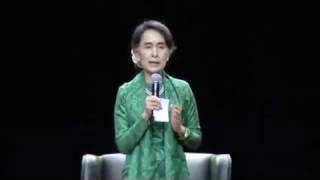
The Singapore based Burmese held a massive town-hall meeting with AungSanSuuKyi this evening in Singapore. She discussed her 21st Century Panglong, telling the audience that the problem for lack of peace is mis-understanding among top leaders. The ethnic armed organizations who have not signed peace "lack courage and wisdom to make peace'. Overall, the thrust and tone of her entire speech is essentially economic/developmental nationalism: making Burma great, again! To wild and thunderous cheers, she promised to make Burma an envy of Asia, overtaking Singapore economically in the next 20 years. Now on to the subject that concerns me: the Rohingya. My heart sank even deeper listening to the Q and A (she read out questions submitted in writing) and here is the accurate transcription (my English translation, which I stand by 100 against the recorded Burmese language exchange. I think that actual Burmese exchanges will be on YouTube if people are interested in verifying my transcript below against the Burmese language exchange). asked directly re: fabricated issue (of #Rohingya): Q: We as Burmese are worried about the externally fabricated issue (implying in no uncertain terms Rohingya). How prepared is your leadership to deal with this fabricated campaign? We Burmese are fully behind you as our leader. ASSK: Well, the fact that you know this problem to be externally fabricated is already a very good national defence. They (fabricators of Rohingya crisis) are playing their tune to our ears. Too noisy now! (Laughing out loud). Well, we must have our own tune to play the world back. Q: I worry about the security of our borders. What is your government doing to make our borders secure and safe. A: In some places we have border walls. The walls we have built along the borders may not be tall or high enough. If we build stronger and taller walls it will cost the gov. a lot of $. But to protect our people we are prepared to spend as much as is necessary. 50% of the safety measures are like building walls. (the other 50 is non-material like citizens themselves not involved in cross-border illegal smuggling).
- Angola: New Media Law Threatens Free Speech
Update: On January 23, Angolan President Jose Eduardo Dos Santos signed the new media law that limits freedom of expression, despite opposition from the Journalists Union and other groups. The union said it would challenge the law before the Constitutional Court. (Johannesburg) – Angolan President José Eduardo dos Santos should refuse to sign a new media law until parliament revises provisions restricting the right to freedom of expression, Human Rights Watch said today. The law grants the government and ruling party expansive power to interfere with the work of journalists, and potentially to prevent reporting on corruption or human rights abuses. Angola's President José Eduardo dos Santos gives an interview to the media, which remains largely controlled by the ruling Popular Movement for the Liberation of Angola (MPLA), August 31, 2012. © 2012 Reuters Parliament passed the Press Law on November 18, 2016, with minimal debate, together with a new Television Law, Broadcast Law, Journalists Code of Conduct, and statutes of the recently established Angolan Regulatory Body for Social Communication (ERCA, Entidade Reguladora da Comunicação Social Angolana). The five laws constitute what the government called the Social Communication Legislative Package (Pacote legislativo da comunicação social). “Angola’s new media law is the latest threat to free expression and access to information in the country,” said Daniel Bekele, senior Africa advocacy director at Human Rights Watch. “President Dos Santos should uphold his commitment to human rights and refuse to sign these media restrictions into law.” A number of the Press Law’s articles violate Angola’s international obligations to respect media freedom, Human Rights Watch said. These include: Article 29 gives the Ministry of Social Communication the authority to oversee how media organizations carry out editorial guidelines and to punish violators with suspension of activities or fines; Article 35 imposes excessive fees to establish a media group of 35 million kwanzas for a news agency (US$211,000) and 75 million kwanzas (US$452,000) for a radio station; and Article 82 criminalizes publication of a text or image that is “offensive to individuals.” Under the penal code, defamation and slander are punishable with fines and imprisonment for up to six months. The law’s overly broad definition of defamation opens the door for the government to arbitrarily prosecute journalists who report about illegal or improper activity by officials and others, Human Rights Watch said. Criminal defamation laws should be abolished entirely, as they are open to easy abuse and can result in harsh consequences, including imprisonment. ECRA’s final draft statutes and the other media laws were unexpectedly put forward for discussion just days before their November 18 approval, catching many media professionals unaware. Journalists and media freedom activists have criticized the process as lacking consultation and transparency. “We were never officially informed about dates of the discussion or approval of this law – not even during the discussion of details,” Teixeira Candido, the head of the Angolan Journalism Union, told Human Rights Watch. Parliament approved the establishment of the regulatory body, together with the first drafts of the other four bills of the Social Communication Legislative Package, in August at the initiation of the ruling party, the Popular Movement for the Liberation of Angola (MPLA), which controls roughly 80 percent of the assembly’s seats. The first draft gave the body the authority to “enforce compliance with professional journalistic ethics” and to issue licenses to journalists, which are required for them to work. After criticism from the Journalism Union, however, the government agreed to limit this authority to a new body controlled by media professionals. Under the revised statute, six of the ERCA members are to be appointed jointly by the government and the party with the most seats in parliament. The journalism union nominates two members and the other political parties in parliament appoint the remaining three. The new media laws follow government officials’ complaints about what they consider an irresponsible media, including social media. In December 2015, President Dos Santos said, “Social networks should not be used to violate other people's rights, humiliate, slander or convey degrading or morally offensive content.” After parliament passed the recent package of laws, Social Communication Minister José Luis de Matos told the media that the new media law would ensure that journalists take more responsibility for their work because they “cannot assume that they have the right to do what they want.” Angolan political figures, including members of the government, have used the defamation provision of the old 2006 media law to crack down on critics. In 2008, Graça Campos, a journalist and editor of the weekly paper Angolense, was sentenced to a six-month suspended jail term for publishing articles accusing three former ministers of involvement in corruption. In March 2011, Armando Chicoca, a correspondent for Voice of America, was sentenced to a year in jail for articles critical of a judge in Namibe province. In February 2014, Queirós Chilúvia, another journalist, was sentenced to a six-month suspended jail term for investigating screams and cries for help emanating from a police station. In May 2015, Rafael Marques, a prominent journalist, was given a six-month suspended jail term for revealing killings and torture in the country’s diamond fields. The African Commission on Human and Peoples’ Rights has long called for the abolition of criminal defamation laws in the continent, saying that they open the way to abuse and can result in very harsh consequences for journalists who expose abuses of power, corruption, and human rights violations, all of which are rife in Angola. In 2014, in a landmark judgment Lohé Issa Konaté v. Burkina Faso, involving a criminal libel conviction of a Burkinabe journalist, the African Court on Human and Peoples’ Rights ruled that imprisonment for defamation violated the right to freedom of expression and that such laws should only be used in restricted circumstances. The court also ordered Burkina Faso to amend its criminal defamation laws. After 40 years of independence, the Angolan media remains largely controlled by the MPLA. The government owns the only radio and television stations that broadcast across the entire country, as well as the official news agency. Reporters Without Borders ranks Angola, 123rd out of 180, in its 2016 World Press Freedom Index. In August 2013, Human Rights Watch urged the government to repeal the country’s criminal defamation laws and stop using them to harass journalists. “The predominance of the Angolan government and the most powerful political party undermine the independence of the journalism regulatory body and risks making it a mechanism for censorship and control rather than media freedom,” Bekele said. “Unless this new media law is revised, the precarious situation of the media in Angola will only get worse.” __________________________________________________________________________________________________________________________________________________________ (c) 2017 Human Rights Watch
- Burma Edges Closer to Ethnic Cleansing
Witness all the hallmarks of the tragedies in Bosnia, Darfur, Kosovo, Rwanda. A human tragedy approaching ethnic cleansing is unfolding in Burma, and the world is chillingly silent. In recent weeks, hundreds of Muslim Rohingya people have been killed, and more than 30,000 displaced. Houses have been burned, hundreds of women raped and many others arbitrarily arrested. Access for humanitarian-aid organizations has been almost completely denied. Thousands have fled to neighboring Bangladesh, only to be sent back. Witness all the hallmarks of past tragedies: Bosnia, Darfur, Kosovo, Rwanda. This isn’t the first explosion of violence against the Rohingyas, who are among the world’s most persecuted minorities. For decades these Burma-based Muslims have been subjected to a campaign of grinding dehumanization. In 1982, they were stripped of their citizenship rights and rendered stateless, with restrictions on movement, marriage, education and religious freedom. The Burmese government and military claims that the Rohingyas are in fact illegal Bengali immigrants. But Bangladesh doesn’t recognize them. As some Rohingyas say, “We are trapped between a crocodile and a snake.” Their plight intensified in 2012 when two severe outbreaks of violence resulted in the displacement of hundreds of thousands and a new apartheid emerged between Rohingya Muslims and their Rakhine Buddhist neighbors. Conditions have since become increasingly dire. The latest episode was sparked by an Oct. 9 attack on Burmese border-police posts, which killed nine officers. While no conclusive findings have been made about the attack, Burma’s military alleges that a group of Rohingyas were the perpetrators. Even if that were true, the military’s response has been grossly disproportionate. Rounding up suspects, interrogating them and putting them on trial would be one thing. It’s quite another to reportedly unleash helicopter gunships on civilians, rape women and throw babies into a fire. According to one Rohingya interviewed by Amnesty International, the military “shot at people who were fleeing. They surrounded the village and started going from house to house. They were verbally abusing the people. They were threatening to rape the women.” Another witness described how her two sons were arbitrarily arrested: “It was early in the morning, the military surrounded our house, while some came in and forced me and my children to go outside. They tied my two sons up. They tied their hands behind their backs, and they were beaten badly. The military kicked them in the chest. I saw it myself. I was crying so loudly. When I cried, they pointed a gun at me. My children were begging the military not to hit them. They were beaten for around 30 minutes before being taken away.” She hasn’t seen them since. Two people may be able to prevent this crisis from further deteriorating: Burma’s de facto leader, Aung San Suu Kyi, and United Nations Secretary-General Ban Ki-moon. Ms. Suu Kyi is already facing increasing criticism for her failure to act, though she faces severe constraints. She won an electoral mandate last year and runs Burma’s first democratically led government in more than half a century, but the military still holds enormous power. Under Burma’s constitution, the ministries of home affairs, border affairs and defense remain in military hands. Her caution is thus understandable, denying the military any pretext to destabilize her new and fragile government. But the priority must be to save lives and prevent a humanitarian catastrophe. In September, Ms. Suu Kyi invited former U.N. chief Kofi Annan to head a commission and find solutions to the Rohingyas’ plight. But her response to the latest abuses has been disappointing. At the very least, she should lift all restrictions on humanitarian aid so that people can receive emergency assistance. She should allow access for journalists and human-rights monitors, and set up an independent, international inquiry to establish the truth about the current situation. She should call for an end to mass attacks on civilians. As for Mr. Ban, his visit and negotiations to lift the military regime’s block on international aid after Cyclone Nargis hit Burma in 2008 saved thousands of lives. In his final weeks in office, he should repeat this strategy: Go to Burma and, using his good offices, bring together Ms. Suu Kyi, the military and the Rakhine state authorities and insist on humanitarian access. John McKissick, head of the office of the United Nations High Commissioner for Refugees on the Bangladesh side of the border, has accused Burma’s government of ethnic cleansing. The U.N.’s special rapporteur on human rights in Burma, Yanghee Lee, has condemned the lockdown on Rakhine State as “unacceptable.” It’s time for action from the very top. It’s also time for the international community to speak out. If we fail to act, Rohingyas may starve to death if they aren’t killed by bullets first. We could end up as passive observers once again wringing our hands belatedly, saying “never again.” Let us act now before it’s too late. Mr. Ramos-Horta is a Nobel Peace Prize laureate and former president of East Timor. Mr. Rogers is the East Asia team leader at Christian Solidarity Worldwide and author of “Burma: A Nation at the Crossroads” (Random House, 2015).
- A Genocide in the Making
In the photo, a Rohingya refugee from Burma carries the body of a six-month-old boy who died in a Bangladeshi refugee camp on November 26. Photo credit: MUNIR UZ ZAMAN/AFP/Getty Images Last fall, Burmese voters elected their first democratic government in half a century. That inspired hope that the country’s long history of violence and oppression was finally taking a turn from the better. Now, just one year later, that promise has given way to dread. In a small pocket of western Burma, a new phase has begun in what threatens to become the genocide of the country’s Muslim Rohingya minority. Government security forces have responded with widespread violence to a series of coordinated attacks by militant Rohingya on police outposts since October 9. The military has created a 20 kilometer-square “operation zone” barring all independent journalists from the area. Despite the restrictions, numerous reports have emerged of rapes, torture, and extrajudicial killings of Rohingya civilians by the police and army as they sweep through villages in search of militants. The Rohingya have been refused citizenship by successive Burmese governments, who assert they are illegal Bengali immigrants. Control measures applied only to Rohingya have, for years, severely limited their access to healthcare and education. More than 120,000 already live in displacement camps following waves of violence in 2012 and 2013 in which ethnic Buddhist Rakhine razed their neighborhoods across Rakhine State. A recent escalation in the latest violence has raised the official death toll since the October crackdown to 134, although Rohingya advocacy groups put it at more than 420. Despite Bangladesh’s refusal to take refugees, several hundred are believed to have fled to camps there. A number who crossed the Naf River separating the two countries in the middle of November were gunned down mid-river. While a number of security personnel have been killed in skirmishes, the overwhelming majority of deaths have been Rohingya. The government has claimed that all are militants, but with independent media completely barred from the region, the claims have been impossible to verify. In recent decades, scholars of genocide have identified several likely indicators of mass killings. In recent decades, scholars of genocide have identified several likely indicators of mass killings. Several of those signs are now clearly in evidence in western Rakhine: The systematic dehumanization of the target group; their isolation inside camps and barricaded ghettos; and violent attacks on them involving the participation of security forces. These trends have intensified in recent weeks with the amplification of a narrative that singles out the Rohingya as a menacing alien presence in Burma. The new civilian government, elected in April amid jubilation that Burma was finally charting a passage towards democratic rule, has shown a worrying tolerance toward these ominous developments — at times borderingt on outright complicity. The blanket exclusion of independent journalists from the area in recent weeks has created a black hole in which security forces can attack villages, carry out arbitrary arrests, and block the movements of Rohingya, who are unable to leave their homes to access markets or to reach medical care. Satellite imagery released by Human Rights Watch shows that 1,250 Rohingya buildings in five villages have been destroyed by recent arson attacks. The government, led by Aung San Suu Kyi, has responded by saying that the Rohingya are burning their own homes to garner international sympathy. Presidential spokesman U Zaw Htay told journalists in late October that the government had initially deliberately blocked aid to Rohingya who had fled police and military sweeps to force them to return to their villages, where they could be investigated for possible involvement in the October attacks. This appears to be an attempt at starving them into submission, and suggests that the government believes all Rohingya to be suspects. This latest eruption of violence fits uneasily with the optimistic narrative of a changing Burma. In April 2016, the National League for Democracy, headed by Aung San Suu Kyi, was sworn into government. She immediately renewed efforts to broker ceasefires with warring ethnic armies in the north and east of the country, and later appointed former UN chief Kofi Annan to head an advisory commission to investigate and address human rights violations in the violence-torn Rakhine State. Despite the worsening crisis, Suu Kyi continually refuses to be drawn on the plight of the Rohingya. At best, she calls repeatedly, but vaguely, for rule of law to be respected in Rakhine State. She asked the U.S. Ambassador to Burma in May 2016 to refrain from using the word “Rohingya” lest it imply recognition of a group that the state in Burma long ago deemed to be an illegal presence in the country, and to whom it has refused citizenship and all associated state protections. The growing volume of criticism directed at the Nobel laureate’s position mirrors the increasing dangers facing the Rohingya. Since the violence of 2012 and 2013, when Rohingya and ethnic Buddhist Rakhine attacked each other in bouts of vicious bloodletting, Rohingya have been increasingly contained inside villages, camps, and barricaded ghettos. Their 1.3-million-strong population is allowed access to only one adequately equipped hospital in the state, and is completely barred from attending higher education. The latest violence will ensure a further tightening of those restrictions, with the UN warning that 160,000 Rohingya have been without aid since October 9. It was hoped that Suu Kyi’s government might improve conditions for the Rohingya, but recent events cast doubt on this. Demanding greater security for the maligned group would be politically costly. The ultra-nationalist Buddhist lobby in Burma has repeatedly branded the Rohingya as “terrorists” and “Islamizers,” and public opinion is pitched wholeheartedly against their being granted greater protections. Any criticism from Suu Kyi of the military’s actions in Rakhine State would be interpreted as a sign that she sympathizes with the Rohingya, and her support could fall. Accordingly, her National League for Democracy has made no attempt to rein in the hate speech. Nor has it called publicly for any control measures on the group to be removed. Meanwhile, rhetoric from officials has grown more ominous. It has dehumanized Rohingya in precisely the ways that, as we now know, historically pave the way for mass violence against marginalized groups. The Home Affairs Minister Kyaw Swe recently described the Rohingya presence as “an invasion” of “rapid Bengali breeders,” language that cast them as animals. When Aung Win, head of a governmental commission set up to investigate the October 9 attacks, declared that “all Bengali villages are military strongholds,” he cast the group as outsiders deserving of attack. Later he told the BBC it was highly unlikely that troops had raped Rohingya women on the grounds that they “are very dirty.” State media has weighed in too. On November 26 an opinion piece in the state-run Global New Light of Myanmar newspaper warned that the country was “facing the danger of the human fleas” that “we greatly loathe for their stench and for sucking our blood.” The Nazis had used the analogy of “fleas” to describe the Jews. An earlier opinion piece on November 1 was entitled “The Thorn Needs Removing If It Pierces!” It went on to speak of “trespassers” on Burma soil, and similarly warned of the threat they allegedly pose to the country’s sovereignty. This lightly veiled call, in print, for the cleansing of the Rohingya — published without government disapproval — suggests an alignment between the civilian government, the military, and ultra-nationalist Rakhine groups that will tolerate the very worst of humanitarian excesses against the Rohingya. By attacking the police outposts, a small fraction of the Rohingya population may have sealed the fate of the entire community. Punishment of the Rohingya has always been collective, despite the fact that collective punishment is illegal under international law. Groups tend to resort to armed conflict when institutional channels for negotiating grievances are closed off, and the decision to attack may have reflected a sense of resignation that, even in a democracy, the Rohingya would forever remain a pariah group. The response by the government and security forces — the targeting of an entire identity, rather than individuals who may have committed wrongdoing — marks a key stage in the turn to mass violence. Today we know enough about the conditions that give rise to genocide that no one in power can justifiably claim ignorance. An understanding of these processes is assumed among all modern leaders, Aung San Suu Kyi included. The democratic mandate handed to her civilian government a year ago has resulted in that most pernicious of democratic outcomes — a tyranny of the overwhelming majority against which a small and vulnerable population is now bracing itself. Rather than providing a pathway to harmony after decades of conflict, Burma’s transition has unleashed popular hatreds that no institution in the country seems either able or willing to rein in. Suu Kyi should know that inactivity in the face of genocidal actions can carry moral, legal, and even criminal responsibility. © 2016 Foreign Policy
- Iraqi Christians revisit ghost town abandoned by Islamic State
A damaged picture of Jesus and a CD from his daughter's wedding were pretty much all Iraqi Christian Said Shaba found when he returned to the ransacked house he had to flee when Islamic State arrived two and a half years ago. The militants stole a safe with his savings and set the two-storey house ablaze before Iraqi forces pushed them out a month ago from the northern town of Bartella as part of a campaign to retake nearby Mosul, the group's last stronghold in Iraq. With the jihadists using suicide car bombers to stop an army advance on Mosul located just 20 km (12 miles) away, Bartella remains a tense ghost town. Black army Humvees patrol the potholed streets where Islamic State fighters set homes on fire, while rows of shops and restaurants have been flattened during fighting. But tired of living with his seven-member family in a rented house in nearby Erbil, Shaba and other Christians came to check on their houses for the first time since fleeing Bartella in 2014 when Islamic State seized Mosul and much of Iraq's north. "They destroyed and stole everything. They even took away our safe," the 59-year-old said, pointing to a wardrobe in his bedroom where a safe containing $1,400 in local currency and dollars once stood. When rumors of an Islamic State offensive in August 2014 spread, Shaba drove his family to the safety of Erbil one morning, planning to return to take cash and documents. But he never made it back as the jihadists were already in control of Bartella by the afternoon. His petrol storage facility, the family's main source of income, a few blocks from his modest house, was destroyed during fighting, he said. Luckily, among the debris on the house's floor a picture of Jesus survived though militants tore out parts of the face. His wife Nidhal kissed the painting and put it on a wall in the ransacked reception room. A CD containing pictures of their daughter's wedding also made it through the occupation. "They have left nothing intact including windows, doors and walls," said Milano Yousuf, the daughter. "This CD is more important to me than all the furniture. It is irreplaceable." Returning for good to Bartella and other nearby towns is not option for now for thousands of civilians -- Christians and Muslims alike -- as the battle for Mosul drags on. The army has closed Bartella and other towns and villages, using them as forward base. Special forces commanders and U.S. officers, who have been backing the army campaign, met in the town on Wednesday. The Iraqis and the Americans arriving in Humvees declined to discuss the meeting, which took place amid heightened security. Dozens of army vehicles with mounted guns were parked on an unpaved square in the town. The army only lets in civilians selectively to inspect their houses and take some belongings, officers say. Still, many hope they can stay. Hundreds were queuing at a checkpoint, where officers sent many back for lack of paperwork. Shaba, the Christian entrepreneur, said he got his army permit to go home only through "wasta", or personal connections. "We need to make sure the places are safe, that Daesh left no bombs," said an Iraqi officer, using a derogatory Arabic term for Islamic State. Apart from Christians, there were also many Shi'ites, seen by Islamic State as heretics, trying to head home. "We are trying to see our house for the first time since we fled in August 2014," said 28-year-old Ahmed Ali, a Shi'ite who escaped with his 17-member family from their Bartella home when the militants approached. His cousin was killed by the Sunni fighters, he said. "Life has become very difficult, paying rents in Erbil with very little work," he said, standing with a veiled relative near the checkpoint where soldiers told civilians without permits go back. "We don't know whether our house still stands but we hope to go back soon, God willing." (Editing by Patrick Markey and Giles Elgood) © Reuters 2016
- ‘I can’t take it anymore’: Ohio State attacker said abuses of Burma’s Muslims led to ‘boiling point’
Participants in a vigil at Jacob's Porch pray after the attack of Ohio State University, who rammed his car into a crowd of pedestrians and attacked them with a butcher knife. (Paul Vernon/AFP/Getty Images) The Ohio State University student who carried out a knife attack on campus Monday wrote in a Facebook post shortly before the rampage that the abuse of a little-known Muslim community in Burma had driven him to the “boiling point,” writing, “I can’t take it anymore,” CNN reported. “Seeing my fellow Muslims being tortured, raped and killed in Burma has led to a boiling point,” Abdul Razak Ali Artan allegedly wrote on his Facebook page shortly before Monday’s rampage, where he injured 11 people with a butcher knife before police killed him. “America! Stop interfering with other countries,” he wrote. Artan’s Facebook post throws a little-known and long-persecuted Muslim community in western Burma, also known as Myanmar, into the spotlight. More than 1 million Rohingya Muslims live in Burma, but they have long been denied citizenship and other basic rights, and many from Burma’s Buddhist majority consider them illegal immigrants from Bangladesh. Aung San Suu Kyi — the Nobel laureate leading Burma’s new civilian government — has been criticized for refusing to use the term “Rohingya,” which she says is inflammatory. In recent weeks, thousands of Rohingya Muslims have been fleeing into the forests and neighboring Bangladesh on the heels of a brutal military crackdown that followed a terrorist attack on police posts Oct. 9, allegedly carried out by Rohingya militants. Human Rights Watch has alleged that the military has perpetrated a scorched-earth campaign, providing before-and-after satellite images that showed three villages completely burned. The death toll estimates vary, but several dozen have been killed since October, activists say. Earlier this week, a U.N. refugee agency official, John McKissick, was in the Bangladesh region of Cox’s Bazar — where more than 30,000 people, many of them Rohingya, have fled to — andtold the BBC that Burmese troops were “killing men, shooting them, slaughtering children, raping women, burning and looting houses, forcing these people to cross the river” into Bangladesh. He said that the “ultimate goal” of Burma's government is “ethnic cleansing of the Muslim minority.” Suu Kyi’s government dismissed his comments as “unjust allegations.” Suu Kyi, who was awarded in the Nobel Peace Prize in 1991 for her efforts to combat the military junta that ruled her country for decades, has been the subject of much international criticism for what some say is a failure to address the human rights abuses in her country. More than 100,000 Rohingya continue to be confined to squalid displaced-persons camps in Rakhine state, four years after violent clashes with their Buddhists neighbors that left more than 200 dead. They have little access to decent health care or education for their children, and their movements remain restricted, according to a U.N. report in June. Severely malnourished 25-day-old twins are held by her mother, a displaced Rohingya woman, in their house at a camp for internally displaced people in Rakhine state in 2014. The report cited a “pattern of gross human rights violations” against the Rohingya, acts that it said could rise to the level of “crimes against humanity” in a court. Suu Kyi told The Washington Post in an exclusive interview in October that it will “take time” to address the crisis and deflected charges that she had not done enough to intervene. “Things take time,” she said. “The situation in the Rakhine is a legacy of many, many decades of problems. It is not something that happened overnight. We’re not going to be able to resolve it overnight. It goes back even to the last century.” Suu Kyi’s government came to power in March after the country’s first election after decades of military rule, but the generals still retain enormous power and are in charge of the country’s security forces. Annie Gowen is The Post’s India bureau chief and has reported for the Post throughout South Asia and the Middle East. Copyright 2016 The Washington Post Company
- Duterte on Indictment: ‘Western court threats are bullsh*t, European lawyers
Philippine President Rodrigo Duterte. © Romeo Ranoco / Reuters Controversial Philippines leader Rodrigo Duterte has branded as “bullsh*t” Western threats to indict him in the International Criminal Court (ICC) over extrajudicial killings in the country’s war on drugs. He added that European lawyers have “brains like a pea.” In October, ICC prosecutor Fatou Bensouda said the court may have jurisdiction to prosecute those responsible for killings in the Philippines, adding that her office was looking for instances of state officials “ordering, requesting, encouraging or contributing” to crimes against humanity. During a speech on Monday, Duterte shared his thoughts on his possible international prosecution, typically not mincing his words. “You scare me that you will jail me? International Criminal Court? Bulls**t,” he said, as cited by Reuters. According to the Philippines president, Washington is behind the attempt to put him behind bars. “America itself is threatening to jail me in the International Criminal Court. It is not a signatory of that body. Why? Because at that time, they were afraid [former President George W.] Bush would face it,"he said. Unlike Manila, Washington never signed the Rome Statute and isn’t part of the Hague-based ICC. The US and its allies have no idea how grave the problem with the trade and use of methamphetamines was in the Philippines, Duterte said. Dealing with the issue was so important that he was ready to “rot in jail” in order to achieve his goal, he added. The Philippines leader also said he saw nothing wrong with threatening to kill bad elements of society, especially when it’s done to protect the country. "I will never allow my country to be thrown to the dogs. I said when I was a mayor, 'If you destroy my city with drugs, I will kill you,’” he added. "Simple as that... When was it a crime to say, 'I will kill you,' in protecting my country?" Duterte said. According to Philippines police figures, 2,500 people have been killed since Duterte became president on June 30 and launched his crackdown on the drugs trade. Around 1,900 people were slain in anti-drug operations by security forces, while the rest are believed to be victims of vigilantes and fighting between criminal gangs. Earlier in November, Duterte slammed the ICC, calling it useless and hinting that the Philippines may follow Russia’s example and withdraw from it. Duterte has made a name for himself thanks to his scathing remarks about the US, which used to be the Philippines top ally under his predecessor. Duterte called outgoing US President Barack Obama “a son of a whore” and told him to “go to hell” for his perceived attempts to lecture the Philippines. He announced the cancelation of military exercises between the Philippines and American forces, but softened his stance shortly afterwards. However, the Philippines leader welcomed Donald Trump’s election win, saying there were a lot of similarities between him and the US president-elect. Autonomous Nonprofit Organization “TV-Novosti”, 2005–2016. All rights reserved.
- Analysis of the new phase of Rohinya cleansing and its deep implications for Burma
Dear Friends, A journalist asked me a few questions to get soundbites and quotes. I turned them into a more comprehensive interview. Thought this may serve as a succint backgrounder if you are interested in the contextual view of the current annihilation phase of the Rohingya genocide. Why do you as a Buddhist and Burmese support Rohingys when your whole country, the military, the NLD and the society, hate and want to evict them as a group? Historical evidence clearly indicates today's Rakhine coastal region to be an ethnically and religiously diverse shared homeland for both Rakhine and Rohingya for centuries. This is also the region that had far greater historical interaction and inter-mingling with the Bay of Bengal-based communities of present-day east coast of India, Bangladesh (East Bengal) than the central plains of Burma, where today's dominant, ruling group, the Burmese, have been based. I therefore support unequivocally the right of return for Rohingya people - close to a million by now - whom the Burmese have purged since the first army-organized large scale operation in 1978. There are more official reasons which compel me to support the Rohingyas and their cry to live in Northern Rakhine. First, the governments of Burma, including the senior most leaders of the Burma Armed Forces embraced officially and verifiably Rohingya people as one of the ethnic minorities of the Union of Burma. Second, Rohingyas are like any other ethnic minorities along Burma's porous and long borders with China, India, Thailand and Bangladesh, whose presence and identities predate the emergence of present-day Burma. Burma as we know it is a colonial product of negotiations amongst the Burmese nationalists, ethnic minority leaders and the British colonials, and its borders were drawn artificially, splitting up these borderlands communities into members or citizens of new nation-states. As early as 1950's the Burmese leaders, both civilians and military, acknowledge the presence and adjustable identities these borderlands people. I know this because my own late great-uncle was a senior commander stationed in Rakhine, who was Deputy Chief of the predominantly Rohingya administrative district named Mayu District, after Mayu River in Northern Rakhine. In addition, there are over 1,3 million Rohingyas - by Burma's official, conservative estimate - that continue to live in what you may call 'vast open prisons' where the ethnic cleansing is taking place. The Burmese government of ex-general Thein Sein proposed to the visiting UNHCR head in August 2012 to effectively evict them and transmigrate them to other countries, with UN financing. UN rejected the proposal on grounds that Rohingyas are not refugees. They are the country's people, born and bred there, and it is the Burmese state's responsibility to look after them. Even without discussing the genocidal acts committed by the Burmese regime, the fact that it refuses categorically to register the birth of every single Rohingya new born makes Burma a major violator of international law, for instance, the Child Right Convention, which entitles all new-born infants, the right to a nationality. My country is verifiably in the wrong, in terms of facts and international law, not to mention on grounds of Buddhist principles of compassion and human kindness. Is Aung San Suu Kyi ignoring the plight of the Rohingyas? Aung San Suu Kyi is not simply ignoring or lukewarm about the plight of Rohingyas. She is personally complicit and now officially guilty in making their plight worse by the day. She is reportedly very "racist" towards the Muslims, and she unilaterally made the decision to NOT allow any Muslim MP in her party during the 2015 election , effectively pandering to the majoritarian anti-Muslim electorate. She shares the Burmese generals' concern about the growth of Muslim population and she shares their military's institutionalized view that Rohingyas are illegals or just colonial era migrants with no root in the country. By cleansing her now nominally ruling NLD of all Muslim MP candidates and representatives, she has practically aligned herself with the army, her key partner. Why is there so much majoritarian racism towards Rohingyas and Muslims? It is important to note that the ground-swell of Islamophobia is to a large extent the outcome of decades of Myanmar military's anti-Muslim propaganda. The generals turned racists and purged the armed forces of Muslims at all levels. and they turned sight on to the society at large. Beyond communal prejudices between Buddhists and Muslims, the hatred, fear of Muslims among the majority Burmese, as well as other non-Rohingya non-Muslim minorities is just unprecedented. This anti-Rohingya and anti-Muslim popular hatred is akin to Nazi Germany's popular and official anti-Jew sentiments. That is why, Aung San Suu Kyi, pandering to the military and popular racism towards Rohingyas is extremely troubling. Have the international communities not actually created enough pressure on Myanmar to treat the Rohingyas fairly? The mythical international community has known the persecution of the Rohingyas for decades - in fact since 1970's. There is plenty of evidence and documentation from the Rohingyas, from human rights organizations such as Amnesty International, Human Rights, embassy reports, UN reports, etc. But the UN has failed to take any real and concrete measures or actions to stop a member state violating blatantly all major international human rights laws and treaties - like the Rome Statute Article 6 (Genocide Convention of 1948), Child Right Convention, CEDAW. The failure of the UN and the failure of the Burmese leaders to address the needs of the ROhingya to lead a peaceful normal productive community life in their own homeland of N. Rakhine is going to have major negative ramifications for Burma, region and the world. In an otherwise fractured Islamic world, Rohingya genocide is the one issue that anger 1.7 billion Muslims around the world. That anger will in due course translate into radical actions to end the Rohingyas' plight. ======================= FRIDAY'S PROTESTS IN DHAKA, BANGLADESH AGAINST THE ROHINGYA GENOCIDE. (Similarly large protests were held in Bangkok, Jakarta and Kuala Lumpur). This is an overview of what I think is happening and what is in store for Burma. Myanmar's persecution of the Rohingyas unites ALL MUSLIM COMMUNITIES unlike any other issue. In due course, this justified outrage among the Muslim communities around the world - and outrage at the failings of Western regimes and the UN System - will morph into radical actions, support and calls for Jihad in Burma - in the real sense. Burma has more than enough on its plate. When - not if - the GRASSROOTS rage among Muslims of the world explodes that will spell deep troubles for the Burmese society, economy and politics. The military is on a trajectory that will prove self-fulfilling sooner rather than later. Here is what I think of the leadership of Aung San Suu Kyi and Min Aung Hlaing. (When I was trying to puncture the sanctions regime and re-engage the world in Burma I worked with a couple of young colonels. One of them has become Min Aung Hlaing's right hand, and is tipped to be 'the next commander in chief' after Min Aung Hlaing. Knowing these military men - and myself a military officers' corp admit as a young man, I have little confidence in the capacity of these one-dimensional men to lead the country out of the decades of mess, previous generations of politicians and generals have created. Aung San Suu Kyi and Min Aung Hlaing have put the country on a slippery slope of Balkanization, pr oxy wars, and Jihadist battles. They are doing so, out of their racist delusions, miscalculations, and illusions of power and grandeur. Min Aung Hlaing and genocidal generals thought they were brilliant in continuing on with the Tatmadaw's 4-decades of Rohingya Genocide. The radicalized Rohingya youth attacked a few Burmese border posts. The Tatmadaw thought it was godsend. 1) So, they pounced on the Rohingya. The generals attempted to wipe out as many Rohingya villages and communities as possible. 2) Their propaganda geniuses - like Ye Htut, Zaw Htay, etc. - gleefully framed the Rohingya attackers as "Jihadists" "ISIS-style fighters" "militants" "extremists", and in short, "TERRORISTS". They didn't even bother with the Rakhine fall-guy option and 'communal conflict' or "sectarian violence" spins. They were getting in on for the slaughter themselves. 3) Oops, the impact of their attacks on the Rohingya got caught on satellite cameras. They were forced to admit that the Air Force was involved in the ethnic cleansing by flying gunship helicopters. 4) When world cries foul, Min Aung Hlaing and his now desperate spinmasters resorted to their de fault spin: "skyful of lies" (fabricated and fake stories of rape, killings, etc.) 5) Unable to conceal their genocidal deeds on the ground from the impact-dectors up the Northern Rakhine sky, Min Aung Hlaing ordered his men to seal off the genocidal fields of N. Rakhine while blocking aid to 100,000 Rohingyas. 6) Honey-tongued but deceitful, Min Aung Hlaing and team decided to let a small group of western diplomats to go and assess the situation, while emptying vast areas of any Rohingya who might speak to the diplomat-investigators. (Rohingyas found ways to appear on the route of the visiting dip delegation!) 7) The lies, denials and fabrications by Min Aung Hlaing and his spinmasters are such that no-body in their right mind buys any of the official spins. 8) Meanwhile, the Rohingya activists have captured and disseminated worldwide all the images of crimes - all recorded on smart-phones - committed by Min Aung Hlaing and his men. 9) Unlike previous waves of violence, Rohingya activists were better prepared. Smart-phones, social media, etc. enable them to let the world witness the GENOCIDE; it has been going on since 1978. 10) Min Aung Hlaing and his racist genocidal deputies miscalculated the response from the ASEAN and South Asia. With thousands of Muslims angrily taking to the streets on Friday in Dhaka, Chittagong (right next to Western Burma), Jakarata, Bangkok, and Kuala Lumpur, and Rohingya news on the front pages of national newspaper, the discourse around Rohingyas have shifted irreversibly: A) Myanmar is indeed engaged in genocide AND ethnic cleansing of the Rohingya Muslims; B) Aung San Suu Kyi is no longer seen as a force for good, but rather the most important accomplice in genocide, with the Myanmar military leaders being the main genocidal perpetrators; C) Rohingyas feel energized and inspired by the outpouring of international solidarity, especially and most importantly from fellow Muslims in Asia and beyond; and D) Malaysia has broken ASEAN's tradition of not condeming another country's "internal affairs". I think both Suu Kyi and Min Aung Hlaing leaderships are putting the country at grave risk of furture instability, violence and a definitely a very probably site for Jihadist battles. The country is already a proxy theatre for US-led western forces and China, with the un-finished civil war along very strategic borders, making the entire country vulnerable to the Great Power Games. With so many fronts being opened, and with completely un-impressive ability to even fight the information war in the social media and conventional media vis-a-vis human rights and Rohingya activists, the generals will in due course lose their own plot. They have bitten off more than they could chew. But, the public in Burma will pay for the racist, stupid leadership of both Aung San Suu Kyi and General Min Aung Hlaing.
- Rohingya Groups Around the World Initiate a People Tribunal on the Genocide in Burma
Rohingya Groups submitted an initiative for a People Tribunal on the Genocide in Burma to the Secretariat of the Permanent People's Tribunal in Rome. A press conference (around the UN Genocide Day of 9 December) will be held at the Queen Mary University in London. Read the full letter below: _____________________________________________________________________________________ 24 November 2016 Mr Franco Ippolito, President Dr Gianni Tognoni, Secretary General Ms Simona Fraudatario, Coordination The Permanent Peoples’ Tribunal Fondazione Lelio e Lisli Basso Via della Dogana Vechia 5 Rome Italy Dear Mr Ippolito, Dr Tognoni and Ms Fraudatario, We, the undersigned group of researchers, academics, and activists, in coalition with global Rohingya refugees, hereby request that the Permanent Peoples’ Tribunal (PPT) take up the urgent case of Myanmar’s Muslim Rohingya ethnic minority. We make this request in response to the well documented unfolding and escalating genocide in Rakhine state, Myanmar. We ask that the Tribunal examine the current crisis in the context of historical evidence of recurring patterns of persecution by the Myanmar state against the Rohingya, that have precipitated at least three waves of mass exodus since the 1970s. We make this request on the basis of compelling evidence of ongoing: widespread institutional discrimination; state sponsored hate crime; mass killings; mass sexual violence; wholesale destruction of communities and neighbourhoods; massive forced displacement; apartheid structures of segregation; targeted population control; state denial of Rohingya identity; forced labour; denial of access to livelihood, healthcare, freedom of movement, and food. Evidence of these genocidal violations, with blanket impunity, is to be found in the extensive and systematic research conducted by a range of academic and human rights organisations (Green, MacManus and de la Cour Venning, ISCI, 2015; Zarni and Cowley, 2014; Fortify Rights, 2015; Human Rights Watch, 2012, 2013; ASEAN, 2015). In October/November 2016, evidence of a new reign of terror and wholesale destruction of communities exercised by the Myanmar state against the Rohingya population has emerged. This month, we have received evidence of widespread killings, curfews, rape and arson in Northern Rakhine State (NRS), the worst affected area. All on-the-ground reports paint a picture of a terrified Rohingya community trapped in their homes, unable to access food, health services or livelihoods. NRS is an information ‘black hole,’ with travel to the region tightly restricted by the Myanmar authorities. In spite of rare UN Security Council Meetings to discuss the violence against the Rohingya people, the international community has thus far failed to take any meaningful action to intervene and end the genocide. International institutions of global justice such as the ICC, the UN Security Council and ASEAN have failed to act in the face of robust evidence of genocide. The election of the National League for Democracy (NLD) in 2015 was met with much global optimism. However, Aung San Suu Kyi has simply entrenched the persecution of the Rohingya; indeed, this year she demanded foreign governments refrain from using the term ‘Rohingya.’ Disturbingly, Aung San Suu Kyi’s government has chosen to ignore the criminal nature of state policies toward the Rohingya. The Myanmar government in public statements continues to deny the existence of the Rohingya identity. Meanwhile, the establishment in August 2016 by the Myanmar government of a high-level commission, headed by former UN Secretary-General, Kofi Annan, has been welcomed by many as a move in the right direction. Civil society actors are, however, deeply skeptical about the Commission’s potential to effect real change for the Rohingya. Crucially, the Commission has been instructed to operate within the framework of the 1982 Citizenship Law, which effectively excludes the Rohingya from the rights of citizenship. Many are concerned that the Commission does not adequately represent the Rohingya community – indeed, it does not have a single Rohingya on it. Of great concern also is the fact that one of the three Rakhine members, Saw Khin Tint, has openly rejected the existence, identity and history of the Rohingya people, both in her public speeches and in writing. Myanmar’s own Human Rights Commisssion has also refused even to acknowledge the existence of the victim group and the domestic criminal justice process is itself an instrument of persecution. The Tribunal would provide an arena in which to: establish the facts, inform the public, preserve collective memory, and protect against the rewriting of history. It will challenge the silence of states and international institutions, and pressure them to fulfill their international human rights obligations. In addition, we see the Tribunal as a vehicle through which to inform and strengthen civil society, and foster international solidarity to end this persecution. We request that the Tribunal move beyond narrow legal paradigms, the application of which is determined by the political calculations of key UN member states. Instead, we urge the Tribunal to draw on increasingly recognized criminological frameworks for apprehending state crime and genocide, being sensitive to the spirit of Raphael Lemkin’s intention behind the UN Genocide Convention (1948). We would welcome the participation of any other state persecuted ethnic groups inside Myanmar at any stage of the proceedings. Holding the People’s Tribunal at this time would enable civil society to leverage the renewed media and political attention now focused on the situation of the Rohingya in Rakhine state. Priority focus areas for potential impact include: 1) intervention in, and potential mitigation of, an unfolding process of genocide; 2) shifting the debates and public understanding around the persecution of the Rohingya from one of ‘humanitarian crisis,’ development and ‘inter-communal’ violence to one of ‘genocide,’ and serious human rights violations with a key focus on the criminality of the Myanmar state. Initiators Rohingya Youth Development Forum (RYDF), Arakan-Burma Rohingya Youth Initiative Canada (RYIC) European Rohingya Council (ERC) Burma Human Rights Network Rohingya Community Netherlands (BRCNL) Burmese Rohingya Community, Denmark (BRCD) Rohingya Organisation Norway Swedish Rohingya Association (SRA) Canadian Burmese Rohingya Organisation (CBRO) Rohingya Intellectuals Community, Australia (RICA) Burmese Rohingya Community in Australia (BRCA) Burmese Rohingya Associate, Queensland (BRAQA) Arakan Rohingya National Organisation (ARNO) Rohingya Arakanese Refugee Committee, Malaysia Burmese Rohingya Association in Japan (BRAJ) Rohingya Advocacy Network in Japan (RANJ) Social Welfare Society for Development (SWSD), Chittagong, Bangladesh British Rohingya Organisation UK (BROUK) Rohingya Blogger Supporting Initiators International Movement for a Just World (JUST), Malaysia Centre for Human Rights and Advocacy (CENTHRA), Malaysia The International State Crime Initiative (ISCI) Queen Mary University of London (QMUL) Genocide Watch, Washington DC, USA Burma Task Force, USA Protect the Rohingya, South African Lawyers Youk Chhang, Genocide survivor and Director of the Documentation Centre of Cambodia Dr Maung Zarni, Advisor to the European Centre for the Study of Extremism, Cambridge, UK Ko Aung, 8888 student leader and former Burmese political prisoner, UK References ASEAN Parliamentarians for Human Rights, Disenfranchisement and Desperation in Myanmar’s Rakhine State: Drivers of a Regional Crisis (October 2015) Green P., MacManus T., de la Cour Venning, A., Countdown to Annihilation: Genocide in Myanmar (International State Crime Initiative, 2015) Human Rights Watch, All You Can Do is Pray: Crimes Against Humanity and Ethnic Cleansing of Rohingya Muslims in Burma’s Arakan State (April 2013) Human Rights Watch, ‘The Government Could Have Stopped This’: Sectarian Violence and Ensuing Abuses in Burma’s Arakan State’ (August 2012) Lowenstein, A. K., Persecution of the Rohingya Muslims: Is Genocide Occurring in Rakhine State? A Legal Analysis (Fortify Rights, 2015) Zarni, M. and Cowley, A., ‘The Slow-Burning Genocide of Myanmar’s Rohingya,’ Pacific Rim Law and Policy Journal, Vol. 23, no. 3, June 2014.